The Question Mark Over “Cadaver Fat”: A Surgeon Who Uses It Every Week Answers It

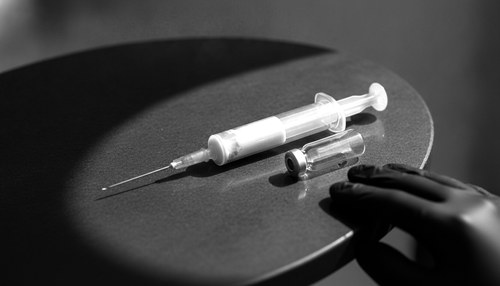
Black and white editorial still life of a prefilled syringe of processed allograft fat graft and a small vial on dark polished stone, a surgeon's gloved hand at the edge of the frame. Illustrative image. Commentary by Frank Agullo, MD, FACS.

Jenny McCarthy’s November 3 podcast gave the internet her implants, which I wrote about yesterday, and one more line. Her surgeon guest said “cadaver fat is the hot new thing,” and, as Parade and E! News reported it, left a “question mark” hanging over whether anyone should want it.

Fair. New things deserve a question mark. So here is the answer from someone who was handed the syringe before most of the country had heard of it.

It Is Fat. That Is the Point.

“Allograft fat is fat. So it’s fat without the cells, the actual nucleus in there, so there’s minimal DNA. So what we do is we inject that, and then your body kinda grows into it, moves into those cells, and creates its own fat.”

“Cadaver” is the word that makes it a headline. Allograft is the word that makes it ordinary. Surgeons have used screened, processed donor tissue for decades: dermal matrix in reconstruction, bone in dental work, tendon in orthopedics. Fat is the newest tissue on that list, not a new category of risk.

“It’s like a network, almost like a beehive, and then your cells move in and they create the new fat cells. What we’re seeing is that everything we put in stays, and then at about four to six weeks it actually fluffs out a little bit more, so you do get a little bit extra.”

The Regulation Answer

“The difference here is that donor tissue does not go through the normal FDA approval protocols like drugs and medications do. Instead, the process used to prepare the donor tissue must go through FDA guidelines. alloClae did not skip FDA approval, because donor grafts do not go through the same FDA channel as drugs. They do have to comply with strict FDA guidelines.”

It is an FDA-regulated human tissue allograft. Not a drug, not a device, not a loophole. If a clinic tells you it is “FDA approved,” they are using the wrong word; if a podcast tells you it skipped the FDA, so are they.

Where the Question Mark Belongs

Not on safety. On price, and on volume.

“The allograft is great because there’s no downtime. It’s a donor fat, we can do it in the office with local anesthesia, it’s in and out, and you’re back to work the next day. The problem is that it’s very expensive.”

“If we did the liposuction and the fat transfer, I’m probably going to transfer somewhere around 600 or 700 cc’s to each buttock. If we try to do that with the allograft, I think it’s impossible; it’s too much money.”

That is the honest limit. A hip dip, a breast upper pole, a liposuction divot, a deflated cheek with the finer face version, Lipoderma (“The allograft is too thick for the face”): the graft earns its keep. A full new shape: your own fat, in the operating room, where liposuction gives you a waist on the same day. “I wouldn’t do it all at once because we want your body to replace that with its own fat, and then we can always repeat the sessions.”

And it is not magic. It is your fat once your cells move in, so it lives by your rules: “If you gain those five pounds back, it’ll fill back in. Because the adipose cells, your fat moves in, and the fat will get bigger or smaller depending on your weight.” Long-lasting, with the potential to be permanent. Not a promise.

What I Would Tell the Podcast

The hot new thing is a scaffold of donor fat that your own fat grows into, regulated as tissue, placed in an office, priced by the cc. It replaced the biostimulator I used to inject in breasts, because there is no PLLA in it and nothing for the body to react to. It did not replace liposuction and fat transfer, and it will not, because your fat is free and there is a lot of it. The full version, with the comparison table, is on Agullo Plastic Surgery, and the office side, alloClae and Lipoderma, is on Southwest Plastic Surgery. The men’s version of the buttock story is here, and why I put donor fat above filler on the face is here.

Why Choose Dr. Agullo

I am certified by the American Board of Plastic Surgery and the American Board of Surgery, completed my plastic surgery fellowship at the Mayo Clinic, and serve as Clinical Associate Professor of Plastic Surgery at Texas Tech University Health Sciences Center. Castle Connolly has listed me as a Top Doctor every year from 2014 through 2026. I was one of the first twenty surgeons invited to use alloClae, and I still do fat transfer with liposuction every week, so I have no reason to sell you one over the other.

Ready to Talk?

If the question mark is yours, bring it in. Call (915) 590-7900, text 1-866-814-0038, or book online at agulloplasticsurgery.com/appointments. #StayBeautiful

Find me at @RealDrWorldWide on Instagram, TikTok, and Snapchat, @Agullo on X, or @AgulloPlasticSurgery on Facebook.

Donor Fat in a Vial: Why I Put Lipoderma Above Filler on My Own Menu

Black and white photograph of a woman in a velvet evening dress seated with her back to the camera at a vanity, the round mirror turned away, a single peony in a glass, no face. Illustrative image, not a patient. Commentary by Frank Agullo, MD, FACS.

I said fat was overtaking the filler era. Now it is on my menu. Lipoderma, donor fat, above HA filler at the MedSpa.

Why fat beats gel

“I think we have seen that facial fillers have been quite overdone, and patients are really getting away from looking overfilled and want to look more natural. We have seen that these hyaluronic acid fillers may not dissolve completely, and they do tend to migrate. It seems like they create some kind of inflammatory response in some patients, creating nodules or inflammation. And of course, the feel of a filler is not quite like natural fat, which is squishy and soft, something whose borders you wouldn’t be able to identify the way you can with a filler.”

“Fat is the best filler for a deflated face. A deflated face has lost fat. And what we do when we do fat grafting is replace the fat in those spaces. So it’s like with like.”

What donor fat is

“We can also use Lipoderma, which is a donor fat graft. This comes already prepared in a vial, so it can be injected in the office in one of the exam rooms, and it gives a lot of the same benefits as using your own graft. These benefits are that the results are soft, very long-lasting, and very natural.”

No harvest. No operating room. Long-lasting, potential to be permanent, no PLLA foreign body response.

What it gives up

“For some patients that don’t want as much downtime, we’ve been using Lipoderma, which is a donor fat graft that gives us very similar results to the patient’s own fat grafting.”

Very similar. Not identical. Your own fat is free by the cc, placed while you sleep. Donor fat is bought by the cc, placed awake. That is the trade.

Who should book it

“The first thing patients notice is the deflation on the face, which we may treat early with fillers like Sculptra, Lipoderma or hyaluronic acid to restore this lost volume.”

The GLP-1 face, early. Before the skin lets go and it becomes a lift.

Menu and prices: the MedSpa post and fees. My ranking of own fat, donor fat and filler: agulloplasticsurgery.com. Last launch: Morpheus8 Cool.

Why Choose Dr. Agullo

I am certified by the American Board of Plastic Surgery and the American Board of Surgery, trained in plastic surgery at the Mayo Clinic, and teach as Clinical Associate Professor of Plastic Surgery at Texas Tech University Health Sciences Center. Castle Connolly has listed me as a Top Doctor for thirteen consecutive years, 2014 through 2026.

Ready to Talk?

Call (915) 590-7900, text 1-866-814-0038, or book online at agulloplasticsurgery.com/appointments. #StayBeautiful

Find me at @RealDrWorldWide on Instagram, TikTok, and Snapchat, @Agullo on X, or @AgulloPlasticSurgery on Facebook.

I Called Fillers a Tax. The World Just Stopped Paying It

Black and white close portrait of four women of different backgrounds and ages, bare natural skin, lit by a single hard light. Illustrative image, not patients. Frank Agullo, MD, FACS.

The International Society of Aesthetic Plastic Surgery counted 4,737,957 hyaluronic acid filler treatments worldwide in 2025. That is 25.2 percent fewer than the year before, and fewer than in 2021. Poly-L-lactic acid fell 33.7 percent. Calcium hydroxyapatite fell 25.7. Fat grafting to the face held at 944,410.

I think we have seen that facial fillers have been quite overdone, and patients are really getting away from looking overfilled and want to look more natural. We have seen that these hyaluronic acid fillers may not dissolve completely, and they do tend to migrate. It seems like they create some kind of inflammatory response in some patients, creating nodules or inflammation.

What I Have Been Doing All Year

Fillers over time have started to come out of favor, as we are now noticing that the filler really never dissolves. The results can last about a year, but the filler does not dissolve, it just disperses. I have seen cases where it blocks the lymphatic drainage, and patients start having bags under the eyes, which are worse in the mornings, or they have discoloration or lumpiness. Sometimes they can also get inflamed. So I have dissolved a lot of under-eye fillers in order to improve all these complications, and that is why I am more inclined to use fat rather than hyaluronic acid fillers.

Why Fat

I think fat grafting has been rising for many years. It’s an essential component of almost all facial procedures. I incorporate fat grafting into lower eyelid surgery, I incorporate it into all my facelifts, and I incorporate it in any facial procedure where the patient has lost a considerable amount of weight.

We have been using the patient’s own fat, because we have the benefit of using however much volume we really need, as the number of fat CCs does not increase the cost of the procedure, and the patient’s own fat is free. This gives a very natural, soft result, which is of course long lasting. For some patients that don’t want as much downtime, we’ve been using Lipoderma, which is a donor fat graft that gives us very similar results to the patient’s own fat grafting.

The Catch, Because There Is One

Now, the main factor that disappoints people with fat injections is that the amount of retention is really unpredictable. Even though we know the patient is going to keep fifty to eighty percent of the volume, that percentage is quite unpredictable, so we are always overfilling. Patients that lose fifty percent of the volume we inject are sometimes disappointed, and we have to go back and inject more fat.

The good thing is that whatever does stay is going to be quite permanent.

The table, the Botox line and the hand numbers are in the full post on the Agullo Plastic Surgery site.

Why Me

Double board-certified, Mayo Clinic trained, Clinical Associate Professor of Plastic Surgery at Texas Tech, Castle Connolly Top Doctor 2014 through 2026. Fat in almost every facial operation I do, and a lot of other people’s filler dissolved this year.

Ready to Talk?

Call (915) 590-7900, text 1-866-814-0038, or book online. #StayBeautiful

Find me at @RealDrWorldWide on Instagram, TikTok, and Snapchat, @Agullo on X, or @AgulloPlasticSurgery on Facebook.
It Does Not Dissolve. It Disperses.

Black and white photograph of a person in a dark jacket seen from directly behind, standing at a tall window in hard morning light with one hand raised to the side of the face, the room around them in shadow. Illustrative image, not a patient. Commentary by Frank Agullo, MD, FACS.

Ask an injector how long under-eye filler lasts and you will hear “about a year.” That is true of the result. It is not true of the product.

“Fillers over time have started to come out of favor, as we are now noticing that the filler really never dissolves. The results can last about a year, but the filler does not dissolve, it just disperses.”

It disperses into the one place on the face that cannot afford it.

“I have seen cases where it blocks the lymphatic drainage, and patients start having bags under the eyes, which are worse in the mornings, or they have discoloration or lumpiness. Sometimes they can also get inflamed. So I have dissolved a lot of under-eye fillers in order to improve all these complications, and that is why I am more inclined to use fat rather than hyaluronic acid fillers.”

Worse in the mornings. If that sentence describes you and you had filler under the eyes a few years ago, that is the first thing I will look for.

So what do I put there?

“The tear trough is a very common area that we inject. My preference is the patient’s own fat, as it gives us a lasting result. It is done in the operating room, and I use cannulas to inject right above the inferior orbital rim. It softens the tear trough and gives us long-lasting results.”

Fat is what was there before it left. I wrote about how grafting works and how much of it stays in Fat Transfer 101. For a patient who wants the exam room and not the operating room, there is a donor fat graft.

“We can also use Lipoderma, which is a donor fat graft. This comes already prepared in a vial, so it can be injected in the office in one of the exam rooms, and it gives a lot of the same benefits as using your own graft. These benefits are that the results are soft, very long-lasting, and very natural.”

Either way, no needle.

“I prefer to use a cannula in this area, as it decreases the chance of bruising from piercing a vessel, or even intravascular injection.”

Same argument I made about hands. Thin skin, vessels near the surface, a blunt tip that slides past them. And if you want to know what a sharp tip in the wrong place looks like, the 60-minute window covers it.

Now the part nobody selling filler says out loud. Some under-eyes should not be injected with anything.

“Patients with festoons, thin skin, and true fat herniation are not the greatest candidates for fillers under the eyes. Fat is one of the procedures we perform when treating the periorbital area, and just adding volume to the tear trough can hide the under-eye bags for a while. But as they keep progressing, it comes to a point where adding volume is not going to help, and we actually need to remove those herniated fat pads.”

A real bag is fat pushing forward. You can hide it next to more volume for a while. Then it wins, and the answer is a lower lid operation, not a fourth syringe.

Festoons are their own problem.

“Festoons are frustrating because they are very difficult to remove completely. They are a combination of edema or swelling in the area, skin retraction from the facial ligaments, and loose skin. We can usually improve them, and in some cases remove them, using Morpheus8 microneedling with radiofrequency, and it often takes more than one treatment to repair this area. Sometimes it just has to be done surgically with a midface lift.”

Put filler in a festoon and you have made a heavier festoon.

So the order is: diagnose, dissolve what should not be there, and then, if the problem really is a hollow, fat. The full write-up with the three options side by side is on the Southwest Plastic Surgery blog.

It does not dissolve. It disperses. Plan accordingly.

Call (915) 590-7900, text 1-866-814-0038, or book at agulloplasticsurgery.com. #StayBeautiful

Find me at @RealDrWorldWide on Instagram, TikTok, and Snapchat, @Agullo on X, or @AgulloPlasticSurgery on Facebook.

The Field Is Diverging From Thread Lifts: A Surgeon’s Read on Nonsurgical Lifting in 2026

Black and white editorial portrait of a woman in profile in soft side light, jaw and cheek defined. Nonsurgical lifting commentary by Dr. Frank Agullo, MD, FACS.

There is a growing demand for lifting and contouring of the face without surgery. This actually also extends to the breast, body, even the buttocks. I think the growing demand has accelerated due to GLP-1 treatments, where patients undergo rapid weight loss and the appearance of aging shows up much more accelerated. There is also a tendency for maintenance early on, in order to avoid bigger procedures later.

I want to lay out where I think these technologies actually earn their place, and where the field is quietly moving on.

Start With What Aging Actually Is

As we know, aging is a combination of two things: skin laxity and volume loss. In weight loss patients, the skin has already been stretched out. The volume loss shows up as aging. Added to that, the skin that had previously been stretched out is now sagging, so the aging shows up much, much faster than in regular patients.

That is why the GLP-1 patient is changing how this conversation goes. The clock runs faster on them, and the early-maintenance mindset has become the norm rather than the exception.

The Volume Tools, Old and New

We’ve been using fillers underneath the eyes and the temples for quite a long time. The newer volume replacement materials include Sculptra, which is a biostimulator. After it is injected, the body tries to absorb the material and thus produces collagen.

The more exciting category is biostimulating and regenerative. PRP, protein-rich plasma, and PDGF, the platelet-derived growth factor. PDGF has not been cleared for injection, although some practitioners are using it off-label, but it is a great adjunct to any procedure that performs microneedling or resurfacing. It regenerates the tissues quicker, and with the growth factor we get a younger appearance and more protection of collagen.

Lipoderma is one of the newest available fillers. It is a donor-derived fat graft, which has a framework that allows the ingrowth of your own fat cells. This is a more permanent solution, more natural and more like the actual fat that we have in our face, rather than scar tissue or collagen. Tiger Aesthetics is going to come out next year with a similar product called Derma Clay, for the face and hands. They currently have one called Aloe Clay, which we use in the breast and buttock as a natural donor fat graft filler. That filler is more coarse, so it does not work well on the face.

The Tightening Tools

For skin tightening, the best therapies at the moment are radiofrequency. The use of Morpheus8, which is microneedling with radiofrequency, is one of the most sought-after treatments in our practice. We also use FaceTite in the face, which is a more invasive radiofrequency treatment that treats under the skin and above it, and is usually combined with even liposuction of the neck.

We haven’t seen a lot of new technologies in laser, but the fractionated lasers are still the most used. One has to be careful with skin types, as darker skin types tend to create hyperpigmentation or scarring.

Why I Have Almost Left Thread Lifts Behind

I think thread lifts had a peak in the last two years, but patients have found that they’re really not long-lasting. The threads can behave differently on one side of the face than the other and do create asymmetries. Sometimes these threads are not completely absorbed by the body and can be palpated, or give other problems. We’ve really almost diverged away from thread lifts, and we’ve started to do more minimally invasive surgical procedures instead.

That is the quiet shift in the field worth naming out loud. The threads promised a surgical result without surgery, and they did not deliver it consistently enough to keep.

Set the Expectations Honestly

All these treatments are good in the early stages of aging, or weight-loss-related aging, and they usually give subtle improvements. They can correct specific areas like temporal wasting, hollowness underneath the eyes, or nasolabial lines. The longevity depends on the therapy. Regular fillers can last up to a year. Sculptra tends to last longer, as the collagen generated stays around. The new regenerative treatments, like Lipoderma, or in the future Derma Clay, will be longer-lasting, if not permanent. But aging continues once we set the clock back, even in surgical procedures.

The expectations have to be toned down in nonsurgical procedures and well communicated to the patient. This is true especially with skin tightening using radiofrequency. A lot of the tightening is going to depend on the patient’s own response and cannot be foreseen. Every patient reacts differently and gets different tightening results.

The Test That Sends a Patient to Surgery

Here is my rule of thumb. If the patient is consulting with me and they reach up to their face and pull with their fingers upwards, bringing their brows and cheeks and jowls up, or even tightening their neck back, that’s a sign the patient needs a surgical procedure and not a noninvasive one.

The deep plane lift and the endoscopic deep plane lift are great procedures, which create very natural and long-lasting results. We’re seeing patients completely avoid the noninvasive procedures and go straight to the surgical procedures early on. I trained the deep plane facelift the long way, through the Ponytail Academy intermediate course in Pittsburgh and the advanced course in Santa Monica, after a Mayo Clinic fellowship. The patients who skip straight to it are usually the ones who already did the mirror test on themselves.

The Credential Behind the Opinion

Double board-certified by the American Board of Plastic Surgery and the American Board of Surgery, American College of Surgeons Fellow, Mayo Clinic plastic surgery fellowship, Clinical Associate Professor of Plastic Surgery at Texas Tech University Health Sciences Center Paul L. Foster School of Medicine, and Castle Connolly Top Doctor for thirteen consecutive years. I do both the injectables and the surgery, which is exactly why I can tell you when the injectable is the wrong answer.

Ready to Talk?

If you want the honest read on which side of the line your face is on, that is a consultation, not a sales pitch.

For the patient-facing clinical guide and the mirror test in detail, see the companion post on agulloplasticsurgery.com. For the MedSpa-to-surgery continuum, see the version on swplasticsurgery.com.

Call (915) 590-7900, text 1-866-814-0038, or book online at agulloplasticsurgery.com. #StayBeautiful.

@RealDrWorldWide on Instagram, TikTok, and Snapchat, @Agullo on X, or @AgulloPlasticSurgery on Facebook.