The Curvy Fruit Problem: Butt Enhancement Pills, Read by a Surgeon Who Grafts Fat for a Living

Black and white editorial portrait of a woman in a fitted black dress and heels in three-quarter profile against a dark studio backdrop, one hand on her hip, the other holding a plain unlabeled capsule bottle out toward the camera. Illustrative generated image, no real person, not a patient and not a result.

A patient put four bottles on my counter last month. Maca root. Fenugreek. Aguaje, which the internet has renamed “the curvy fruit.” And a fourth one with a silhouette on the box and the word “enhancement” in gold script.

Five months. Nothing.

Nothing was ever going to happen, and the reason is the most useful sentence I say in a week.

The Sentence

“We’re born with a certain number of fat cells, unless we do something to make fat cells grow. The fat cells get bigger or smaller, but they don’t multiply.”

Every one of these products is built on the idea that a plant compound acting a little like estrogen will steer fat to the hips and buttocks. No controlled trial shows that. The FDA does not review these products for effectiveness before they go on sale. And a cream does not move fat through skin.

What a pill can do is change your appetite. Then this happens:

“Because the adipose cells, your fat moves in, and the fat will get bigger or smaller depending on your weight.”

Everywhere. In the proportions you were born with.

“It always goes away from the places you don’t want.”

Three Things That Actually Move a Buttock

Muscle. The only tissue you can grow in a chosen place, and it tightens the skin over it:

“Bulking will, yeah. Because when you do that, it tightens quite a bit. So bulking will definitely help. The problem with the gym is the results are a year, two years. They’re not instant. That’s the nice thing about plastics.”

If you want to buy a supplement for your shape, buy protein. “That’s where the supplements come in. If you can’t keep up with your regular food, then you have to start using some protein shakes or powders.”

Your own fat. The Brazilian butt lift is fat moved on purpose, with a waistline as the side effect:

“The nice thing about doing it with your own fat is that we can shape you as well in the other areas. So we could take some fat from the lower back area and really accentuate your waistline.”

“With the fat, we’re going to lose a little bit of what I inject; you’re going to keep about 60, 70 percent. So I always put more than what we need, and of course your fat is free, so I can use as much as we need to.”

I wrote about who is a candidate and what weight does to the result earlier this year, so I will not repeat it here.

An implant, or donor fat. For projection:

“Implants I really recommend if what you’re looking for is more projection. It does give us better projection than fat. But even when I put in implants, I still put a little bit of fat around it to give it shape.”

And for the lean patient with a hip dip and no fat to harvest: “The allograft is great because there’s no downtime. It’s a donor fat, we can do it in the office with local anesthesia, it’s in and out, and you’re back to work the next day.”

The Part the Bottle Gets Backwards

The pills feel safe and the surgery feels dangerous. The surgery’s reputation came from one technique, and I have spent a good part of my career against it:

“There have been no cases of fat embolus when fat has only been injected in the subcutaneous fat. The only cases of fat embolism have all had intramuscular fat injections.”

I told Texas Today in October: “The technique that kills people is injecting fat into the muscle. We changed where and how we place it years ago, and we teach that. Fast and cheap is not a plan.”

The bottle is fast and cheap. That is the whole pitch. Every BBL death I know of had one thing in common, and it was never ultrasound guidance and never a slow, well-fed year in the gym.

The full post, with the comparison table, is on the Agullo Plastic Surgery blog.

Why Choose Dr. Agullo

I am certified by the American Board of Plastic Surgery and the American Board of Surgery, completed my plastic surgery fellowship at the Mayo Clinic, and serve as Clinical Associate Professor of Plastic Surgery at Texas Tech University Health Sciences Center. Castle Connolly has listed me as a Top Doctor every year from 2014 through 2026. I was the founding vice president of the World Association of Gluteal Surgeons (2019 to 2020) and its president (2022 to 2023), and my 2024 North American study supported subcutaneous-only grafting as the safe standard. Pricing is on the fees page; an exact quote can only be provided after a consultation.

Ready to Talk?

Bring the bottles to the consult. We will read the labels together. Call (915) 590-7900, text 1-866-814-0038, or book online at agulloplasticsurgery.com/appointments. #StayBeautiful

Find me at @RealDrWorldWide on Instagram, TikTok, and Snapchat, @Agullo on X, or @AgulloPlasticSurgery on Facebook.

The Question Mark Over “Cadaver Fat”: A Surgeon Who Uses It Every Week Answers It

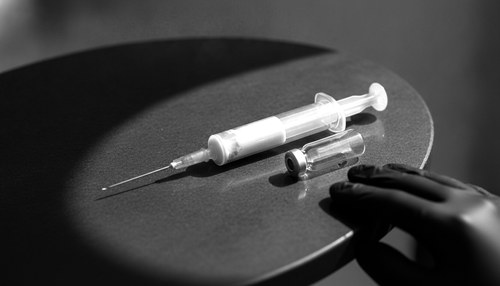
Black and white editorial still life of a prefilled syringe of processed allograft fat graft and a small vial on dark polished stone, a surgeon's gloved hand at the edge of the frame. Illustrative image. Commentary by Frank Agullo, MD, FACS.

Jenny McCarthy’s November 3 podcast gave the internet her implants, which I wrote about yesterday, and one more line. Her surgeon guest said “cadaver fat is the hot new thing,” and, as Parade and E! News reported it, left a “question mark” hanging over whether anyone should want it.

Fair. New things deserve a question mark. So here is the answer from someone who was handed the syringe before most of the country had heard of it.

It Is Fat. That Is the Point.

“Allograft fat is fat. So it’s fat without the cells, the actual nucleus in there, so there’s minimal DNA. So what we do is we inject that, and then your body kinda grows into it, moves into those cells, and creates its own fat.”

“Cadaver” is the word that makes it a headline. Allograft is the word that makes it ordinary. Surgeons have used screened, processed donor tissue for decades: dermal matrix in reconstruction, bone in dental work, tendon in orthopedics. Fat is the newest tissue on that list, not a new category of risk.

“It’s like a network, almost like a beehive, and then your cells move in and they create the new fat cells. What we’re seeing is that everything we put in stays, and then at about four to six weeks it actually fluffs out a little bit more, so you do get a little bit extra.”

The Regulation Answer

“The difference here is that donor tissue does not go through the normal FDA approval protocols like drugs and medications do. Instead, the process used to prepare the donor tissue must go through FDA guidelines. alloClae did not skip FDA approval, because donor grafts do not go through the same FDA channel as drugs. They do have to comply with strict FDA guidelines.”

It is an FDA-regulated human tissue allograft. Not a drug, not a device, not a loophole. If a clinic tells you it is “FDA approved,” they are using the wrong word; if a podcast tells you it skipped the FDA, so are they.

Where the Question Mark Belongs

Not on safety. On price, and on volume.

“The allograft is great because there’s no downtime. It’s a donor fat, we can do it in the office with local anesthesia, it’s in and out, and you’re back to work the next day. The problem is that it’s very expensive.”

“If we did the liposuction and the fat transfer, I’m probably going to transfer somewhere around 600 or 700 cc’s to each buttock. If we try to do that with the allograft, I think it’s impossible; it’s too much money.”

That is the honest limit. A hip dip, a breast upper pole, a liposuction divot, a deflated cheek with the finer face version, Lipoderma (“The allograft is too thick for the face”): the graft earns its keep. A full new shape: your own fat, in the operating room, where liposuction gives you a waist on the same day. “I wouldn’t do it all at once because we want your body to replace that with its own fat, and then we can always repeat the sessions.”

And it is not magic. It is your fat once your cells move in, so it lives by your rules: “If you gain those five pounds back, it’ll fill back in. Because the adipose cells, your fat moves in, and the fat will get bigger or smaller depending on your weight.” Long-lasting, with the potential to be permanent. Not a promise.

What I Would Tell the Podcast

The hot new thing is a scaffold of donor fat that your own fat grows into, regulated as tissue, placed in an office, priced by the cc. It replaced the biostimulator I used to inject in breasts, because there is no PLLA in it and nothing for the body to react to. It did not replace liposuction and fat transfer, and it will not, because your fat is free and there is a lot of it. The full version, with the comparison table, is on Agullo Plastic Surgery, and the office side, alloClae and Lipoderma, is on Southwest Plastic Surgery. The men’s version of the buttock story is here, and why I put donor fat above filler on the face is here.

Why Choose Dr. Agullo

I am certified by the American Board of Plastic Surgery and the American Board of Surgery, completed my plastic surgery fellowship at the Mayo Clinic, and serve as Clinical Associate Professor of Plastic Surgery at Texas Tech University Health Sciences Center. Castle Connolly has listed me as a Top Doctor every year from 2014 through 2026. I was one of the first twenty surgeons invited to use alloClae, and I still do fat transfer with liposuction every week, so I have no reason to sell you one over the other.

Ready to Talk?

If the question mark is yours, bring it in. Call (915) 590-7900, text 1-866-814-0038, or book online at agulloplasticsurgery.com/appointments. #StayBeautiful

Find me at @RealDrWorldWide on Instagram, TikTok, and Snapchat, @Agullo on X, or @AgulloPlasticSurgery on Facebook.

Newsweek Asked Whether Ozempic Butt Is Muscle Loss. Here Is What I Told the Reporter.

Black and white editorial portrait of a lean woman in a fitted dark dress, three-quarter profile from behind her shoulder against a plain studio backdrop, hard directional light along her back and the line of her hip. Illustrative generated image, not a real person and not a patient. Commentary by Frank Agullo, MD, FACS, Dr. WorldWide.

Newsweek ran it on August 9 under the headline “‘Ozempic Butt’ Isn’t Always Muscle Loss.” The setup was a Gallup survey: 11 percent of American adults are on a GLP-1 for weight loss, nearly four times the 2024 share. The point, from the two clinicians quoted, was that the deflated look everyone is posting about is mostly fat and volume leaving, not muscle, and that protein and lifting protect the muscle that is at risk.

I was one of the sources the reporter asked. I sent my answer the same week. It did not run, which is fine; they had two good voices and a word count. But I am the one who sees the buttock on the exam table after the drug has done its work, so here is what I told her, in the words I sent.

The first thing is that I do not read this the way a prescriber does.

“After people lose 20 to 60 pounds on these drugs, I examine what is left: how much fat was lost, how much muscle is left and how the skin is behaving. I do not look at this story as the endocrinologist and nutritionist do.”

The muscle number is real. It is also smaller than the headline.

“The DEXA substudies from the semaglutide and tirzepatide trials suggest the amount of weight lost that is lean mass could be 25-40%. Therefore, if one lost 50 pounds, then up to 20 pounds may be lean mass. However, lean mass is not the same thing as functional muscle. But that figure includes water, glycogen, and the organ weight, so the true skeletal muscle loss is smaller than the headline number.”

Then the question in the headline, answered the way I answered it.

“Not really. I am a plastic surgeon and most of what they call “Ozempic butt” or “Ozempic face” in my clinic is due to rapid fat loss. They are losing their fat and the skin envelope has not shrunk enough yet to fit. The buttock falls flat because there is not enough fat left to fill the skin that stays in place. There is some real muscle loss underneath, but the look that alarms people is mostly fat and skin.”

“Most of what people call Ozempic butt is deflation, not muscle wasting. The fat is gone and the skin envelope stays behind. Protein and lifting will protect the muscle, but they will not shrink loose skin.”

That last sentence is the whole reason a plastic surgeon belongs in this story. The article’s advice, protein and resistance training, is right, and I give it to every GLP-1 patient I see.

“Protein and weight resistance are really the two drivers that work. For my GLP-1 patients, I suggest 1.2-1.6 g of protein per kg of body mass daily plus lifting weights two to three times a week. Since the drug is so good at appetite reduction, my patients accidentally do not eat enough protein, so it must be intentional.”

But it fixes one of three problems. It does nothing for the other two.

“Most people do not realize that the scale measures mass (or weight), not the specific types of mass that a person loses. Two patients can each lose 40 pounds, but look differently based on whether their weight loss was composed of fat or muscle.”

So here is the sort I do in the room. A flat buttock with donor fat still on the flanks is a fat transfer, placed under ultrasound in the fat layer only, never the muscle. A flat buttock with a fold you can lift with your hand is a buttock lift, and no amount of grafting will fix a hanging envelope. A weak, soft buttock with the skin still tight is muscle, and that one belongs to the gym, not to me. Which is which, with the table, is in the full post on Agullo Plastic Surgery.

And whichever one you are, the weight has to stop moving before I plan anything. That rule, and who is actually a candidate for body contouring after a GLP-1, is the same one I gave Newsweek for its August body contouring story. Why I keep a probe on the skin for every fat injection is here, what the weight you keep means for the fat that survives is here, and the med spa half, what the devices can and cannot do for the skin, is on Southwest Plastic Surgery.

Ready to Talk?

I am Frank Agullo, MD, FACS, double board-certified, Mayo Clinic fellowship trained, Clinical Associate Professor of Plastic Surgery at Texas Tech, Castle Connolly Top Doctor 2014 through 2026. Call (915) 590-7900, text 1-866-814-0038, or book at agulloplasticsurgery.com/appointments. #StayBeautiful

Find me at @RealDrWorldWide on Instagram, TikTok, and Snapchat, @Agullo on X, or @AgulloPlasticSurgery on Facebook.

The Miami Thong Lift for a Double Butt Crease: A Consultation, Nearly Verbatim

Black and white editorial photograph for Miami thong lift commentary by Dr. Frank Agullo, MD, FACS.

A patient in her late twenties came to me on video. She had a lipo 360 with fat transfer to the buttock two years ago with another surgeon. Good projection. But under each buttock there was a second fold, and she wanted her hips lower and rounder, a pear instead of an hourglass. I am publishing the exchange nearly as it happened, identifiers removed, because almost nobody knows this operation exists.

The visit

Her: I gained about forty pounds in the last two, three years. I’m working hard on losing that weight, but I’m scared it will get worse with weight loss. Do you think it’s best to do the surgery now?

Me: “Let’s talk about what we want to achieve. I know that you want to get rid of the, kind of like this double butt crease, this area right here.”

Her: Yeah, that area stresses me out a lot.

Me: “So for this, we would do the thong lift, the Miami thong lift. It’s an incision that goes right here. I do a little bit of lipo here, and then we tuck that in so it kind of does a circle inside. So that would be the fix for that.”

Me: “You wanted to reduce the size here a little bit? The upper hips? Yeah, so we could do lipo here to take that out.”

The crease question

Her: Could we, like on the bottom of my butt, make it more round? Could we move fat around? Because I have no crease. You know this crease? I don’t have that, so I was wondering if we could put fat here.

Me: “So the crease here is actually good, it’s good when it’s short. If you look at very sexy buttocks, this crease is short. When it gets long, it’s because the buttock has fallen down, so it folds. So you actually, you’re good with that. I think that part’s fine.”

Me: “I do see that this is a little flat, like here, and you’re full here. Your projection is good. So really it’s just giving it a little bit of shape. So maybe removing a little here, adding a tiny bit here, and the rest for projection. And then lifting this up would make it look really nice.”

Me: “There’s a lot of different ways to describe it. Some people say like frog butt or elephant because of this, but we can fix that. I’m one of the few surgeons that does this procedure, the Miami thong lift. So where are we going to get fat from? Your back and your arms? Okay.”

The pear shape question

Her: Would it be possible to add fat to my outer thighs? I want to look like a pear rather than an hourglass.

Me: “I just don’t think you have enough, because we’re taking from your upper back and your arms. So we can add whatever fat we get there, or if we don’t have enough, we can use the allograft, which is the donor fat, and we can inject that into the saddlebag area to create more curviness lower down. So more like a heart shape.”

Her: A lot of other BBL doctors I asked, they declined to do that area, to inject fat in there.

Me: “We do it routinely because sometimes, you know, I get patients that have very skinny thighs. And if we just do the buttock, it looks funny, it looks like a chicken. So routinely we add to that area.”

Her: Oh, like to the thighs, not just the hips. And I can do everything at once?

Me: “You could, yeah.”

The fibrosis question

Her: I have pretty bad fibrosis on my stomach from my second round of lipo. What is fibrosis caused by?

Me: “So a lot of times it’s, number one, when they do too much lipo. Number two, if any of the fluid gets caught and it doesn’t come out, it creates like a capsule and scar tissue. So that’s why I really recommend doing lymphatic massages after the liposuction.”

Her: I didn’t also wear my faja. Is that also why?

Me: “That’s another one, yeah. It’s a lot of the aftercare. Number one, if you do too much lipo, then you get that really bumpy look. And number two is the aftercare. It really prevents the fibrosis.”

Her: Thank you, doctor. I learned a lot today.

My exam note that day: a double butt crease deformity, flat hips with fuller saddlebags, mild cellulite, good buttock projection.

What I tell everyone about the scar

To another patient the same year who had hip implants placed elsewhere and the same second fold: “On the posterior view, you do have a little bit of a double butt crease deformity. So to make this kind of go up and look more rounded instead of having that second bump, it would be the Miami thong lift. The incision goes right in the middle, on either side, but it hides completely when you are standing in the nude.”

“It is actually gonna pull up almost like a wedgie, so it will pull up everything and make it up and rounded. And it usually ends right about here, so you really don’t see any scars on the outside.”

And on why she had never heard of it: “That’s a procedure that very few surgeons do and very few people know about. And sometimes the surgeons just don’t know how to make it better.”

Surgery is about three to three and a half hours under general anesthesia, and you go home the same day. No drains. Five to seven days to light activity and driving, about four weeks to exercise, a compression garment for four weeks, and two weeks of sitting on your thighs with a cushion instead of on the buttock. In about four to six weeks you should be able to put on a bathing suit.

That is the whole subject. The second crease is not a volume problem, it is a position problem, and more fat makes it worse. A short hidden incision, a little lipo above it, and fat moved to where the shape needs it.

I am a double board-certified plastic surgeon, a Mayo Clinic fellowship alum, and I teach plastic surgery as a Clinical Associate Professor at Texas Tech University Health Sciences Center.

Call the office at (915) 590-7900, text us at 1-866-814-0038, or book a consultation at drworldwide.com.

#StayBeautiful

He Came In With a Plan: A Surgeon on the Young Men Who Research Their Own Faces

Black and white photograph of a young man's jawline in hard side light, head turned fully away so the face is in shadow and no features are identifiable, dark crew neck against a dark wall. Illustrative image, not a patient. Commentary by Frank Agullo, MD, FACS.

The men do not arrive with a question anymore. They arrive with a list.

“The patient is a man in his late twenties who came in asking for buccal fat pad removal and improvement in his jawline. He really didn’t come in for recommendations. He had already done a lot of research. He had seen a video about buccal fat removal, how it made the face more triangulated, but he also wanted to have jawline filler and a chin implant to strengthen his lower face contour.”

I have written before about these consults. Here is one, every identifying detail removed.

The intake form first.

“On his pre-op intake form, I saw what I see often on this type of patient. No medical problems, but a long list of supplements, including peptides, peptide stacks, an LED home device, protein powders, and retinoid cream.”

Then the exam, the part a video cannot do.

“When I examined him, he was already an attractive fellow. His chin projection was actually in line with the norms, lining up with the mouth and the nose. So he had a normal chin projection for his frame. Mild asymmetry, as expected, between the left and right side of the face and jawline. A slight amount of cheek fullness. And good jawline definition.”

Normal chin. Good jawline. The video got the cheek right.

I did not say no. I said look.

“The procedures he was asking for were not inappropriate. We did a 3D simulation, which did show improvement in his facial balance and contours, which he liked. In the end, he decided on buccal fat pad removal with chin augmentation and fat transfer to the jawline, rather than jawline fillers, for a more permanent result. Of course, we stopped all supplements two weeks before surgery.”

The chin stayed. The filler went, replaced by his own fat. Fillers are a tax you pay forever; the specialty’s own numbers agree.

Three months later.

“It’s been three months since his surgery and he is very satisfied. I am surprised he has brought up his upper eyelids and his nose at post-op appointments, and I’ve asked him to wait at least six months to a year to allow this surgery to completely heal and give us a good idea of his facial features.”

What I took from it is not about buccal fat.

“What I took away from this case is that these patients are very motivated. They have done their research and they understand the procedure they’re going to go through. Sometimes they do have unrealistic expectations. Tools like 3D imaging help the patient visualize what can actually be done and help them decide whether to undergo the procedure. I was happy to see that this patient, unlike many others, was obtaining his peptides and supplements through another doctor’s oversight and through a legitimate pharmacy.”

Unlike many others. Underline that.

The clinical version, with the exam-to-plan table and the FAQ, is on agulloplasticsurgery.com. The men in my waiting room can bring me a plan. I reserve the right to improve it.

Call (915) 590-7900, text 1-866-814-0038, or book at agulloplasticsurgery.com. #StayBeautiful

Find me at @RealDrWorldWide on Instagram, TikTok, and Snapchat, @Agullo on X, or @AgulloPlasticSurgery on Facebook.
The Hole the Implant Leaves Behind

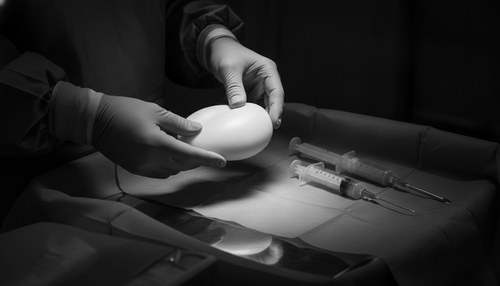
Black and white photograph of a surgeon's gloved hands holding a smooth silicone gluteal implant above a draped surgical tray, fat grafting syringes beside it. Commentary by Frank Agullo, MD, FACS.

Ten years ago, somewhere overseas, a surgeon put two implants in her buttocks. This summer she sat in my office and asked me to take them out and put fat in their place, in one surgery, and go home.

I understand the appeal. One anesthetic, one recovery, one bill.

The problem is not the fat. It is the hole.

“When the patient wants the implants out, I usually will stage it before doing the fat transfer. We can do a little bit of fat transfer at the same time, but it really depends where the implant was placed. If it was placed over the muscle, then a fat transfer will be difficult, as a lot of the fat will go into the pocket and die, becoming necrotic and forming a firm nodule.”

Transferred fat is a graft. It has no blood supply of its own for the first several days and survives only by sitting against living tissue that can feed it. An implant pocket is a cavity lined with scar. Put fat in it and you have filled a space, not planted anything.

“If the implant is under the muscle, then there is a good layer of fatty tissue where we can transplant the fat using the BBL method and ultrasound. But a lot of times, when we remove the implant, a large divot is left at the apex where the implant was, and it will require further fat transfer. Sometimes it can be done with alloClae, which is a donor fat graft. More often than not, the procedure needs to be staged.”

So two operations, three to six months apart.

“The main reason is we want the swelling to settle down, the implant pocket to close off, and the patient to recover physically before undergoing general anesthesia again.”

What happens in the meantime is less dramatic than patients have been led to expect. The capsule comes out if it is thick, stays if it is paper-thin and taking it would mean cutting muscle, and comes out entirely if the implant has ruptured. The muscle itself is not sewn back together in layers, whatever another office has told you.

“If you try to put a bunch of sutures in muscle, because there’s no fascia in the middle of the muscle, it just rips open.”

It heals on its own, in about five days, because it is muscle and muscle has blood. A drain stays in for roughly a week so the pocket collapses instead of filling with fluid.

“I can tell you in the buttock, in more than a thousand cases, I’ve never had a hematoma in the buttock. It just behaves different.”

Then, months later, the fat. And here the news is good.

“Fat survival is the same in a buttock that has had an implant, still has an implant, or has had an implant removed. We always overfill when we do a fat transfer, because we know we’re only going to get about fifty to eighty percent of the fat to survive and integrate.”

The wait was never about the fat. It was about turning a cavity back into tissue.

One more thing, because every patient who asks about conversion has read that buttock implants are a disaster.

“I don’t think they have fallen out of favor. I think they have always had somewhat of a negative reputation. This is because many physicians place the implants over the muscle, which over time creates sagging, and you can see a double butt deformity. You can feel the implants. You can even flip them, as you can see in some YouTube videos.

“Placing them inside the muscle does avoid a lot of these complications. It is a more difficult surgery, but the few surgeons that perform it have decreased complication rates when done correctly.”

Hers, as it happened, were in the muscle, which is why I could tell her the removal would be uncomplicated and that she would have options afterward. Most of the stories that scare patients off are about implants that were never put there.

That is not an argument against implants. It is an argument about where they go.

Call (915) 590-7900, text 1-866-814-0038, or book at agulloplasticsurgery.com. #StayBeautiful

Find me at @RealDrWorldWide on Instagram, TikTok, and Snapchat, @Agullo on X, or @AgulloPlasticSurgery on Facebook.

Fifty to Eighty Percent, Not Zero

Black and white studio photograph of an adult woman standing in swimwear, photographed from behind, illustrating buttock contour. Illustrative image, not a patient photograph or a surgical result. Commentary by Frank Agullo, MD, FACS.

Two things patients believe about fat transfer, both wrong.

The first is that none of it lasts.

“One of the biggest misconceptions is that all the fat disappears. Patients think that none of it lasts, when in actuality, we do get a fifty to eighty percent retention rate. This could be less than what the patient wanted, but it’s still an addition and not a complete loss.”

The second is that they will see it right away.

“The other misconception is that the results are instant, but the patient has to keep in mind that swelling often hides the results. It does take about four to six weeks to start seeing the actual retention, volume, and new contours.”

Now the rest of it.

“Fat transfer is exactly what it sounds like. We take fat from one place and move it to another place. So a lot of times, patients get a double benefit. They get to reduce the amount of fat from a place they want to reduce, and they get to augment the amount of fat in a place they want to augment.”

The list of places it can go is longer than most people expect.

“In my practice, we routinely do fat transfer to the face, which can go in the temporal hollows, the periorbital area or around the eye, the nasolabial lines, the lips, the jawline, the chin, and the cheekbone area.

“We can also use it to augment the breasts or to hide rippling. We can use it for fixing a bad liposuction where there’s a lot of contour irregularities. We can use it to enhance the buttock, the hips, and the thighs. We can also inject it into the muscles to create muscle definition in the biceps, triceps, trapezius, the calf muscles, and even the thighs. You can also enhance the six-pack by injecting into the rectus muscles.”

On what drives the retention number:

“A lot is determined by the patient’s own healing response and circulation, and also if they adhere to instructions, keeping them away from exercise and on a healthy diet. I often use AuraClens, which contains Poloxamer 188, to wash out the fat graft and also strengthen the cell membrane for higher retention rates.”

If you think you are too lean to donate:

“Although you may think that lean patients don’t have any fat that they can donate for themselves, there are usually areas where some amount of fat can be obtained. And these areas are usually the flanks and the medial thighs.”

And against the alternatives:

“Fillers are going to be more palpable, and fat is going to feel a lot more natural, but it is unpredictable in terms of how much retention we can get. The great thing about fat is that it’s free, and we can use as much as we need to correct the deformity, or augment, or sculpt, versus fillers, which have a cost per unit.”

One condition on all of it:

“Remember that fat grafts will change with the patient’s weight, so it is ideal to maintain your weight over time.”

The graft is living tissue. It gains and loses along with the rest of you, which is the part nobody mentions when they are selling it.

Call (915) 590-7900, text 1-866-814-0038, or book at agulloplasticsurgery.com. #StayBeautiful

The Tell on a Bad Lipo: Why Liposuction 360 Lives or Dies on Judgment

Black and white editorial study of a contoured midsection. Liposuction 360 and fat transfer read by Dr. Frank Agullo, MD, FACS.

You can spot a bad liposuction from across a room. The contour is wrong. The waist has a divot where it should have a curve, the belly button sits at a strange angle, and there is that scooped, hollow look that says someone took out too much. That is the result patients are terrified of when they sit down across from me, and they are right to be.

Here is the thing nobody selling you a discount lipo wants to say out loud. The procedure is not hard to perform. It is hard to perform with restraint.

I do a lot of these. Counting by treated areas, I do roughly ten thousand a year. Counting by patients, somewhere between five and six hundred. That volume teaches you one lesson over and over: the smooth result and the lumpy one separate on judgment, not effort.

What Liposuction 360 Actually Treats

Three-sixty is exactly what it sounds like. We treat the full abdomen including the waistline, a little blending into the mons, the lateral chest, the upper and lower back, and the flanks. We are sculpting all the way around the trunk rather than flattening one panel of it.

For arms, the approach is essentially circumferential too. The goal is a contour that reads from every angle, not just head-on in a mirror.

The Real Skill Is Knowing When to Stop

The over-done look comes from one mistake: removing too much fat. You have to leave enough healthy fat behind so the result still looks like a body and not a deflated balloon. A bad lipo announces itself. The contour is irregular, the belly button looks off, and you can tell at a glance that someone had work done.

I tighten the skin with J-Plasma so the surface smooths back down over what is left. How much it tightens depends on how your skin responds, and I will not promise you a number I cannot control.

How I Keep It Smooth Afterward

Two things prevent the lumps and fibrosis people dread, and neither is glamorous.

First, lymphatic massage. We have an in-house tech, and I want you in two or three times a week for about four weeks. That breaks up fibrosis before it sets. Second, I leave a small drain in the abdomen, so when you do those massages, any trapped fluid comes out fast. Lumpiness almost always traces back to fluid getting stuck, so draining it early is the cheapest insurance you can buy.

“Will Lipo Fix the Bulge When I Relax?”

Often, no, and I will tell you that to your face. What I can remove is what we can pinch. If you have a bulge that appears when your muscles relax, that is usually the muscles themselves separating, and the only thing that repairs separated muscle is a tummy tuck.

A tummy tuck makes the abdomen flat and tight and rebuilds the muscle wall like a built-in corset. It is a bigger improvement than lipo alone, and it comes with a scar. That trade-off is yours to make, but you should make it with the full picture in front of you, not after the fact.

Don’t Throw the Fat Away

This is the decision I push patients hardest on. Once we discard your fat, it is gone, and buying volume back later with a product like Sculptra gets expensive fast.

We do not need to do a dramatic Brazilian Butt Lift to make this worthwhile. Sometimes filling the hip dips is enough to carry a smooth line from waist to hip without adding projection. I tailor it from very subtle to dramatic, working off a photo of the shape you actually like, and I transfer fat with a deliberate overfill because roughly thirty percent reabsorbs. It looks a little full at first, then settles into the result we planned.

Lipo Alone vs. Lipo With a Tummy Tuck

What’s Bothering You The Honest Answer
Pinchable fat, skin that snaps back Liposuction 360
Bulge only when muscles relax Tummy tuck repairs separated muscle
Loose skin after weight loss Tummy tuck or excision, not lipo
Flat tummy plus loss of curve Lipo plus fat transfer to hips

What Recovery Is Really Like

Easier than the videos suggest. I have had liposuction myself, so this is not a guess. The soreness is like going back to the gym after a long layoff: uncomfortable with movement, but tolerable. If you have had a C-section, this is the easier recovery.

You see a difference almost immediately, though you will be swollen. We provide two Marena fajas with clips so we can size you down as the swelling drops, worn for four weeks, off twice a day to shower. You shower the next day, my nurse visits to help with that first one, and most swelling clears by two weeks. Improvement keeps going for up to six months.

Why Volume Sells Liposuction Short

Here is an opinion that costs me the occasional easy sale. Liposuction is not really a fat-removal procedure. It is a contouring procedure, and the difference matters.

If all I did was vacuum out the maximum amount of fat, I could give you a number on a chart and a worse-looking body. The artistry is in what stays: the way the waist still curves, the way the back blends into the flank, the way the line carries from one region to the next without a seam. That is why the fat transfer half of this conversation is not an upsell. Moving a little of your own fat to a hollow can do more for the overall shape than removing another ounce ever would. Subtraction and addition, working together, beat brute-force removal every time.

The Credential Behind the Caution

Double board-certified by the American Board of Plastic Surgery and the American Board of Surgery, Mayo Clinic plastic surgery fellowship, Clinical Associate Professor of Plastic Surgery at Texas Tech University Health Sciences Center Paul L. Foster School of Medicine, and Castle Connolly Top Doctor for thirteen consecutive years. Body contouring is a large part of what I do, and I treat the restraint as seriously as the technique.

Ready to Talk?

If you want contour without the over-done tell, let us map it out together. For the patient-facing walkthrough, see the companion post on agulloplasticsurgery.com. For the recovery and massage menu, see the version on swplasticsurgery.com.

Call (915) 590-7900, text 1-866-814-0038, or book online at agulloplasticsurgery.com. #StayBeautiful.

@RealDrWorldWide on Instagram, TikTok, and Snapchat, @Agullo on X, or @AgulloPlasticSurgery on Facebook.