The Wound Does Not Care How the Nicotine Arrived

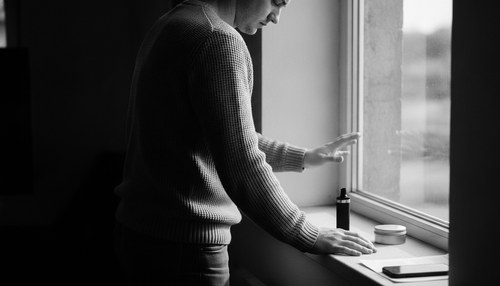
Black and white photograph of a person seen from behind at a window, pushing a vape pen and a small plain tin away along the sill. Illustrative image, not a patient. Commentary by Frank Agullo, MD, FACS.

“I quit smoking for this.” Patients say it at the consult and they mean it. They have done the hard thing.

Then I ask about the pouches.

“Any type of nicotine is the same, and this is something patients don’t realize. They think that because we say smoking, we just want them to stop smoking. But any other form, like Zyn or dip or vaping, the patches and the gum, they all have nicotine.”

The wound does not care how the nicotine arrived. It only knows that the smallest vessels feeding it have closed.

“They have the same effect, which is they constrict the small capillaries that carry the nutrients and the growth factors and cells to the scar area to repair and heal. When these vessels clamp down, the flow of blood to these areas is decreased to the extent that we may have wound openings or even skin death.”

Skin death. I use the words on purpose, because I have seen it and patients have not.

“We see the complications most often in tummy tucks, where there can be loss of skin in the inferior portion, in breast surgeries, where there can be loss of the nipple and areolar complex or breast skin, and in facelifts, where there can be necrosis of the skin flaps that we elevate. These all end up with bad scarring.”

Those three operations are the ones I refuse.

“If I know a patient is smoking, I will refuse to do most procedures, but especially any facelift or neck lift, any breast lift or breast reduction, and tummy tucks. All these procedures rely on flaps and capillary blood flow.”

A flap is skin I lift and move while it stays attached at one edge. That edge is its whole blood supply until new vessels grow in. Nicotine is the thing that stops them growing.

The rule itself is short.

“We want patients off of nicotine at least two weeks before and two weeks after, preferably two weeks or longer before and none after.”

I do not test for it as a routine.

“I don’t nicotine test patients routinely, unless there is a question or a doubt. I do communicate very strongly with patients about what the consequences can be, and I trust that my patients are responsible adults who will comply, because they don’t want to have complications.”

Two more questions come up in the same breath, and they have different answers.

Cannabis first. It is not a nicotine problem.

“Marijuana and cannabis vapes are a little bit different. They don’t usually have nicotine, but the smoke itself does cause airway reactivity and can interfere with general anesthesia. So I also recommend at least two weeks before and two weeks after to stay away from it.”

Same window. Different organ. The airway belongs to the anesthesiologist, and I do not argue with anesthesiologists.

Then the partner. Someone always asks about the partner.

“Secondhand smoking is just as bad as firsthand smoking, as the nicotine effect will clamp down the capillaries. So patients should stay away from partners that smoke. We don’t want to do a nicotine replacement during recovery because the nicotine will have the same effect in a gum or a patch as if the patient was smoking.”

So no patch, no gum, and no sleeping next to someone who smokes, for two weeks on either side of the date.

When the answer about the pouches is yes, the surgery moves. Not cancelled, moved. Patients are annoyed for about a week and grateful for the rest of their lives, because the alternative is a scar I cannot fix.

That is the whole post. The wound does not care how the nicotine arrived.

Call (915) 590-7900, text 1-866-814-0038, or book at agulloplasticsurgery.com. #StayBeautiful

Find me at @RealDrWorldWide on Instagram, TikTok, and Snapchat, @Agullo on X, or @AgulloPlasticSurgery on Facebook.

Red Light Therapy: Why the Wound-Healing Science Is the Reason to Take It Seriously

Black and white editorial portrait of a face lit by a soft directional light. Red light therapy commentary by Dr. Frank Agullo, MD, FACS.

Patients ask me whether red light therapy is real or just a nice glow. The reason the wound healing research gives us confidence in red light for skin rejuvenation is that the mechanism for wound healing is the same as for skin rejuvenation.

The Mechanism Is Pretty Well Established

The mechanism for LED red light therapy is pretty well established. That’s the mechanism of action on the wound healing side. The light at red and near-infrared wavelengths is absorbed by the mitochondria of the cells. This raises ATP, or energy production, and drives the proliferation of specific cells active in wound healing, like fibroblasts and keratinocytes. It increases collagen synthesis and local blood flow. This has been described in peer-reviewed publications.

And the same mechanism of action is activated in aesthetic applications. So when I use it on skin, I am not hoping for a vague glow. I am running the same cellular cascade that closes a wound.

What the Studies Show

There are randomized controlled trials showing reduction in the wrinkles around the eyes up to thirty percent. There’s also a controlled trial that showed increased intradermal collagen density, which in turn reduces the appearance of fine lines and wrinkles in the skin. And there have been other multicenter randomized studies that have shown measurable crow’s feet improvement.

Where I Put It in the Hierarchy

I am not going to pretend red light replaces a facelift or resurfacing. As an adjunct, though, it earns its place. After surgery it supports the healing the body is already doing. For skin, it supports collagen, and it stacks well with microneedling.

The Catch Nobody in the Gadget Aisle Mentions

Now, it’s important to know that results do vary by wavelength, dose, and device, and many home consumer units are weaker than the devices used in clinical trials. I personally use Elixir MD, which is an FDA-cleared LED device, which builds credibility for plastic surgeons to cut post-surgical downtime. This device uses a spectrum of wavelengths: red for mitochondrial stimulation and blood flow, infrared for deeper tissue repair, blue to reduce bacterial load, and yellow for cellular repair.

The Credential Behind the Opinion

Double board-certified by the American Board of Plastic Surgery and the American Board of Surgery, American College of Surgeons Fellow, Mayo Clinic plastic surgery fellowship, Clinical Associate Professor of Plastic Surgery at Texas Tech University Health Sciences Center Paul L. Foster School of Medicine, and Castle Connolly Top Doctor for thirteen consecutive years. I never write a confident claim that is not grounded in peer-reviewed evidence or my own practice experience, and red light clears that bar.

Ready to Talk?

If you want red light to do real work, the device and the dose matter as much as the idea.

For the patient-facing guide, see the companion post on agulloplasticsurgery.com. For the LED program at the practice, see the version on swplasticsurgery.com.

Call (915) 590-7900, text 1-866-814-0038, or book online at agulloplasticsurgery.com. #StayBeautiful.

@RealDrWorldWide on Instagram, TikTok, and Snapchat, @Agullo on X, or @AgulloPlasticSurgery on Facebook.