
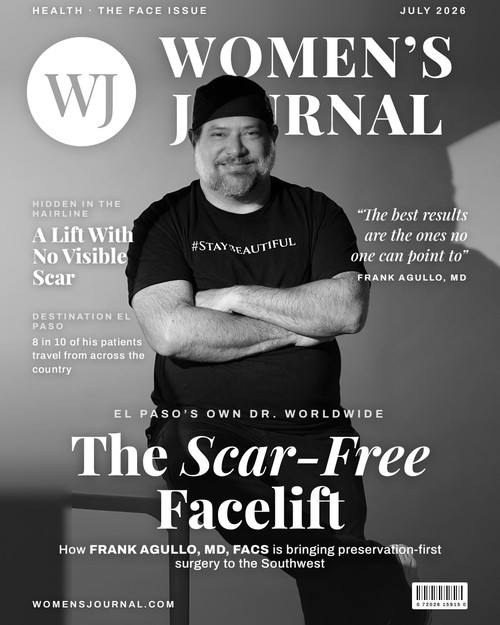
The July issue of Women’s Journal is their Face Issue. The cover is me, arms crossed, in a #StayBeautiful shirt, next to a quote I have said in the operating room more times than I can count: the best results are the ones no one can point to.
Strange feeling, seeing your own sentence printed in serif type on a magazine rack. Also a useful one. Because the story they chose to tell is the story I have been trying to get patients to hear for two years.
Not a new machine. Not an injectable. A facelift you cannot see.
What the Cover Story Actually Covers
The piece, written by Adriana Sinclair, is about the ponytail lift, which is the nickname for what I perform as a total endoscopic deep plane facelift. The name comes from the incision placement. The openings sit so far back inside the hairline that a patient can pull her hair into a high ponytail or a bun without showing a single mark.
No cut in front of the ear. No scar tracing the earlobe. None of the tells that made facelifts recognizable for fifty years.
Instead of lifting skin, I thread an endoscope, a camera thinner than a pencil, beneath the surface and reposition the deeper layers of the face: the brow, the midface, the jawline. The skin comes along because the foundation under it moved, not because I pulled on it.
If you want the full technical walk-through, I wrote it up in April in The Facelift You Can’t See. The Women’s Journal piece is the patient-facing version of that argument.
Tension Is the Enemy
Here is the opinion that runs through everything I do to a face. Tightening skin and adding tension is what creates the pulled, wind-blown look every patient says they are terrified of. Skin is a cover, not a scaffold. Treat it like a scaffold and it tells on you.
The deep plane approach, open or endoscopic, moves the structural layer and lets the skin settle where it belongs. That is why the results read as rested instead of redone. It is also why they hold. Repositioned tissue stays put in a way stretched skin never will.
Surgeons argue about plenty inside this space. How deep, how wide, on whom. I have been in those rooms, including at The Aesthetic Meeting in Boston this spring. But the direction of the field is not really in dispute anymore. Deep plane won.
Training With the Man Who Invented It
The cover story spends time on something I insist on being transparent about: where I learned this.
The ponytail lift was created by Dr. Chia Chi Kao in Santa Monica. I took his intermediate course in Pittsburgh, then applied to the advanced Ponytail Academy, the invitation-only program held at his own operating suite in Santa Monica, and was accepted.
Those days are not lecture-hall days. Cadaver lab on the midface. Live demonstrations of endoscopic tissue elevation. Long arguments about candidacy, because knowing who not to operate on is most of the job.
I brought all of it back to my AAAASF-accredited practice in El Paso, where it joined what Mayo Clinic fellowship training and twenty years of facial surgery had already built. That stack matters. A technique is only as good as the hands and the judgment around it.
Who the Ponytail Lift Is For, and Who It Is Not
Surgeon to reader, candidly: this operation is not for everybody, and any surgeon who tells you otherwise is selling.
The endoscopic version shines for patients who want the brow, midface, and jawline lifted discreetly, typically earlier in the aging curve, before heavy jowling and significant loose skin take over. For a patient with a lot of skin excess, a traditional open deep plane facelift remains the stronger tool, and I offer both, which keeps me honest. When you only own a hammer, every consult looks like a nail.
Recovery between the two is similar. Both rely on repositioning deeper tissue rather than surface tension, which is exactly why both are built to last.
Why a Magazine Cover Matters to Patients in El Paso
There is a line in the piece I want to underline. El Paso used to be a city people left for this kind of surgery. That has reversed. More than eight in ten of my facelift patients now travel to El Paso from out of town, from across Texas and the rest of the country.
A national cover story is not why they come. They come for the work. But the cover is a signal that the work happening on the border is being noticed at the national level, and I am proud of that for my city, not just for my practice. I see patients in English and Spanish, often in the same hour, and that bilingual, binational room is part of what makes this practice what it is.
Thirteen straight years as Best Plastic Surgeon in El Paso. Castle Connolly Top Doctor thirteen consecutive years. Texas Super Doctors Hall of Fame. Those lines have lived on my CV for a while. Seeing the philosophy behind them on a newsstand is new.
The Quote I Will Stand Behind
“The best results are the ones no one can point to.”
That is the whole preservation-first argument in eleven words. If someone can tell you had a facelift, something went wrong: too much tension, too much volume, wrong plane, wrong patient. The win condition is a colleague saying you look well rested and meaning it.
Women’s Journal put that sentence on a cover. My job is to keep making it true one face at a time.
Ready to Talk?
If the cover story raised questions about your own face, let’s answer them properly, in person. Call Southwest Plastic Surgery at (915) 590-7900, text my consult line at 1-866-814-0038, or book through agulloplasticsurgery.com. Find me as @RealDrWorldWide on Instagram, TikTok, and Snapchat, @Agullo on X, or @AgulloPlasticSurgery on Facebook. #StayBeautiful
Companion reads: the patient-focused version on agulloplasticsurgery.com and the practice story on swplasticsurgery.com.