
For a stretch of years, the Brazilian butt lift carried the highest death rate of any operation in aesthetic surgery. That statistic was real, and it was earned.
It was also, it turns out, about one centimeter of tissue.
“There have been no cases of fat embolus when fat has only been injected in the subcutaneous fat. The only cases of fat embolism have all had intramuscular fat injections.”
Read that twice. Not most cases. All of them. The complication that made this operation infamous does not happen in the fat layer. It happens when a cannula ends up in muscle, where the large gluteal veins run, and fat enters the circulation and travels to the lungs.
So the entire safety problem reduces to a question of where the tip of the instrument is. And the tip of the instrument is somewhere you cannot see.
Unless you look.
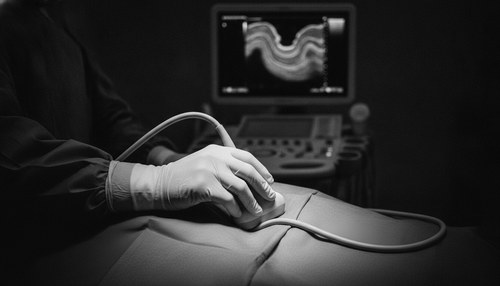
“The ultrasound shows us exactly where the tip of the cannula is while we’re injecting fat into the buttock. Ideally, the cannula should be injecting fat into the deep fat layer above the muscle. We inject some fat in the superficial fat layer for shaping, but the bulk of the volume is injected in that deep compartment.
“By visualizing exactly where we’re at, we’re avoiding intramuscular or deeper injections, which can cause fat embolism, a very severe complication. That’s the importance of the ultrasound. It makes the procedure safer by knowing exactly where you’re at at all times.”
My protocol has not changed much in years, because it was already built around that idea.
“We continued using blunt tips with cannulas larger than 4 millimeters. We avoided injections into the muscle. We used ultrasound to visualize the location of the tip of the cannula while injecting, making sure not to perform any intramuscular injections. I always use an upward-angled cannula, and the patient is positioned in a jackknife type position.”
Now, the part I want any prospective patient to actually use.
“The most important thing is whether the surgeon is using ultrasound or not. No matter the experience level of the surgeon, there’s always a risk that you can misjudge and be in the wrong plane, and this is completely avoidable with direct visualization.”
Experience is not a substitute for looking. I have done a great many of these and I still put the probe on the skin, because a surgeon’s sense of depth is an estimate and a screen is a measurement.
Two groups where that gap matters most:
“That’s especially true of male patients, who have a very thin fat layer, and also massive weight loss patients, who have a very thin fat layer, so they’re at higher risk for intramuscular injections.”
When there is barely any fat between skin and muscle, the margin for error shrinks to almost nothing. Those are exactly the patients most likely to be told the operation is simple.
I spent my terms as vice president and then president of the World Association of Gluteal Surgeons pushing on this.
“I think the biggest achievement of WAGS while I was Vice President and President was educating patients and surgeons, both members and non-members, about safety. Also incorporating ultrasound into the BBL procedure, and creating a course and a certification for using ultrasound for Brazilian butt lifts. We also showed that the BBL can be performed safely.”
Ask your surgeon one question. Do you use ultrasound during the fat injection?
There is no good answer other than yes.
Call (915) 590-7900, text 1-866-814-0038, or book at agulloplasticsurgery.com. #StayBeautiful
Title alternatives (title PICKED 2026-09-09 by blog-publish-driver under the 2026-09-05 standing default; option kept is above)
- Every Reported BBL Fat Embolism Had One Thing in Common
- One Centimeter of Tissue
- Why I Put a Probe on the Skin Before Every Fat Injection
- The Operation Was Never the Problem. The Plane Was.