There are two types of plastic surgeons when talking about aging. They are the loudest type and the quietest type. The loud type says fillers, then more fillers, then a surgery. The quiet type takes a longer view and plays the game on a cellular level. Better mitochondria, better collagen, better skin, better sleep. Less for the surgeon to do eventually, as the patient ages more slowly.
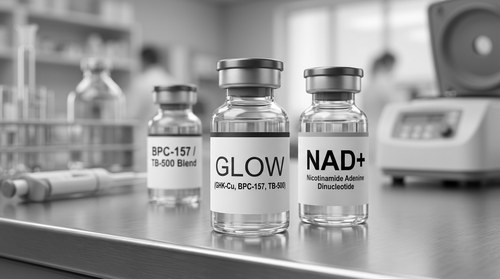
My career took the loud road. Deep plane facelifts, breast preservation, body contouring. These are real operations on real anatomy you can see from across the room. I am not going anywhere near quitting those. In recent years, though, I have found myself thinking more about the quiet road as well, because the science is finally at a level where I can stand up and discuss it. This is a post on my take on peptides outside the operating room. NAD+ as a tool for daily energy and longevity, GHK-Cu as a skin-quality investment, and the GLOW blend used on patients who are not recovering from surgery but would like to see a bit more of their thirties in their forties.
What a Peptide Is, in Plain English
Peptides are small amino acids in a chain. Insulin is one, oxytocin is another, and human growth hormone is a peptide. Your body makes tens of thousands of peptides each day, sending signals between tissues. The therapeutic peptides we offer on the wellness menu are the man-made counterparts to molecules that your body produces every single day, made at a cGMP pharmaceutical standard and dosed by the milligram.
The dose simply tells the body to do something it already knows how to do: lay down collagen, repair damaged DNA, build new microvasculature, or restore mitochondrial energy. Peptides do not perform the chemistry to do this work, the peptides signal cells to do so. The work is done by the patient’s own cells.
This is the crucial distinction that tells you what peptides cannot do. Peptides cannot bring back a face that has lost over 20 pounds of its volume along with all of its supportive ligaments and muscles. They cannot make a 45-year-old neck look like one at 30. Surgery does this. Peptides cannot replace surgery when surgery is what your body needs. However, they can build the cellular foundation around surgery stronger, both before and after it. And for the patients who do not need surgery just yet, they can extend the length of the runway.
NAD Plus, the Molecule I Take Seriously
NAD+ is the chemical that means nicotinamide adenine dinucleotide. Technically, it is a coenzyme, and it sits on the menu next to peptides as the longevity molecule with the highest evidence. The “nicotin” component refers to its link to the etymology of vitamin B3. This is not related to smoking. I discuss this with patients on every visit.
NAD+ is the cofactor required for the operation of mitochondria, the part of a cell that produces its energy, and it is used by sirtuins, an enzyme family important in DNA repair and cell maintenance. Longevity researchers care about NAD+ because the levels drop as we get older, correlating with visible signs of aging and even hidden ones, and restoring the NAD+ levels in animals restored cellular function. Human studies are younger, more chaotic, but on track in the same direction.
NAD+ infusions are the more common NAD+ formulation patients have heard of. It is what is responsible for the “I felt so amazing after my infusion” posts online. An infusion run too fast will make patients uncomfortable with chest pain, hot flushing, and burning around the neck and head. That is dose and infusion-rate dependent and normal. An infusion run more slowly over 2 to 3 hours will make patients comfortable throughout. We use the slow rate for all of our infusions. The low-dose subcutaneous injection taken at home is maintenance therapy.
When speaking with patients about NAD+, I suggest they look at two separate timeframes: the acute and noticeable lift in energy and mental clarity immediately after an infusion, and the slower, less noticeable cellular improvements over months and years. Patients book their NAD+ infusion because of the former. I prescribe it because of the latter.
GHK-Cu, the Skin Investment That Runs Deeper Than Topical
GHK-Cu, or copper peptide, is glycyl-L-histidyl-L-lysine copper, a three-amino-acid string normally present in human plasma in high concentration, peaking in one’s twenties with a concentration decrease following that point in life. GHK-Cu is the same active compound in many topical copper peptide skin-quality products available on shelves at any dermatology or beauty counter. However, topical GHK-Cu must penetrate the skin’s outermost barrier (the stratum corneum), designed specifically to keep molecules such as this from entering the skin at high enough concentrations to start cell repair and regrowth. Injectable GHK-Cu delivers the peptide at a controlled dose directly to the dermis. It does not have to fight the skin barrier.
GHK-Cu has been shown to trigger more than 300 gene functions related to repair of injured tissue, and to stimulate fibroblasts (skin cells) to create new collagen, new elastin, and support the survival of stem cells of the epidermis (basal stem cells). Copper peptide also demonstrates anti-inflammatory properties and holds results through preclinical research and some early clinical data on hair regrowth, wound healing, the dermal density of skin, and photoaging. There is not a single part of this story that has been fabricated out of thin air by a skincare brand. What has been misrepresented, and is essentially a lie, is the implication that the topical version of GHK-Cu achieves anything remotely similar to the concentrations proven beneficial in studies of GHK-Cu as a treatment.
When GHK-Cu is ordered for wellness (not surgery), it is most often a woman in her early-to-mid forties who follows best practices about sun exposure, knows surgery is not for her at this time, but wishes for her aesthetic plan to use meaningful cellular improvements as well. The blue color is normal, caused by the copper. It is also injected subcutaneously, most often with injections done at home by the patient.
GLOW, Used Outside the Operating Room
GLOW is a mixture of three peptides: GHK-Cu, BPC-157, and TB-500. I covered these peptides in my post on surgical recovery, where their ability to work synergistically to bring about healing (collagen, angiogenesis, and cell migration) is best leveraged. On a wellness, non-surgical front, the thinking is a little different.
In terms of using the blend on an ongoing basis in wellness settings, I most frequently prescribe only GHK-Cu on a cycle basis, rather than the full blend. The effects and benefits attributed to GHK-Cu, namely improved skin and hair quality, are largely a story on its own. The two peptides BPC-157 and TB-500 show literature to be most beneficial for tissue repair, which is exactly what these peptides were designed for. Dosing them as a permanent maintenance medication for a healthy patient without any particular illness is, to me, dosing the patient far past marginal benefit. It would be better to keep the peptides available to be utilized for a genuine wound, injury, tendinopathy, or surgical recovery, where the effects of higher doses are more easily evaluated.
The only exception that would justify use in a wellness, non-surgical patient would be one dealing with a chronic soft-tissue problem, significant chronic inflammation, or who is recovering from a previous injury. In this scenario, the GLOW blend can be of benefit when cycled and used over a fixed course of time. It is important that this discussion take place with the patient on a case-by-case basis.
What Peptides Do Not Replace
Peptides cannot replace the use of SPF, can never replace adequate and consistent sleep, and can never replace what any given individual uses to maintain themselves day to day, such as some combination of sleep, protein consumption, resistance training, sun protection, and not engaging in behavior that will age you faster (such as drinking your liver and face into early aging). A peptide protocol can be layered on top of this foundation. However, peptides cannot be used as substitutes for it. The attempt at the latter will be a waste of money.
Peptides also are incapable of replacing surgery when the actual physical structure and tissue of your face need it. A patient who has experienced loss of volume along the cheeks and jawline in a way that takes decades off their appearance is not going to achieve a return of these areas with a peptide treatment, regardless of what it may offer. In this scenario, the appropriate course of action is a deep plane facelift, done well, and peptides can serve as support for the recovery process and longevity afterward, not as an outright replacement for it.
The Cautious Side, in Plain Language
It is essential to note that peptides are not under the regulatory process known as FDA new drug approval. Instead, they are compounded at US 503A pharmacies by a licensed and registered physician, and, as I said, there are gray-market options for peptides with questionable identities and origins. This is because a great percentage of the time, such products have not been formulated in a sterile and consistent environment. My clinic partners exclusively with a US-based pharmacy that adheres to cGMP regulations and provides a certificate of analysis with each batch. While my costs will likely be higher than many other sources of peptides you may encounter (on places like Instagram or Telegram), that extra expenditure is, without a shadow of a doubt, why you should stick to a trustworthy source. Do not buy peptides from Instagram. Ever.
For peptides such as growth-factor peptides (a related category of growth factors and signaling molecules), active malignancy is a contraindication to treatment. Pregnancy and breastfeeding are also off the protocol. For patients with a prior personal history of cancer, we will have an extended conversation, and in most instances we will request that an oncologist sign off on treatment. For patients who are anticoagulated for medical reasons, doses will be adjusted in coordination with their cardiologist to maintain patient safety.
Fillers are a tax. That is the way I think of them when it comes to cosmetic procedures. I like and use fillers all the time for the right patient, but the comparison stops there. Peptides differ, in that they do the work that the body already knows how to do, and once you stop peptides, your body just continues on with its own pace of aging. There is no rebound effect, no dependency, and no need to keep dripping peptides for the remainder of time. Used judiciously for specified periods, with a physician defining the dosage and the length of treatment, these can indeed be a valuable longevity tool. However, for patients who wish to continue with the peptides forever, with no rhyme or reason to their prescription, the situation is far more murky.
Why Choose Dr. Agullo for a Peptide Wellness Protocol in El Paso?
Double board-certified, American Board of Plastic Surgery and American Board of Surgery. Fellow of the American College of Surgeons. Mayo Clinic plastic surgery fellowship. Clinical Associate Professor of Plastic Surgery at Texas Tech University Health Sciences Center. Affiliate Professor at UTEP. Castle Connolly Top Doctor for thirteen consecutive years. Every single peptide I prescribe is sourced through a US cGMP-certified compounding pharmacy, personally dosed and monitored to ensure effective and appropriate treatment. Wellness peptide visits at Southwest Plastic Surgery take the same care and level of medical attention as surgical consultations. Complete medical histories are established and a thoughtful treatment plan is curated to monitor patients over time.
Ready to Talk?
If you are curious about whether a peptide protocol fits your goals, the starting point is a wellness consultation. We will review your medical history, your aesthetic goals, your current routine, and what you actually want out of the next decade of your face and body. If peptides fit, we will write a protocol. If they do not, I will tell you. The point of the visit is not to sell you a vial.
For two more reads on the same subject, see the longer clinical version, Peptides for Anti-Aging and Wellness: A Plastic Surgeon’s Clinical Read on NAD Plus and GHK-Cu on agulloplasticsurgery.com, and the practice program version, NAD Plus, GHK-Cu, and the Peptide Wellness Program at Southwest Plastic Surgery.
Call (915) 590-7900, text 1-866-814-0038, or book online at agulloplasticsurgery.com. #StayBeautiful.
@RealDrWorldWide on Instagram, TikTok, and Snapchat, @Agullo on X, or @AgulloPlasticSurgery on Facebook.