
Reading the Ambassador Face: A Candid Surgeon’s Breakdown of Layered Aesthetic Work

Black and white editorial comparison of two portraits side by side. Aesthetic analysis commentary by Dr. Frank Agullo, MD, FACS.

Reading a face from photos is one of the more interesting things I do, and influencers make it easier. So much of their work gets documented, especially when they are a brand ambassador for a med spa and probably get a lot of their care in exchange for the publicity. Let me read one of these faces candidly, the way I would talk it through with a colleague. This is an educational read, not a diagnosis. I have not treated her, and a photo is not a consultation.

What We Can Be Fairly Sure About

We know for a fact that she’s had neurotoxin to the upper face, which includes the forehead, crow’s feet, and glabella, in hopes of making her eyes more open. She’s had Sculptra to the temples to fill in her temporal recession, hollowness, or temporal wasting. She’s also had Renuva to the temples, also for volume. This is a fat graft. It’s a donor fat graft that is processed, and it encourages ingrowth of fat in that area.

She also had hyaluronic acid filler in the lips, which it seems she did not like and then had dissolved, even though I still see some hints of more volume than she previously had. There is some filler still there that wasn’t completely removed. She had a Botox lip flip. She’s also had PDGF for the under eyes, which is platelet-derived growth factor, which encourages collagen ingrowth. She’s had various lasers and radiofrequency, including Tixel, a thermal resurfacing device, Moxi, a resurfacing laser, and Agnes RF, which is very similar to Morpheus8.

The Weight Loss Is Doing a Lot of the Work

Judging by her earlier photos and her photos now, she’s definitely lost too much weight. I’m not sure if she’s been using a GLP-1, but this has caused her to lose a lot of the good fat in the face, which is the reason she had to fix the temporal wasting. You can notice in the current pictures that she has a lot less lower cheek fat and a lot more angulated jawline. This could all be from weight loss.

Now she has a lot more anterior malar volume, so she may have had some Sculptra and Renuva in the upper cheek area. I’m sure she maintains the skin also with broadband light, like BBL. And I think she’s probably had neurotoxin also to the masseters and lower face, which you can see from her slimmer jawline. She probably has good skin quality maintenance with medical-grade topicals, so tretinoin, vitamin C, but this has never been disclosed.

Why the “She Had X” Take Is Usually Wrong

When you read a face like this, the honest answer is never one thing. It stacks many small treatments over years, plus a real weight change, plus maybe one well-chosen surgical step. The internet wants “she had a facelift” or “she had buccal fat removal.” The truth is messier, and from a photograph you can only ever offer a careful, hedged read.

The One Thing That Hints at Surgery

Now, what calls my attention the most, and I’m not sure she’s had any surgical work, and she is rather young, under forty, is that her brow position is significantly different from her earlier days. It’s pulled up and laterally, which actually opens her eyes. Although a certain degree of this can be achieved with botulinum toxin, the degree she’s showing looks more pronounced. She may have had an endoscopic brow lift, the ponytail type, which can help with brow shaping, and it’s very effective and looks very natural.

Other than that, I don’t see any other signs of actual surgical work. You can see that her nose is unchanged. Although she may have had a rhinoplasty in her early life, you can see that it is off the midline and could actually use improvements. It does look unchanged from her previous photos to now.

The Credential Behind the Opinion

Double board-certified by the American Board of Plastic Surgery and the American Board of Surgery, American College of Surgeons Fellow, Mayo Clinic plastic surgery fellowship, Clinical Associate Professor of Plastic Surgery at Texas Tech University Health Sciences Center Paul L. Foster School of Medicine, Editorial Board Member at Aesthetic Plastic Surgery, and Castle Connolly Top Doctor for thirteen consecutive years. The technical read is fair game. The flat “she had X” diagnosis is not.

Ready to Talk?

If there is a look you are chasing, the real question is which of these layers applies to your face, and in what order.

For the patient-facing treatment-by-treatment guide, see the companion post on agulloplasticsurgery.com. For the treatment menu behind this kind of work, see the version on swplasticsurgery.com.

Call (915) 590-7900, text 1-866-814-0038, or book online at agulloplasticsurgery.com. #StayBeautiful.

@RealDrWorldWide on Instagram, TikTok, and Snapchat, @Agullo on X, or @AgulloPlasticSurgery on Facebook.
The Field Is Diverging From Thread Lifts: A Surgeon’s Read on Nonsurgical Lifting in 2026

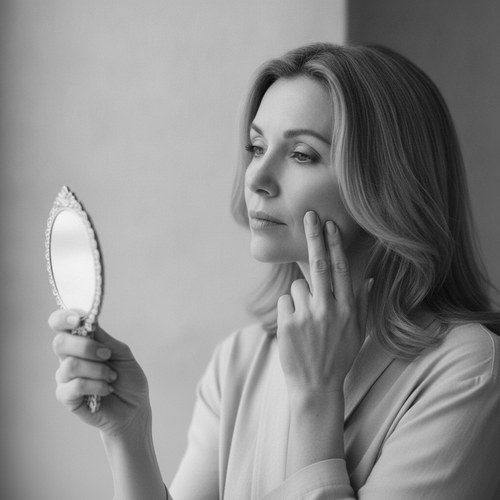
Black and white editorial portrait of a woman in profile in soft side light, jaw and cheek defined. Nonsurgical lifting commentary by Dr. Frank Agullo, MD, FACS.

There is a growing demand for lifting and contouring of the face without surgery. This actually also extends to the breast, body, even the buttocks. I think the growing demand has accelerated due to GLP-1 treatments, where patients undergo rapid weight loss and the appearance of aging shows up much more accelerated. There is also a tendency for maintenance early on, in order to avoid bigger procedures later.

I want to lay out where I think these technologies actually earn their place, and where the field is quietly moving on.

Start With What Aging Actually Is

As we know, aging is a combination of two things: skin laxity and volume loss. In weight loss patients, the skin has already been stretched out. The volume loss shows up as aging. Added to that, the skin that had previously been stretched out is now sagging, so the aging shows up much, much faster than in regular patients.

That is why the GLP-1 patient is changing how this conversation goes. The clock runs faster on them, and the early-maintenance mindset has become the norm rather than the exception.

The Volume Tools, Old and New

We’ve been using fillers underneath the eyes and the temples for quite a long time. The newer volume replacement materials include Sculptra, which is a biostimulator. After it is injected, the body tries to absorb the material and thus produces collagen.

The more exciting category is biostimulating and regenerative. PRP, protein-rich plasma, and PDGF, the platelet-derived growth factor. PDGF has not been cleared for injection, although some practitioners are using it off-label, but it is a great adjunct to any procedure that performs microneedling or resurfacing. It regenerates the tissues quicker, and with the growth factor we get a younger appearance and more protection of collagen.

Lipoderma is one of the newest available fillers. It is a donor-derived fat graft, which has a framework that allows the ingrowth of your own fat cells. This is a more permanent solution, more natural and more like the actual fat that we have in our face, rather than scar tissue or collagen. Tiger Aesthetics is going to come out next year with a similar product called Derma Clay, for the face and hands. They currently have one called Aloe Clay, which we use in the breast and buttock as a natural donor fat graft filler. That filler is more coarse, so it does not work well on the face.

The Tightening Tools

For skin tightening, the best therapies at the moment are radiofrequency. The use of Morpheus8, which is microneedling with radiofrequency, is one of the most sought-after treatments in our practice. We also use FaceTite in the face, which is a more invasive radiofrequency treatment that treats under the skin and above it, and is usually combined with even liposuction of the neck.

We haven’t seen a lot of new technologies in laser, but the fractionated lasers are still the most used. One has to be careful with skin types, as darker skin types tend to create hyperpigmentation or scarring.

Why I Have Almost Left Thread Lifts Behind

I think thread lifts had a peak in the last two years, but patients have found that they’re really not long-lasting. The threads can behave differently on one side of the face than the other and do create asymmetries. Sometimes these threads are not completely absorbed by the body and can be palpated, or give other problems. We’ve really almost diverged away from thread lifts, and we’ve started to do more minimally invasive surgical procedures instead.

That is the quiet shift in the field worth naming out loud. The threads promised a surgical result without surgery, and they did not deliver it consistently enough to keep.

Set the Expectations Honestly

All these treatments are good in the early stages of aging, or weight-loss-related aging, and they usually give subtle improvements. They can correct specific areas like temporal wasting, hollowness underneath the eyes, or nasolabial lines. The longevity depends on the therapy. Regular fillers can last up to a year. Sculptra tends to last longer, as the collagen generated stays around. The new regenerative treatments, like Lipoderma, or in the future Derma Clay, will be longer-lasting, if not permanent. But aging continues once we set the clock back, even in surgical procedures.

The expectations have to be toned down in nonsurgical procedures and well communicated to the patient. This is true especially with skin tightening using radiofrequency. A lot of the tightening is going to depend on the patient’s own response and cannot be foreseen. Every patient reacts differently and gets different tightening results.

The Test That Sends a Patient to Surgery

Here is my rule of thumb. If the patient is consulting with me and they reach up to their face and pull with their fingers upwards, bringing their brows and cheeks and jowls up, or even tightening their neck back, that’s a sign the patient needs a surgical procedure and not a noninvasive one.

The deep plane lift and the endoscopic deep plane lift are great procedures, which create very natural and long-lasting results. We’re seeing patients completely avoid the noninvasive procedures and go straight to the surgical procedures early on. I trained the deep plane facelift the long way, through the Ponytail Academy intermediate course in Pittsburgh and the advanced course in Santa Monica, after a Mayo Clinic fellowship. The patients who skip straight to it are usually the ones who already did the mirror test on themselves.

The Credential Behind the Opinion

Double board-certified by the American Board of Plastic Surgery and the American Board of Surgery, American College of Surgeons Fellow, Mayo Clinic plastic surgery fellowship, Clinical Associate Professor of Plastic Surgery at Texas Tech University Health Sciences Center Paul L. Foster School of Medicine, and Castle Connolly Top Doctor for thirteen consecutive years. I do both the injectables and the surgery, which is exactly why I can tell you when the injectable is the wrong answer.

Ready to Talk?

If you want the honest read on which side of the line your face is on, that is a consultation, not a sales pitch.

For the patient-facing clinical guide and the mirror test in detail, see the companion post on agulloplasticsurgery.com. For the MedSpa-to-surgery continuum, see the version on swplasticsurgery.com.

Call (915) 590-7900, text 1-866-814-0038, or book online at agulloplasticsurgery.com. #StayBeautiful.

@RealDrWorldWide on Instagram, TikTok, and Snapchat, @Agullo on X, or @AgulloPlasticSurgery on Facebook.

The Field Is Diverging From Thread Lifts: A Surgeon’s Read on Nonsurgical Lifting in 2026

Black and white editorial portrait of a woman in profile in soft side light, jaw and cheek defined. Nonsurgical lifting commentary by Dr. Frank Agullo, MD, FACS.

There is a growing demand for lifting and contouring of the face without surgery. This actually also extends to the breast, body, even the buttocks. I think the growing demand has accelerated due to GLP-1 treatments, where patients undergo rapid weight loss and the appearance of aging shows up much more accelerated. There is also a tendency for maintenance early on, in order to avoid bigger procedures later.

I want to lay out where I think these technologies actually earn their place, and where the field is quietly moving on.

Start With What Aging Actually Is

As we know, aging is a combination of two things: skin laxity and volume loss. In weight loss patients, the skin has already been stretched out. The volume loss shows up as aging. Added to that, the skin that had previously been stretched out is now sagging, so the aging shows up much, much faster than in regular patients.

That is why the GLP-1 patient is changing how this conversation goes. The clock runs faster on them, and the early-maintenance mindset has become the norm rather than the exception.

The Volume Tools, Old and New

We’ve been using fillers underneath the eyes and the temples for quite a long time. The newer volume replacement materials include Sculptra, which is a biostimulator. After it is injected, the body tries to absorb the material and thus produces collagen.

The more exciting category is biostimulating and regenerative. PRP, protein-rich plasma, and PDGF, the platelet-derived growth factor. PDGF has not been cleared for injection, although some practitioners are using it off-label, but it is a great adjunct to any procedure that performs microneedling or resurfacing. It regenerates the tissues quicker, and with the growth factor we get a younger appearance and more protection of collagen.

Lipoderma is one of the newest available fillers. It is a donor-derived fat graft, which has a framework that allows the ingrowth of your own fat cells. This is a more permanent solution, more natural and more like the actual fat that we have in our face, rather than scar tissue or collagen. Tiger Aesthetics is going to come out next year with a similar product called Derma Clay, for the face and hands. They currently have one called Aloe Clay, which we use in the breast and buttock as a natural donor fat graft filler. That filler is more coarse, so it does not work well on the face.

The Tightening Tools

For skin tightening, the best therapies at the moment are radiofrequency. The use of Morpheus8, which is microneedling with radiofrequency, is one of the most sought-after treatments in our practice. We also use FaceTite in the face, which is a more invasive radiofrequency treatment that treats under the skin and above it, and is usually combined with even liposuction of the neck.

We haven’t seen a lot of new technologies in laser, but the fractionated lasers are still the most used. One has to be careful with skin types, as darker skin types tend to create hyperpigmentation or scarring.

Why I Have Almost Left Thread Lifts Behind

I think thread lifts had a peak in the last two years, but patients have found that they’re really not long-lasting. The threads can behave differently on one side of the face than the other and do create asymmetries. Sometimes these threads are not completely absorbed by the body and can be palpated, or give other problems. We’ve really almost diverged away from thread lifts, and we’ve started to do more minimally invasive surgical procedures instead.

That is the quiet shift in the field worth naming out loud. The threads promised a surgical result without surgery, and they did not deliver it consistently enough to keep.

Set the Expectations Honestly

All these treatments are good in the early stages of aging, or weight-loss-related aging, and they usually give subtle improvements. They can correct specific areas like temporal wasting, hollowness underneath the eyes, or nasolabial lines. The longevity depends on the therapy. Regular fillers can last up to a year. Sculptra tends to last longer, as the collagen generated stays around. The new regenerative treatments, like Lipoderma, or in the future Derma Clay, will be longer-lasting, if not permanent. But aging continues once we set the clock back, even in surgical procedures.

The expectations have to be toned down in nonsurgical procedures and well communicated to the patient. This is true especially with skin tightening using radiofrequency. A lot of the tightening is going to depend on the patient’s own response and cannot be foreseen. Every patient reacts differently and gets different tightening results.

The Test That Sends a Patient to Surgery

Here is my rule of thumb. If the patient is consulting with me and they reach up to their face and pull with their fingers upwards, bringing their brows and cheeks and jowls up, or even tightening their neck back, that’s a sign the patient needs a surgical procedure and not a noninvasive one.

The deep plane lift and the endoscopic deep plane lift are great procedures, which create very natural and long-lasting results. We’re seeing patients completely avoid the noninvasive procedures and go straight to the surgical procedures early on. I trained the deep plane facelift the long way, through the Ponytail Academy intermediate course in Pittsburgh and the advanced course in Santa Monica, after a Mayo Clinic fellowship. The patients who skip straight to it are usually the ones who already did the mirror test on themselves.

The Credential Behind the Opinion

Double board-certified by the American Board of Plastic Surgery and the American Board of Surgery, American College of Surgeons Fellow, Mayo Clinic plastic surgery fellowship, Clinical Associate Professor of Plastic Surgery at Texas Tech University Health Sciences Center Paul L. Foster School of Medicine, and Castle Connolly Top Doctor for thirteen consecutive years. I do both the injectables and the surgery, which is exactly why I can tell you when the injectable is the wrong answer.

Ready to Talk?

If you want the honest read on which side of the line your face is on, that is a consultation, not a sales pitch.

For the patient-facing clinical guide and the mirror test in detail, see the companion post on agulloplasticsurgery.com. For the MedSpa-to-surgery continuum, see the version on swplasticsurgery.com.

Call (915) 590-7900, text 1-866-814-0038, or book online at agulloplasticsurgery.com. #StayBeautiful.

@RealDrWorldWide on Instagram, TikTok, and Snapchat, @Agullo on X, or @AgulloPlasticSurgery on Facebook.

Collagen Season: The June Med Spa Specials I’d Actually Book

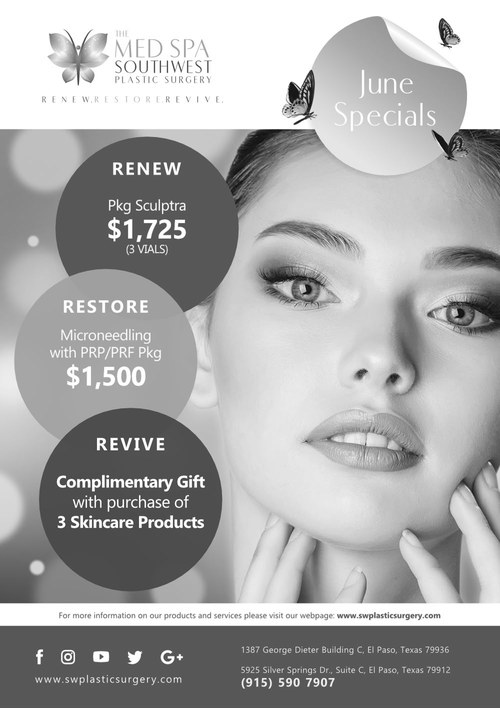
June Med Spa Specials flyer at The Med Spa at Southwest Plastic Surgery East and West, El Paso Texas, supervised by Frank Agullo, MD, FACS, double board-certified plastic surgeon

Collagen Season: The June Med Spa Specials I’d Actually Book

Here is something nobody at a med spa will tell you in June. This is the worst month of the year for your face.

The sun is brutal right now. The pool is open. Half of El Paso is outside between ten and four, which is the exact thing that ages skin faster than any birthday. And what does the wellness world sell you in response? A glow facial for the wedding next weekend.

I want to argue for the opposite. Skip the quick fix. June is when you start the slow stuff, the treatments that compound across the summer, so the face you have in September is better than the one you have right now. I think of it as collagen season.

Three things are on our June board. These are the three I would book if it were my money and my face. Here is the honest version of each, the read you would get if you were sitting across the desk from me.

Renew. The Sculptra package, three vials, $1,725.

I have written before that fillers are a tax. I stand by it. So it should mean something that the first special on this list is, in my opinion, the best non-surgical money on the board, and it is not a filler.

Sculptra is a collagen biostimulator. The active ingredient is poly-L-lactic acid, and it does not work the way a hyaluronic acid syringe works. A traditional filler sits under your skin and takes up space on day one. You leave the office full. Sculptra does almost nothing visible on day one. It triggers your own body to lay down new collagen over the following weeks and months, and the result builds slowly, from your own tissue, on your own scaffolding.

That difference is the entire point.

A filler is a thing in your face. Sculptra is your face making more of itself. One of them you have to keep buying to maintain. The other one is, in the most literal sense, an investment in your own collagen.

Why three vials, and why as a package. Sculptra is a series. You spread the vials across a couple of sessions, a few weeks apart, and the collagen builds in layers. The package at $1,725 just locks you into finishing the protocol at a better price. The most common way I see people waste money on this product is paying vial by vial and quitting after the first one, before their own collagen has done much of anything.

Two honest cautions.

One. This is slow. If you want to look different for an event in two weeks, Sculptra is the wrong tool and I will tell you so. The payoff shows up around the eight to twelve week mark and keeps improving after that. Start in June, peak in fall. That is the trade.

Two. Technique is everything with this product. Sculptra has to be reconstituted correctly, given time to sit, and injected in the right plane by someone who understands biostimulators, or you get nodules instead of a result. That is exactly why the package runs under my supervision and not at a strip-mall injectables bar.

Restore. Microneedling with PRP/PRF, $1,500.

If you have read this blog for any length of time, you know I once wrote a post about vampire facials. It is still one of the most-read things I have ever published, and the science behind it is the second special on the June board.

Microneedling with PRP/PRF is the grown-up version of that treatment.

Here is the mechanism, in plain English. We draw a small amount of your blood and spin it down to concentrate the platelets and the growth factors they carry. That is the PRP, platelet-rich plasma, or PRF, platelet-rich fibrin, which is the newer preparation that releases those growth factors more slowly and over a longer window. Then we use a microneedling device to create thousands of microscopic channels in the skin, and we drive your own concentrated growth factors down into them.

The needling alone triggers a wound-healing and collagen response. The growth factors pour fuel on that response. The result, over a series, is better texture, smaller-looking pores, softened fine lines, and the kind of glow that is actually new collagen and not just a temporary flush.

What I like about this one for June specifically. It is your own biology, so there is nothing foreign going in. It pairs beautifully with the Sculptra patient who wants surface quality and deep collagen working at the same time. And the $1,500 package price is built around a series, because one session is a nice afternoon and a series is what actually changes the skin.

One rule I will not bend on, and June makes me say it twice. Stay out of the sun. Freshly needled skin that hits the pool the next afternoon is begging for a pigment problem, and an El Paso summer punishes that mistake harder than almost anywhere else in the country. Sunscreen and shade between sessions. Every time.

Revive. A complimentary gift with the purchase of three skincare products.

This is the quiet one on the board and the one I most want patients to actually take.

The deal is simple. Buy three medical-grade skincare products and the gift comes with it. No drama. But the reason I am putting my name behind a skincare promotion at all is that skincare is the foundation under everything else on this list, and it is the part patients skip.

You can biostimulate collagen with Sculptra and resurface with microneedling, and then undo a good chunk of it by washing your face with whatever was on sale and skipping sunscreen. Medical-grade skincare is not the drugstore product with a nicer label and a worse price. It is higher actual concentrations of the ingredients that do the work, a real retinoid, a real vitamin C, a real medical sunscreen, formulated to get through the skin barrier instead of sitting on top of it.

Three products, chosen for your skin, used every day, is the cheapest anti-aging on this entire page. The gift is just the nudge to finally build the routine.

A clean comparison

Special What it is Investment Best for
Renew Sculptra collagen biostimulator $1,725 (3 vials) Building your own collagen over the summer, the long game, not a quick fix
Restore Microneedling with PRP/PRF $1,500 Texture, pores, fine lines, and a real glow from your own growth factors
Revive Gift with 3 skincare products Complimentary gift Committing to the daily medical-grade routine that protects all of it

Where to come, East or West

The Med Spa at Southwest Plastic Surgery runs out of two El Paso locations, and the June specials are valid at both.

The Eastside office is at 1387 George Dieter Drive, Building C, El Paso, Texas 79936.

The Westside office is at 5925 Silver Springs Drive, Suite C, El Paso, Texas 79912.

You can book at either. My Med Spa team works across both sites, the protocols are the same, and you should pick the side of town that fits your week. If you want to see the full menu, the Med Spa page and the microneedling page on our practice site are the place to start.

A note on who is doing the work

When you walk into my Med Spa, you should know whose name is on the room. Mine. I trained in plastic surgery at Mayo Clinic, I am double board-certified, I teach the residents at Texas Tech as a Clinical Associate Professor, and Castle Connolly has named me a Top Doctor thirteen years running. None of that is decoration. The Med Spa is the non-surgical half of my surgical practice, and I write the protocols myself.

That is the only reason I will attach my name to a Sculptra package or a vial of your own platelets. If the standard slips, I do not put my name on it.

Ready to talk?

Call our Med Spa at (915) 590-7907 to book any of the June specials at the Eastside (1387 George Dieter Building C) or Westside (5925 Silver Springs Suite C) office. For surgical or combined consults, call my main office at (915) 590-7900, text 1-866-814-0038, or book online at agulloplasticsurgery.com/appointments. Follow me at @RealDrWorldWide on Instagram, TikTok, and Snapchat, @Agullo on X, or @AgulloPlasticSurgery on Facebook. #StayBeautiful