He Broke It With a Baseball: A Septorhinoplasty Consult, Nearly Verbatim

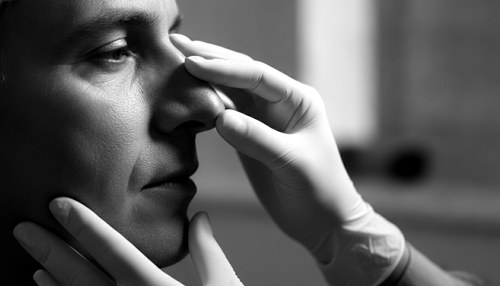
Black and white editorial photograph for septorhinoplasty commentary by Dr. Frank Agullo, MD, FACS.

He had never had surgery. He exercised four times a week. He was not on any medication. The only thing wrong with him was a nose that had been crooked since a baseball hit it when he was a kid.

I am publishing this consult nearly as it happened, identifiers removed, because the questions men ask about their nose almost never get answered out loud.

Him: I broke it when I was young. It was a baseball. But ever since that, I’ve had complications and I know I have trauma inside. You can tell it’s kind of deviated. So I wanted to get that corrected. But if I’m going to do that, I might as well get the exterior as well.

Me: “Do you have problems breathing?”

Him: Yes. I get congestion right away. But I’ve lived like this for a long time, so it’s kind of normal for me. I do notice that I get congested a lot if I start doing exercise.

Me: “And what would you want to change about the way it looks?”

Him: Pretty much, I want to straighten it out. And I noticed that the tip is a little bit down. And I know the bridge here is kind of low. I don’t like that look, it’s too low for me.

He had already been to someone else

Him: I had an appointment with somebody else. The way they wanted to make my nose was too small for my face.

He had gone home, downloaded an app, and made his own version.

Him: I actually liked it more.

He was right. I said it out loud: “It doesn’t balance.”

What I found on exam

Me: “Your nasal base is a little bit wide. So we do bring these bones in, and that helps me straighten everything out. So they probably healed a little bit off. I’m going to look inside just to check your septum too.”

Me: “Your nose looks really irritated. I feel like you have a lot of allergies. And then your septum is going this way. So there’s a lot less space on this right side, and the left side is very open.”

Me: “So we’ll straighten that out. The breathing should improve, but it’s not going to change the congestion when it gets congested or there are allergies. Really, we can’t do much about that, but we can make it structurally more open.”

The tip, and why it barely moves

Him: Doctor, I don’t want my nostrils to be too…

Me: “No, we’re just going up a little bit, so really we shouldn’t change the nostrils at all.”

Me: “It’s just the tip a little bit, because on men we still like a right angle here. We don’t want to make it bigger than that, that’s more feminine.”

Him: So by lifting it, it won’t make it more round or anything?

Me: “No, it’s just going to rotate it up a tiny bit. We’re talking about like two millimeters.”

Him: And the tip of the nose, is it going to be kind of rounded?

Me: “Do you want to change that?”

Him: No.

So we left it.

Where the cartilage comes from

Me: “For this, I have to put in cartilage to fill that in, so it’s permanent and you don’t have to be adding anything else later. So first I’ll use the cartilage that’s in your septum. If it’s not enough, then we do have donor cartilage that we can use. It’s irradiated, doesn’t have any cells, but it saves me and you from having to get any from your ear or your rib, which can be more painful. So this makes it a lot easier, because the rib hurts a lot. And the ear can be uncomfortable too, and sometimes it can make it look funny too.”

The turbinates question

Him: Inside we have the ones that filter the air, the turbinates. Are those going to be reduced?

Me: “So they don’t look big, but on this right side, usually when your septum is deviated, the open side gets bigger, but in your case it’s not that big. So if anything, when I’m in there, if I see that they’re a little bit big, what I do is I fracture them and that makes them shrink a little bit. But I don’t think you need to get mucosa removed or anything like that.”

The scar

Him: The incision right here, am I going to have a visible scar?

Me: “You’re going to have a scar, but it’s going to be very hard to see. Usually it heals in a way that nobody sees it, and you’ll have to look at it in a mirror like this to see it.”

Recovery, in his words and mine

Me: “So it’s an open rhinoplasty. We’ll get everything centered, and the surgery takes about two, two and a half hours. It’s general anesthesia, you go home the same day. I do have to put splints on the outside and on the inside, so it might be a little stuffy for about seven days, then we’ll remove everything. At that point, your breathing should be better.”

Me: “You’ll see the changes in the nose, but it’s still going to be a little swollen. So it’s probably going to take a couple of weeks to start looking better and better. And then about six weeks, we’re pretty close to what it’s going to look like, but the nose itself takes about a whole year for it to keep getting better and better.”

Me: “But the good thing is that there’s no pain after surgery, so it’s a relatively easy recovery. We do have to wait about six weeks before going back to exercise. And going back to normal activity, you’ll feel fine after about three days. It’s just a matter of whether you want people seeing you with the splint or not.”

Me: “If you get any bruising, sometimes you get bruising, I would say only twenty percent of our patients get any bruising underneath the eyes, it can take two weeks to go away, and you can always put a little makeup on if you want to hide it.”

The last thing I told him

Me: “In the beginning, it may look a little extra. Because some of that gets reabsorbed, so we have to plan on it, on how it’s going to come down a little bit.”

He asked me to follow his own simulation during the surgery. I told him I would save it and reference it in the OR. That is not a concession. A patient who can show me what he wants has already done half of my planning for me.

My exam note from that afternoon: sunken and relaxed dorsum, deviation to the left with a subtle deviation to the right, previous trauma, slight downward tip rotation. Plan: rotate the tip up about two millimeters, shave the hump, add a graft for the radix, straighten the nose.

The takeaway

An old broken nose is a structural problem before it is a cosmetic one. The septum and the outside are the same operation. The tip on a man moves two millimeters, not ten. And the version of your nose that looks right is almost never the smallest one on offer.

I am a double board-certified plastic surgeon, certified by both the American Board of Plastic Surgery and the American Board of Surgery, a Mayo Clinic fellowship alum, and I teach plastic surgery as a Clinical Associate Professor at Texas Tech University Health Sciences Center.

Ready to Talk?

If you have been breathing through one side of your nose since middle school, you do not have to keep doing it. Call the office at (915) 590-7900, text us at 1-866-814-0038, or book a consultation at drworldwide.com.

#StayBeautiful

@RealDrWorldWide on Instagram, TikTok, and Snapchat, @Agullo on X, or @AgulloPlasticSurgery on Facebook.


The Page Nobody Reads in the Plastic Surgery Statistics

Black and white editorial collage, cut-out portraits with torn paper edges and engraved botanicals.

There is a ritual to this. My specialty publishes its annual numbers, two hundred outlets publish the top five list, and everyone moves on by Thursday.

Liposuction won. It has won five years running. It actually declined 1 percent and still won by a mile.

Now turn to page 26, where the country gets split into regions. On five procedures, my eight-state region went the opposite way from the national number. The one I want to talk about is the nose.

Rhinoplasty fell 5 percent nationally. Here it rose 16.

“This does match what I see. I’ve seen an increase in surgical rhinoplasty procedures in both men and women. In many places, people are turning to injectable fillers for a liquid rhinoplasty, or non-surgical nose job. But many patients have noticed that when this is done, the nose actually becomes bigger, because filler is volume.”

“We’re adding volume to hide the dorsal hump and maybe push the tip up. But with time, the filler flattens out and migrates to the sides, making the nose look wider and the tip more bulbous.”

You are solving a shape complaint with volume, and volume does not stay where you put it.

“For a real reduction, surgical rhinoplasty reshapes the structure of the nose and reduces its size, removing the dorsal hump, refining the tip, and even narrowing the nose, and it can also remove old filler. A surgical rhinoplasty is a permanent procedure.”

Why the top five is a boring list

Four of the five barely moved. The only real mover is eyelid surgery, up 19 percent.

“These are the usual procedures that made the top five, and they really didn’t move much during 2025. I could see that during 2025 there was a bit of a slowdown in plastic surgery procedures, and I think that was due to changes in the economy. But we’re seeing an increase in 2026.”

“Eyelid surgery did blow up a lot, and it’s also a procedure we’ve performed increasingly over the last two years. It seems to be the first part of the face that patients notice as they age, especially the upper eyelid skin, which can hang and even rest on the eyelashes, giving the patient the impression of being tired and even making makeup hard to put on.”

An economic read, not an aesthetic one. That is not in the report either.

What I am actually seeing

“In my practice, I’ve really seen a huge increase in face procedures, specifically the deep plane face lift and deep plane neck lift, as well as the total endoscopic deep plane face lift, otherwise known as the ponytail lift. These face lifts are often combined with facial fat grafting, upper and lower eyelid surgery, microneedling with radiofrequency or laser resurfacing, sometimes an upper lip lift, fat transfer to the lips, and earlobe reduction.”

“The reason we’re seeing this increase exponentially is that patients are noticing signs of facial aging earlier, or they’ve been on GLP-1s and have had accelerated aging from fat loss in the face and skin sagging.”

“The most interesting thing about a face lift procedure is that it can make you look ten to fifteen years younger. Of course, that depends on the age at which you get the procedure. If you get it at forty, you’re probably going to look like you’re in your early thirties, or even late twenties. But time keeps moving forward, so if we repeat the procedure ten years later, we take you back to that earlier stage of yourself. Now you’re in your fifties, looking like you’re in your thirties.”

The honest caveats

Region 4 is eight states, so I cannot tell you what El Paso did. Nobody publishes that.

These count only board-certified plastic surgeons. For the procedures growing fastest, the uncounted volume is the part worth worrying about.

I have written the full regional breakdown, including the one figure in the report I refuse to quote until ASPS explains it.

Ready to talk?

Call (915) 590-7900, text 1-866-814-0038, or book at drworldwide.com.

Follow along @RealDrWorldWide on Instagram, TikTok, and Snapchat, @Agullo on X, or @AgulloPlasticSurgery on Facebook.

#StayBeautiful


Source: ASPS 2025 Procedural Statistics Report. Commentary from Dr. Agullo’s 2026-09-07 dictation.

What Your Nose Is Telling You After Rhinoplasty: The Drip, the Healing Mucosa, and the One Pattern That Sends You Back to the Operating Room

What Your Nose Is Telling You After Rhinoplasty: The Drip, the Healing Mucosa, and the One Pattern That Sends You Back to the Operating Room. Dr. Frank Agullo, MD, FACS, double board-certified plastic surgeon at Southwest Plastic Surgery in El Paso, Texas.

A national reporter called me last week about a TikTok. A young woman with a fresh rhinoplasty had filmed herself bending over a bathroom counter and watching a clear stream of fluid run out of her nose, captioning it for her followers as if her surgeon had ruined her face. The reaction in the comments was the kind of internet pile-on that travels in a single afternoon. The reporter wanted a surgeon to put the whole panic into perspective. So I did.

What got left on the cutting-room floor, as always, was the longer answer. The answer worth writing for a different audience. The clear drip a patient sees in her bathroom mirror two weeks after rhinoplasty is the most common phone call my office takes about that operation. It is also one of the least talked-about parts of the whole experience. So let me write the longer answer here, where the audience does not need it stripped down to forty-five words for a celebrity sidebar.

The Mucosa Is Half the Operation Nobody Discusses

When we discuss rhinoplasty at a consultation, we discuss the dorsum, the tip, the radix, the alar base, the columella, the deviated septum, the internal valve, the angles, the projection, the rotation. We discuss whether the operation will be preservation, structural, or hybrid. We discuss whether we are addressing function or aesthetics or both. We do not, as a field, spend nearly enough time discussing the inside of the nose, which is the part the patient actually lives with in the first six weeks.

The inside of the nose is lined with a single sheet of pink, ciliated, highly vascular mucosa. It is the same tissue that handles a head cold, a cedar bloom, a perfume that gets too close, and the dust on a hotel pillow. In the unoperated state, it produces and clears about a quart of mucus a day, and you have never thought about it because the cilia move that mucus backward into the throat in coordinated waves and you swallow it without ever paying attention.

A rhinoplasty disturbs the mucosa twice. Once, mechanically, because the operation lives just under it. And again, biochemically, because every surgical wound recruits inflammatory mediators that increase vascular permeability and decrease ciliary beat frequency in patches.

The result is predictable. The lining swells. It leaks. The conveyor belt slows. And the fluid that the body still produces, but can no longer move backward, runs forward. Out the front. Down the lip. Into the tissue in the patient’s hand.

That is the drip. It is not a complication. It is biology.

The Timeline That Settles Most of the Anxiety

Here is what I tell every rhinoplasty patient before they go home from surgery. The first three days, expect a small amount of pink-tinged drainage. The first two weeks, expect a near-constant clear drip, worse when you bend forward or lie down. Weeks three and four, the drip should be intermittent. Weeks five and six, mostly dry. By month three at the outside, the inside of your nose should feel like the inside of a normal nose again, even though the deeper structural healing of the operation continues for a full year.

A meaningful minority of patients stretch the dripping phase out longer than six weeks. Allergy sufferers, smokers, people who live in dusty or smoky environments, and patients who had significant pre-existing congestion will tell me the drip lingers into month two or month three. None of that is a complication. It is the mucosa healing on its own clock.

If a patient is on schedule, the calls I get are reassurance calls. The drip is annoying, the bedroom needs a humidifier, the bedside tissue box needs a backup, and they want me to confirm that what they are seeing is what I described at the consult. The answer is almost always yes, and the conversation ends in two minutes.

What the Patient Should Be Doing at Home

The self-care list is short and the priorities are correct.

Sleep with the head of the bed elevated. Use a wedge, a recliner, or stacked pillows. Gravity is doing as much of the work as the cilia in the first two weeks, and lying flat sends fluid pooling backward into an airway that is not ready to handle it.

Avoid irritants. Cigarette smoke, vaping, perfume, smoke from a fireplace, dusty workspaces, harsh cleaning solvents. Treat allergens the way you would treat irritants if you have a seasonal flare overlapping the recovery window.

Layer in a standard non-sedating antihistamine for a couple of weeks if the drip is dominating the day. It is not a prescription. It is a reasonable over-the-counter habit during the wet phase of recovery.

Hydrate. Humidify the bedroom. Dry indoor air thickens mucus, and thicker mucus moves slower and irritates more.

Resist the impulse to blow hard. Hard nose-blowing in the first two weeks can pop an internal suture or restart a small bleed. Sniff gently, dab, swallow when you can, and save the deep blow for week three.

That is the entire home program for ninety percent of rhinoplasty patients. The remaining ten percent will benefit from a saline rinse, a low-dose nasal steroid, or in the rare case an antibiotic, and those calls belong in the follow-up visit, not on a self-prescribed grocery run.

The Four Red Flags I Want Every Patient to Memorize

Most calls to my office about post-rhinoplasty drainage are reassurance calls. A small number are not. The pattern recognition is straightforward, and every patient should leave the operating room with these four in mind.

Bright red bleeding that does not stop with pressure and head elevation. A few drops of pink-tinged drainage in the first three days is expected. A steady stream of frank red blood that fills more than one tissue, or a single large clot, is not. That is a same-day phone call while it is happening.

Foul-smelling drainage, especially yellow or green. The healthy nasal mucosa is essentially odorless. A bad smell coming from inside the nose is a sign of bacterial activity. Combined with new pain, focal redness, or new swelling, it is enough to bring the patient back to the office that day.

Fever above 100.4 F, increased pain, redness, or swelling. The body has a clean way of telling you that an infection is taking hold. The number is 100.4. Above that, with any of the above, the patient calls.

Persistent unilateral clear watery drainage with a headache that worsens when leaning forward. This is the one almost no surgeon includes in the post-op handout because the underlying problem, a cerebrospinal fluid leak, is rare after a cosmetic rhinoplasty. It is not zero. The pattern is specific and worth memorizing. If a patient describes that exact triad on the phone, the answer is not to wait for a scheduled visit. The answer is an urgent evaluation, typically with imaging, the same day. That call earns a faster response than any other.

Where the Field Has Landed in 2026

Two trends in modern rhinoplasty are quietly making the drip phase shorter and the recovery cleaner. The first is the broader adoption of preservation-based principles, which leaves more of the native mucoperiosteum and mucoperichondrium intact and reduces the surface area of disturbed lining. The second is more disciplined intraoperative management of the soft tissue envelope and the internal valve, which lowers the inflammatory burden on the mucosa and shortens the ciliary recovery curve.

Neither of those trends eliminates the drip. They compress it. A well-planned and well-executed rhinoplasty in 2026 is dripping less, healing faster, and looking more natural at one year than the same operation did fifteen years ago, and the recovery handout my patients leave with reflects that.

How I Talk About It at the Consult

When a patient sits across from me to discuss a rhinoplasty, we map the operation on the outside and the inside of the nose at the same time. We discuss the planned shape of the bridge and the planned shape of the internal valve. We discuss the recovery in two halves. The visible half, where the bruising fades from purple to yellow to ivory over three weeks, and the invisible half, where the mucosa heals on its own clock and the drip settles over four to six.

We discuss the four red flags and they go into the patient’s notes app before she leaves the room. We discuss the antihistamine, the humidifier, and the wedge pillow. We discuss the difference between annoying-but-normal and call-me-right-now. And we discuss the fact that almost every question that arises in the first six weeks will land in the annoying-but-normal column.

That is the conversation that should have happened with the young woman whose TikTok went viral. It is the conversation we have in my office every week. And it is the conversation I would rather have a thousand times in advance than have to repair a panic that bought a brand-new lifelong distrust of plastic surgery.

Ready to Talk?

If you are weighing a rhinoplasty, the first conversation is a consultation. We will plan the operation and the recovery at the same time. If you are already recovering from one done elsewhere and the drip is making you nervous, we can see you, look inside the nose, and tell you whether what is happening is on the expected curve or off it.

For the patient-facing clinical version of this conversation, see Why Your Nose Drips After Rhinoplasty on agulloplasticsurgery.com. For the practice-program version that lays out the in-office recovery support, see Rhinoplasty Recovery at Southwest Plastic Surgery.

Call (915) 590-7900, text 1-866-814-0038, or book online at agulloplasticsurgery.com. #StayBeautiful.

@RealDrWorldWide on Instagram, TikTok, and Snapchat, @Agullo on X, or @AgulloPlasticSurgery on Facebook.