Hair consultations are different from the rest of my practice. Nobody walks in with a wish photo of a celebrity. They bring a photo of themselves, from a few years ago, and they want that hairline back without anyone knowing.
A patient came in recently, 37, never had any treatment before. He brought a picture of his own face. I am publishing the exchange nearly as it happened, identifiers removed, because these are the same questions I get every time.
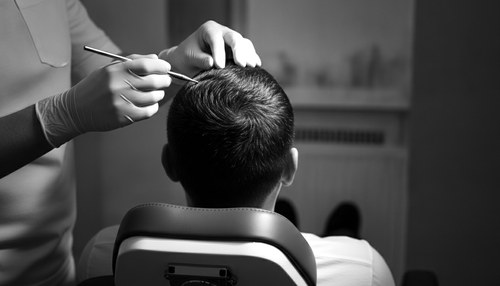
My exam note from that day: bilateral temporal recession points with loss of hairline definition. Plan would be to graft these two areas with as many follicles as possible. 2,500 to 3,000 follicles and may need a repeat procedure.
Me: “Okay, so I do see that you have the temporal recession areas on both sides, and the front is also thinning out a little bit. And I got your wish picture, which creates a very tight straight hairline. So there is a lot of area we have to fill in to create that. But it is definitely doable. It looks like you have good donor hair.
“So there’s two ways of doing it. Are you familiar with the strip and the FUE?”
Him: No, I kind of read it a little bit. Any recommendation of which one would be better?
Me: “Sure. I see that on the back you like to wear it short.”
Him: Yeah, usually from the sides it can’t be that long. Usually I had it like kind of a high fade.
Strip Versus FUE
Me: “Right. So when people wear the hair short on the back, that’s where we get the hair from. So those are the follicles that we use to fill in the front. So one way to take them from the back is doing the FUE, which is the one by one, the neograft. We take them one by one, it heals in, and you don’t see any scars. The other one is doing a strip where I actually cut like a sliver of hair follicles or scalp, but it does leave a scar. So if you wear your hair short, you would see that long scar.
“So in your case, probably the best is gonna be the FUE, which is the one by one, so you don’t have any scars, and we transfer those from the back and we put them in the front one by one, so it looks very natural. I have a hair transplant, so it really looks very natural, and of course, you can do everything normal afterwards, so you can do sports, swimming, you can dye your hair, everything’s back to normal.”
Him: For the haircut you gotta be like a little bit meticulous with that area?
Me: “No, after everything’s healed, everything’s back to normal. There’s zero special care.”
Follicle Count and the Day Itself
Me: “The main thing here is filling in that area. It’s a pretty big area. With the FUE, we can do maximum twenty-five hundred, sometimes twenty-eight hundred follicles. The procedure takes about six to eight hours. We give you a little bit of sedation through an IV so you’ll be comfortable, you’ll sleep through most of it. And then you need about a week for everything to heal and set in.
“After a week, you’re back to normal. You can do normal activity, exercise, running, jumping, swimming, everything back to normal. For this procedure, we do have to shave the hair down all the way to be able to get the hairs one by one. We could spare the top, we could do just the sides if you want to keep the top, or we do the whole thing, whichever is better for you.”
Why Your Hair Type Matters
Me: “So the idea is obviously to fill in as much as we can and get the tightest hairline possible. It is possible you may need another treatment later to make it even fuller, more dense. I think with the first treatment we can get pretty close to what you want, but we may need to add density later. Your hair is good because it’s coarse and it’s a little bit curly, so that covers a lot more than fine hair. So I think we’re gonna get a really nice result for you.”
Timing Around Travel
Him: Does it matter whether I do it before or after?
Me: “No, it really doesn’t matter, it just depends on your timing. You gotta keep in mind your haircut, but the hair grows really quick so you really just need a week where you’re here, and that’s all you need, whether it’s before or after, whichever works better for you, and my coordinator can help you find the right dates.”
The Timeline Nobody Wants to Hear
Me: “Yeah, we can do it after, no problem, as well. There’s no rush. Remember the hair does take four to six months to start growing. So at six months we’re only like fifty percent of the results. At a full year, year and a half is when we have a hundred percent of all the hairs are growing. The graft take is very high, usually ninety-nine percent. We do use PRP, which means we draw a little bit of your blood and get the platelets, and we inject that into the area so that the hairs grow faster with the growth factors, and we get that really high take.”
Him: I was actually completely bald, so for me, it made a huge difference to have hair again.
Me: “Exactly. Psychologically, it really gives you more self-esteem and you feel better. So it is a procedure I highly recommend. There’s really no pain afterwards, it’s easy recovery. You may get a little swollen around your eyes for two or three days but it is, I think, one of the ones where everybody’s happy.”
The takeaway
FUE if you wear your hair short, because there is no line to hide. Twenty-five hundred to twenty-eight hundred follicles in one session, six to eight hours under IV sedation, one week local. Then wait. Four to six months before anything grows, fifty percent at six months, the full result at a year to a year and a half. That last part is the whole job of the consult.
I am a double board-certified plastic surgeon, a Mayo Clinic fellowship alum, and I teach plastic surgery as a Clinical Associate Professor at Texas Tech University Health Sciences Center.
Ready to Talk?
If your hairline has been bothering you and you want a straight answer about what FUE can and cannot do, let’s talk. Call the office at (915) 590-7900, text us at 1-866-814-0038, or book a consultation at drworldwide.com.
#StayBeautiful
@RealDrWorldWide on Instagram, TikTok, and Snapchat, @Agullo on X, or @AgulloPlasticSurgery on Facebook.