“For Research Purposes Only”: The Four Words on a Peptide Vial That Protect Everyone but You

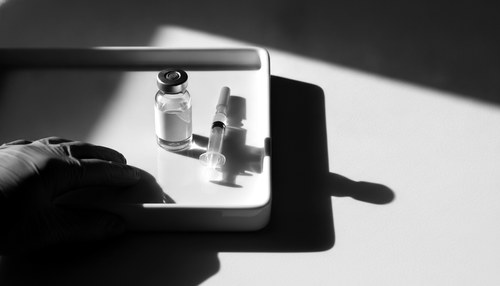
Black and white photograph of a gloved hand beside a small unlabeled glass vial and a capped syringe on a bare tray under hard side light, deep shadow around them, no needle exposed, no face. Illustrative image, not a patient. Commentary by Frank Agullo, MD, FACS.

MDLinx asked me what happens when do-it-yourself peptide injections land patients in a clinic. I told them what I tell the patient: show me the vial.

“Most patients have never been told that ‘compounded’ and ‘FDA-approved’ are different things, and once they see that the label makes no claim about what is actually inside, the conversation changes.”

What are people injecting?

“The most common peptides I’m seeing patients self-inject are the stacks. The Wolverine stack, the Glow stack, and the KLOW stack.”

“Unfortunately, I am seeing a lot of these come from unlicensed sources. A lot of people are buying these from their trainers, or at the gym. But I think the greatest amount of people are buying them from the internet, from unknown sources. And that is where the real danger lies.”

“I can also say that NAD+ is a very popular self-injected substance, even though it actually is not a peptide.”

What does the label actually say?

“A compounded product from a 503A or 503B pharmacy is made under FDA-regulated conditions, sterility-tested, and labeled with a verified dose and purity. By contrast, any vendor, on the internet or anywhere else, can simply stamp ‘for research purposes only’ on a vial.”

I prescribe compounded medications, through a licensed pharmacy, with a prescription.

What does it look like when it goes wrong?

“Yes, I’ve had a patient, a male in his 30s, who was self-administering the Wolverine stack, which he purchased on the internet. He came in with a red area in the buttock, with fevers and night sweats. When we examined him, he had an area that was boggy. We went ahead and lanced it and removed purulent discharge, and we started packing it for about a week, with antibiotics. The cultures came back as Staph aureus. Luckily, it was not methicillin resistant, which would be MRSA. And the patient recovered and healed well.”

“We did note on that examination that he also had some nodules throughout previous injection sites. This could have been due to the substance not being pure or completely aseptic. The nodules could also be from the injection technique itself, the aseptic technique, or the body’s own response creating fibrosis.”

“I have seen many cases like this, so this is not an isolated case. And the common denominator in all these cases has been that the substances or the peptides have been acquired through unlicensed sources. To avoid this, I recommend obtaining all peptides from a certified pharmacy through your physician.”

When should you stop watching and come in?

“I also tell them what a normal injection site looks like at 24 hours versus what should send them to a physician the same day: expanding redness, warmth, fever, or a nodule that is still growing at day five.”

I have written before about what a peptide is and what monitoring means when it is done properly, and about fillers and neurotoxins bought online, which is a separate mess. The full patient version of this one, with the stack table and the label comparison, is on swplasticsurgery.com.

Bring the vial.

Call (915) 590-7900, text 1-866-814-0038, or book at agulloplasticsurgery.com. #StayBeautiful

Find me at @RealDrWorldWide on Instagram, TikTok, and Snapchat, @Agullo on X, or @AgulloPlasticSurgery on Facebook.

Five Percent Is Not Zero

Black and white photograph of an adult masculine torso showing healed inframammary scars after chest masculinization surgery. Commentary by Frank Agullo, MD, FACS.

“Chest masculinization significantly reduces the risk of breast cancer. It is not a mastectomy. Some breast tissue (around 5%) is left behind. These patients can still develop breast cancer later on. Screening should continue, but it changes. Imaging is often not indicated. Rather, annual chest exams and self-chest exams are the norm.”

That is what I gave MDLinx on August 12, in a piece by Alpana Mohta, MD, about a multicenter cohort in JAMA Network Open. The study followed 112 transgender, nonbinary, and gender-diverse patients who developed breast cancer. Only 51.8 percent had a mammogram in the ten years before diagnosis. And 13.4 percent of those cancers were found by accident, sitting in tissue removed during chest masculinization surgery.

The line I keep coming back to is that barely half of them had ever had a mammogram.

Q: How do you frame breast cancer risk with patients considering chest masculinization?

“I tell my patients that although the risk of breast cancer decreases after chest masculinization, it does not go away 100 percent, because the surgery that we do is for aesthetics, and there is some breast tissue left behind.”

Q: How is the procedure different from an oncologic mastectomy?

“It’s not the same as a full mastectomy for oncologic reasons, but it is a mastectomy. We have to leave some breast tissue behind to avoid contour irregularities, and there’s often some axillary breast tissue that can be left behind.”

They are two operations on the same organ doing different jobs, because the cancer surgeon is chasing margins while I am building a chest my patient has to live in for the next fifty years, which means a thin layer stays behind and the armpit keeps its share as well.

Q: What screening do you recommend after surgery?

“After surgery, patients no longer need to have mammograms done every year. It’s more of a clinical self-exam and yearly exam procedure. Of course, on higher-risk patients, we may modify the screening for higher risk.”

“Higher-risk patients are those with a family history or positive genetic testing.”

A mammogram needs a breast to compress, and there is not enough left for the machine to do anything useful with. Which is why I want the genetic question answered before surgery, not after.

Q: When and how does this conversation happen in your practice?

“This is something that we bring up during consultation and in the post-op visits. We also send the tissue to pathology after the surgery, to make sure that there were no tumors or lesions, and to identify any findings that would indicate a higher risk for the patient.”

Every specimen goes, without exceptions, and that 13.4 percent is the reason why. Those cancers were found because somebody actually looked at the tissue, and in the other version of the story the specimen goes in the bin and the diagnosis waits a few years to introduce itself.

The same article cites a 2025 JAMA Oncology analysis: these patients were roughly 50 percent less likely to receive endocrine therapy and about 80 percent less likely to receive postmastectomy reconstruction than cisgender patients. No surgical technique fixes that one, and my own view is that a clinician who fumbles the terminology but keeps the patient in the room is doing better than one who says nothing at all.

If you have had the surgery, ask what your pathology showed. If you are planning it, ask whether your surgeon sends every specimen.

Ready to Talk?

If you want a straight conversation about chest masculinization, or about what your screening should look like now that you have had it, come see me. Office (915) 590-7900, text 1-866-814-0038, or book at https://www.agulloplasticsurgery.com/appointments/.

#StayBeautiful

@RealDrWorldWide on Instagram, TikTok, and Snapchat, @Agullo on X, or @AgulloPlasticSurgery on Facebook.