Kris Jenner at 18 Months: What a Facelift Looks Like When It Has Settled

Black and white photograph of a woman in a long hooded evening cape seen from behind on a stone staircase at night, a line of camera flashes ahead of her, no face. Illustrative image, not a patient. Commentary by Frank Agullo, MD, FACS.

Rome, Saturday night, the All’s Fair premiere. Kris Jenner, 70, in a hooded cape that once belonged to Elizabeth Taylor. Hola says she stole the show and puts the facelift at “last year.” Call it eighteen months.

In April the internet said the lift was slipping. I wrote that one. This is the sequel. No diagnosis, just the clock.

The Honeymoon Is Not the Result

NewBeauty asked me about her in Boston. I told them “two, three months is kind of the honeymoon period for the facelift. That’s when she started posting and announcing that she had the facelift.”

“But on top of that, she had plenty of filters. Those looked amazing. They looked almost unrealistic, which they were.”

“And then when finally a year later we see a picture of her that, you know, they caught without her even being able to pose, you really see the real person.”

Why Month 18 Is the Honest Before-and-After

What my patients hear from us, in order.

“It does take patience because you’ll be swollen. You’ll have bruising. It takes a couple of weeks for people to be comfortable with other people seeing them. So, usually, two weeks, and then if you have any very special events, usually it takes six weeks to really look your best.”

Our pre-op nurse, before every facelift: “For the face procedure recovery, that one is more like a psychological healing. The reason why, because the face is something that we can’t hide. When we do our body, we just put the garment and loose clothes and nobody notices. The face we can’t. So the majority of our patients, around week 3 to 4, they’re regretting what they did. I like to let you know, because once you remember what I tell you when you’re healing, you’re like, okay, she did tell me.”

“You might be one of the lucky ones that don’t swell up a lot, you might be one of the not so lucky that swell up a lot. It varies per patient. Just remember, if you’re very, very swollen, you’re not gonna stay like that.”

“After surgery, firm or hard areas are fibrosis and edema, a normal part of healing. I have patients massage these areas, a lot, and I tell them it keeps getting softer over about three months. It is a lot better at three months than at three weeks.”

Our nurse practitioner, when one side looks different: “You’re always gonna have that one side that’s gonna be a little different than the other depending on the asymmetry of your face. But then again, it’s just so premature right now, because everything’s very swollen, everything’s very irritated. They just removed sutures, so it’s gonna look very red. So we have to let it heal, let the swelling continue to subside.”

Six weeks for an event. Three months for the firmness. A year for the swelling. Eighteen months, nothing left to hide behind.

What Holds and What Drifts

At 18 months Usually holds Usually drifts
Neck and jawline Platysma repair, the cleaned jawline. The deepest work goes last. Neck skin texture, which the lift never treated.
Midface and cheeks The malar fat pad, if it was released and moved as one piece. The midface, if the operation only pulled on the side of the face.
Volume Fat grafts that survived the first six months. Nothing, unless weight changes.
Skin Nothing the lift did. Sun damage, fine lines, pigment.
Scars Faded to a fine line. The earlobe, if closed under tension.

On volume: “Even though we know the patient is going to keep fifty to eighty percent of the volume, that percentage is quite unpredictable, so we are always overfilling.” And: “The good thing is that whatever does stay is going to be quite permanent, and of course maintaining your weight is going to help with that. We know that with aging, fat will decrease in the face regardless, so it is a procedure that we probably have to repeat in the future.”

On weight, from a read I did on another face this fall: “as surgeons we know that 10 or 15 pounds makes a huge difference in the face, whether you gain it or lose it.” And “A facelift will change the position of the tissues,” not the amount of them.

On the midface, the technique question I raised in April is answered at eighteen months, not at eight weeks. More in the facelift you can’t see. A premiere is still a premiere, lighting and glam included; I have not examined her.

A Seventy-Year-Old Face Sets Its Own Terms

“So we have to have realistic expectations, especially when you’re a lot older.”

As I put it in Boston, “if you operate on somebody that’s 30 or 40, it’s not the same as somebody that’s 70 or 80.”

“I think the deep plane lift and the endoscopic deep plane lift are great procedures, which create very natural and long-lasting results, and we’re seeing patients completely avoid the noninvasive procedures and go straight to the surgical procedures early on.”

“I think patients are becoming a lot more willing to undergo facial procedures, including facelifts, because the results now are actually natural and do not change their overall appearance. So they still have a self identity after these procedures and they’re recognizable; they’re just looking ten to fifteen years younger.”

What I Add So the Result Keeps Holding

“In my practice, I’ve really seen a huge increase in face procedures, specifically the deep plane face lift and deep plane neck lift, as well as the total endoscopic deep plane face lift, otherwise known as the ponytail lift. These face lifts are often combined with facial fat grafting, upper and lower eyelid surgery, microneedling with radiofrequency or laser resurfacing, sometimes an upper lip lift, fat transfer to the lips, and earlobe reduction.”

“With most facelift procedures we also do fat grafting. We usually recommend Morpheus8 with Iriescence PDGF, or the Sciton MicroLaserPeel with Profractional, depending on your skin type. We can also use exosomes or nanofat.”

The ten-year version: mother or daughter. Reading a face from photos without diagnosing anyone: Kristen Wiig. The surgical timeline is on agulloplasticsurgery.com; the maintenance version is on the Southwest Plastic Surgery post.

Why Choose Dr. Agullo

Dr. Agullo is certified by the American Board of Plastic Surgery and the American Board of Surgery, completed his plastic surgery fellowship at the Mayo Clinic, and serves as Clinical Associate Professor of Plastic Surgery at Texas Tech University Health Sciences Center. He trained in the endoscopic deep plane lift at the Ponytail Academy in Pittsburgh (intermediate) and Santa Monica (advanced). He has been a Castle Connolly Top Doctor for thirteen consecutive years, 2014 through 2026. His twelve-month photos are the real photos, usually in black and white.

Ready to Talk?

Bring a photo from ten years ago and one that bothers you now. I will tell you what a lift would move, what it would not, and what month eighteen looks like.

Call (915) 590-7900, text 1-866-814-0038, or book online at agulloplasticsurgery.com. #StayBeautiful

Find me at @RealDrWorldWide on Instagram, TikTok, and Snapchat, @Agullo on X, or @AgulloPlasticSurgery on Facebook.
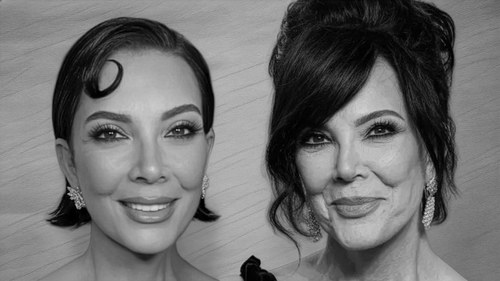
After the Honeymoon: Kris Jenner, the SMAS Plication, and the Difference a Decade Makes

Kris Jenner facelift before and after, greyscale comparison reviewed by Dr. Frank Agullo, MD, FACS, double board-certified plastic surgeon in El Paso, Texas

Last summer, every red carpet, every Vogue Arabia spread, every grainy paparazzi shot of the Bezos wedding ended with the same question. Who did Kris Jenner’s face? The internet lost its mind. One post asking for the doctor’s name racked up tens of thousands of likes. Some called it the best celebrity facelift in a hundred years. The momager looked, depending on the photo, somewhere between thirty-eight and fifty. Then a year passed. Now the same internet that crowned the result is asking why the magic looks like it is wearing off. Stories of “facelift slipping.” Whispers of revision. Comparisons to other women in the same age cohort, like Denise Richards, whose results held while Kris’s seems to be drifting south. I have been watching this story closely. Not because I love celebrity gossip, but because what is unfolding in public, in real time, is the entire arc of a facelift. The honeymoon. The retouch. The first year. The technique that did or did not go deep enough. And what happens when you do a SMAS-based operation on a seventy-year-old face that needed more.

What her surgeon actually did

Kris Jenner’s surgeon is a respected New York plastic surgeon, well trained, well credentialed, and widely reported to perform a hybrid technique, a lateral SMASectomy paired with a deep neck lift. SMASectomy means cutting out a strip of the SMAS, the muscle and tendon layer that sits just under the skin, and stitching the edges back together. SMAS plication is the close cousin, folding that same layer over itself like a hem and tacking it down. Both are SMAS techniques. Both work on the layer of facial anatomy closest to the skin. Neither dissects underneath the SMAS. Neither releases the four retaining ligaments that anchor the face to the skull. This is not the deep plane facelift. It is also not the endoscopic ponytail lift, which I trained to perform at the Ponytail Academy in Pittsburgh and Santa Monica. It is a respectable, well-executed, brand-name version of an older operation. And in a seventy-year-old face, that distinction matters more than people realize.

The honeymoon phase nobody tells you about

Every facelift looks incredible at three months. I mean every single one. Here is why. Three months out, the swelling has not fully resolved. There is still a layer of inflammatory fluid plumping the face. Skin is still tight from the closure. The deep tissues are healing in a position that is, frankly, slightly tighter than where they will eventually settle. Add professional lighting, a glam team, and a heavy hand in retouching, and you have what I call the honeymoon face. The honeymoon face is not the result. It is a preview of the result, dressed up. The real result lives at twelve to eighteen months out, after the swelling has gone, the skin has relaxed, and the tissues have settled into their new home. That is the face you will see in the mirror for the next decade. If the technique was right for the anatomy, the twelve-month face is barely distinguishable from the three-month face. Rested. Younger. Like the patient on a great day. If the technique was wrong for the anatomy, twelve months is when the gap shows up. Volume that was masking a structural issue retreats. Skin that was tight goes lax. The midface, which is heavier than people realize, starts to fall again. And the patient ends up where Kris is now, in the public square, watching strangers debate her face on TikTok.

The midface, the malar bags, and the golf balls

Look at the recent photos with an honest eye and a working knowledge of facial anatomy. The lower face and the neck are still meaningfully better than they were before surgery. That part of the operation worked. The jawline is cleaner. The platysmal bands are quiet. But the midface tells a different story. The cheeks, which were lifted into position briefly by swelling and a tight skin closure, have descended again. The malar bags, the prominent rounded fullness that sits on top of the cheekbones, are now obvious. Two of them. Round, glossy, and impossible to unsee. Some commenters have, less charitably than I would, called them golf balls. This is not some mystery failing. The midface was never fully addressed in the first place, and what we are watching now is exactly how a midface behaves when you do not address it. A lateral SMAS technique tugs on the side of your face. Lovely for the jowl. Useless for the malar fat pad, which is the cushion of fat that gives a cheek its shape instead of leaving you with a literal pouch sitting on top of the cheekbone. The deep plane operation handles this directly. We release the zygomatic ligament, free the malar fat pad, and reposition the whole thing as one composite piece with the rest of the flap. The endoscopic ponytail lift does the same job, just through small openings tucked inside the hairline. Skip the malar release on a face that needed it, and you get exactly this trajectory. The swelling carries you through the honeymoon. Then the swelling leaves, and the cheekbones still are not where they should be.

A seventy-year-old face is not a fifty-year-old face

Skin at seventy is not the skin you had at fifty. The elastin content has dropped, the collagen network is thinner, and the deep ligamentous support that anchors a face to its skull is no longer doing the job it used to. Run the same operation on a fifty-year-old and a seventy-year-old by the same hands and on the same day, and the fifty-year-old will hold the result longer. Every plastic surgeon I have ever trained with knows this. Most of us, out of politeness, do not say it out loud. So I will. At seventy, the technique you pick is more or less the whole game. SMAS-only buys you maybe a year or two of looking the way you did the day after the bandages came off, then a steady drift back toward where you started. The deep plane gives you ten, twelve, sometimes fifteen years. That is not my opinion, that is what the peer-reviewed longitudinal data shows. Which is why the Denise Richards comparison hits where it does. Richards is fifty-five, fifteen years younger than Kris, and her surgeon took her into the deep plane. Younger tissue, deeper operation, more durable result. A year out, she still looks like she did at three months. Kris is seventy, with a SMAS-based operation. The arithmetic was hard before anyone cut a single stitch.

Quick comparison

Aspect Kris Jenner’s facelift (SMAS / lateral SMASectomy) Denise Richards’s facelift (deep plane)
Layer of work SMAS, just under the skin Below the SMAS, releasing the retaining ligaments
Midface release None or limited Yes, true malar repositioning
Skin tension at closure Higher Lower
Patient age at surgery 70 55
Typical longevity 6 to 8 years 10 to 15 years
Honeymoon-to-real-result drift More noticeable Minimal

One more thing about those reveal photos

Let me be the surgeon who says what other surgeons say in the lounge but not on the record. The reveal photos last summer were heavily retouched. I do not say this with any pleasure. I say it because the gap between the polished cover image and the candid Instagram from the same week was too wide to be lighting alone. That kind of editing helps nobody. The patient walks into a setup, because reality always catches up to a retouched photo. The public walks into a setup too, because they sign up for an operation expecting a result the operation was never on its own going to give them. Worst of all, the patient ends up feeling betrayed by an outcome that, honestly, is doing exactly what that technique does at twelve months on a seventy-year-old face. When I do a facelift on you, the photos you see at twelve months are the actual photos. Not filtered. Not retouched. Usually in black and white, because that is how I prefer to show work and because color photography flatters a result you have not earned. What you see is what you have.

Why I trained where I trained

My plastic surgery fellowship was at Mayo Clinic, where they hammer into you the idea that you choose the operation for the anatomy, never the brand for the marketing. From there I went to Pittsburgh for the intermediate Ponytail Academy course, then back out to Santa Monica for the advanced one, because the deep plane and the endoscopic deep plane are the operations that, year over year, actually hold. And I teach as a Clinical Associate Professor at Texas Tech University Health Sciences Center for one simple reason: if I cannot stand in front of a resident and explain why a maneuver works, I do not understand it well enough to perform it on you. I have been a Castle Connolly Top Doctor for thirteen consecutive years. I have published over forty peer-reviewed papers. I have a global following of over 3.5 million across Instagram, TikTok, and Snapchat. None of that matters if the face I deliver does not hold. The face has to hold.

Why choose Dr. Agullo for a facelift in El Paso?

Double board-certified by the American Board of Plastic Surgery and the American Board of Surgery. Fellow of the American College of Surgeons. Mayo Clinic plastic surgery fellowship. Clinical Associate Professor at TTUHSC. Affiliate Professor at UTEP. Ponytail Academy intermediate (Pittsburgh) and advanced (Santa Monica). Castle Connolly Top Doctor for thirteen straight years. Texas Super Doctors Hall of Fame. Aesthetic Everything Top Plastic Surgeon, 2026. Trained in deep plane facelift, endoscopic deep plane (Ponytail Lift), preservation rhinoplasty, supercharged BBL, and rib repositioning for waistline reduction. About sixty percent of my patients fly in from out of town because the operation, not the city, is what they are choosing.

Ready to talk?

If you are thinking about a facelift, the most useful forty-five minutes of your year is a consultation with the surgeon who would actually do it. Bring photos of yourself from ten years ago. Bring the photos that bother you now. Bring the questions you would not ask your dermatologist. I will tell you whether you need a deep plane facelift, an endoscopic ponytail lift, a neck lift only, or to come back in five years. If filler is the right answer for you today, I will tell you that. If you need surgery, I will not pretend you do not. Call (915) 590-7900, text 1-866-814-0038, or book online at agulloplasticsurgery.com. Follow along on social at @RealDrWorldWide on Instagram, TikTok, and Snapchat, @Agullo on X, or @AgulloPlasticSurgery on Facebook. #StayBeautiful