If You Can Feel the Mesh, Your Tissue Is Thin: A Surgeon on the Internal Bra

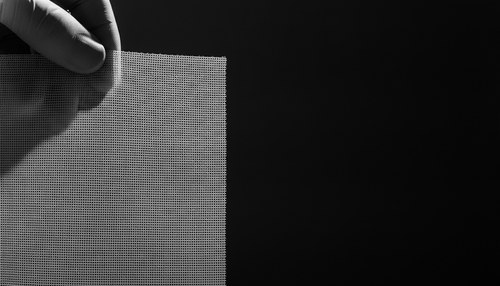
Black and white close-up photograph of a sheet of fine surgical mesh held up against hard side light so the weave shows, dark background, gloved fingertips at the edge of the frame, no face. Illustrative image. Commentary by Frank Agullo, MD, FACS.

A sheet of mesh the size of your palm. Two years, then gone, collagen left behind. I put one in nearly every breast operation I do.

Every Lift, Every Reduction, Every Augmentation

“I actually recommend internal mesh support on all patients, on breast lifts, breast reductions, and breast augmentations.”

“In a breast lift and a breast reduction, it actually helps reshape the breast tissue and support it, just like a push-up bra, to gain more upper pole fullness and avoid bottoming out and lateral displacement.”

“Of course, this is a recommendation, and some patients decline using the mesh, with the knowledge that they will not have that added support.”

Two Years

“The mesh supports the tissues for a period of up to two years. As it dissolves, it leaves behind collagen deposits, so the support remains there even well after the mesh has gone.”

“I use two main types of mesh. GalaFLEX, including GalaFLEX LITE, which is lighter, and DuraSorb mesh. The choice depends on each patient and what we want to achieve.”

The Worry

“We have not had a single case of infected mesh when we have used DuraSorb or GalaFLEX, and we have never had to remove the mesh.”

My practice. Not a study.

“We have been using internal mesh support for breast reconstruction for more than 20 years, and these techniques have been incorporated into aesthetic surgery. There are always risks associated with using any implanted material. In my experience with GalaFLEX and DuraSorb, I have seen significantly fewer complications, if any, compared to other mesh systems and dermal grafts. A lot of the symptoms alleged to have resulted from the use of mesh can actually occur when we don’t use a mesh at all.”

The Fact Nobody Tells You

“There have been cases where the mesh is palpable, and we have decreased this risk by changing to GalaFLEX LITE, which is thinner and less palpable, and to DuraSorb. The fact that the mesh can sometimes be palpated is a sign that the patient has very thin tissues, through which the mesh can be felt. If we had not used a mesh in these cases, we would probably be able to palpate the implant or visually see rippling. In these cases, the mesh is actually helping to thicken the skin and tissue envelope, and as the mesh dissolves over time, that palpability disappears.”

Feel the mesh, or feel the implant. That is the choice thin tissue gives you. Rippling is the version without the mesh.

“It is important to also realize that there are risks involved with not using a mesh. These risks include rippling, implant palpability, and implant displacement.”

She asks The answer
Do I need it? I recommend it on every lift, reduction and augmentation; declining is her call
How long is it in there? Up to two years, then collagen in its place
What if I can feel it? Thin tissue; without the mesh she would feel the implant
Does it change recovery? No, and not the drain either

Contracture

“In all actuality, there has been increasing evidence that the use of GalaFLEX and DuraSorb can decrease the risk of capsular contracture or capsular contracture recurrence. In many cases of recurrent capsular contracture, we are actually recommending a complete wrap of the implant with GalaFLEX or DuraSorb mesh to decrease the risk of recurrence.”

More on that in the capsular contracture revision read.

Recovery

“When we use a mesh, it does not change recovery time, it does not change whether we use a drain or not, and it does not affect how long the drain stays if we do decide to use one.”

The operation where the mesh earns its keep is the auto augmentation lift. The surgical read with the cost ranges is on agulloplasticsurgery.com; the patient version is on the Southwest Plastic Surgery post.

Why Choose Dr. Agullo

Double board-certified, by the American Board of Plastic Surgery and the American Board of Surgery. Mayo Clinic plastic surgery fellowship. Clinical Associate Professor of Plastic Surgery at Texas Tech University Health Sciences Center. Castle Connolly Top Doctor for 13 consecutive years.

Ready to Talk?

Ask to hold the mesh. Then decide. (915) 590-7900, text 1-866-814-0038, or book at agulloplasticsurgery.com/appointments. #StayBeautiful

@RealDrWorldWide on Instagram, TikTok, and Snapchat, @Agullo on X, or @AgulloPlasticSurgery on Facebook.


Does Insurance Cover It? No. Here Is the Rest of the Breast Reduction Answer.

Black and white photograph of a woman seen from behind at a tall window, one hand resting on the sill beside a folded sheet of paper, in hard directional light. Illustrative image, not a patient. Commentary by Frank Agullo, MD, FACS.

Two questions open every breast reduction consult. Does insurance cover it. What does it cost.

First one first. I do not work with insurance. If you would rather have a surgeon who takes insurance, we will recommend one, and we mean that. I am not going to make you scroll for that answer.

Second one. I dictated it for this post, so here it is the way I said it.

How much does a breast reduction cost?

Dr. Agullo: “As of this writing, a breast reduction runs from 11,000 to 15,000 dollars, depending on whether the internal bra mesh is used. You can always find our current fees at agulloplasticsurgery.com/fees, which is the page we keep updated.”

What drives the cost up or down?

Dr. Agullo: “Several things can affect the total. One is the internal bra mesh, which provides internal support and, when it is used, adds to the cost. Liposuction is often combined with a breast reduction to refine the sides and the contour, and any additional lifting of the breast can add to the total as well. The final cost depends on the combination of these elements and the length and complexity of the procedure.”

I publish my fees. Most surgeons do not.

What the Fee Buys

Everything but your prescriptions.

Operating room. Anesthesia. Garments, which for a reduction means two surgical bras, since you will be in one for a month. Vitamins. Scar care. You pick up your own medications. That is all that is on you.

The tissue I remove goes to a pathology lab. The lab bills your insurance directly for the analysis. It is a separate business. Nothing about it runs through my office.

Why a Quote Comes Back Higher Than the Website

What gets added Why it comes up
Internal bra (mesh support) Holds the new shape up from the inside
Liposuction of the sides plus Renuvion J-Plasma No fullness at the edges of the chest, and the skin there tightens
Additional lifting The nipple has a long way to travel
Nipple graft Severe cases only
Incision extended toward the back The tissue does not stop at the breast
Additional operating room time A longer case is a longer case

The side liposuction plus Renuvion pair is the same pair that moves a gynecomastia quote. Different patient, same mechanic.

Revisions of someone else’s reduction sit above all of this and vary more from case to case.

Smaller Is Instant. Finished Is Six Months.

Both halves are true. The breast is smaller and lifted the moment you wake up. What needs to settle is everything around it.

  • Drains out at one week.
  • Normal, easy-going activity at one week.
  • Bruising for two to three weeks.
  • Exercise at four weeks.
  • Four weeks in the surgical bra. No underwire, no pushup.
  • Swelling takes about three months to settle, six months to settle completely.

After the four weeks in the surgical bra comes the sentence I enjoy most. You can go shopping for new bras.

If you have implants and want less, that is a different operation and a different post.

The starting price is public. Your price depends on your anatomy and what we add, and an exact quote can only be provided after a consultation.

Call (915) 590-7900, text 1-866-814-0038, or book at agulloplasticsurgery.com. #StayBeautiful

Find me at @RealDrWorldWide on Instagram, TikTok, and Snapchat, @Agullo on X, or @AgulloPlasticSurgery on Facebook.

A Lift Alone Can Make You Smaller. Somebody Should Say That First.

Black and white torn-paper collage of two cut-out portraits of poised women with engraved magnolia beside a large numeral reading 4th.

Breast lift was the fourth most common cosmetic operation in the country last year. It is also the one where expectations most often go wrong, and usually in two specific ways.

First: a lift on its own does not add size

“If a patient just wants to have a breast lift, then they have to understand that they may be the same size or slightly smaller, maybe half a cup size to a cup size, because we are removing that excess skin. The breast will be perkier, but it’ll also be tighter, and it may appear smaller.”

If you want to be larger, that is a different operation.

“Of course, if they want to be larger, we will need an implant or a fat transfer to the breast. The biggest difference here is that an implant is very predictable, and fat transfer to the breast is going to be a slight change, very natural, and a little bit unpredictable in terms of how much of the fat actually stays, but we can usually count on about a cup size increase.”

Second: the upper pole

“A lot of patients having a breast lift with implants are expecting a lot of upper fullness and a very high implant placement, which is just not possible at the same time as a breast lift. A breast lift will always give a perkier look, more upper fullness, and cleavage, but it’s going to have usually a natural slope on top.”

A natural slope is the result, not a failure of the result.

The incision people are afraid of

“I think a lot of patients are afraid of this surgery because they feel like they’re going to need the full anchor type incision. By offering the circumareolar, or donut, lift for patients whose nipple and areola are above the inframammary fold, this can be a game changer.”

That is an anatomy question, settled at the consultation, not a preference.

Why I put mesh in

“Regardless of the combination of procedures we perform, I do recommend using an internal bra with mesh support, with GalaFLEX or DuraSorb, to give us that support of the breast weight, so that we’re not just relying on skin, which has lost all its elastin and is not reliable long term.”

Skin that stretched once will stretch again. It is not a load-bearing structure.

What the price actually depends on

“Using an implant and/or internal bra support mesh will increase the cost. If a procedure is going to take longer, that can increase the surgical and operative time cost. And any other procedures that we add on, like sometimes liposuction of the lateral chest with Renuvion J-Plasma, or the axilla and upper back, can increase the cost as well.”

On size

“I think the bulk of patients still use the three hundred to four hundred CC implants, which give them one to two and a half cup sizes depending on their starting point.”

Some want far more, and I offer the Mentor MemoryGel Enhance line, which runs up to 1,445cc. Others want less, under 300cc, sometimes with Motiva Preserve for a faster recovery.

“So really, I have a wide range of patients, and I like to help them achieve what they desire in a safe framework, and have a good conversation about how we can get them there.”

Consultations at Southwest Plastic Surgery in El Paso.

Call (915) 590-7900 or text 1-866-814-0038.

#StayBeautiful


Source: Commentary from Dr. Agullo’s 2026-09-07 dictation. Mentor MemoryGel Enhance ceiling of 1,445cc confirmed by Dr. Agullo 2026-09-07.