
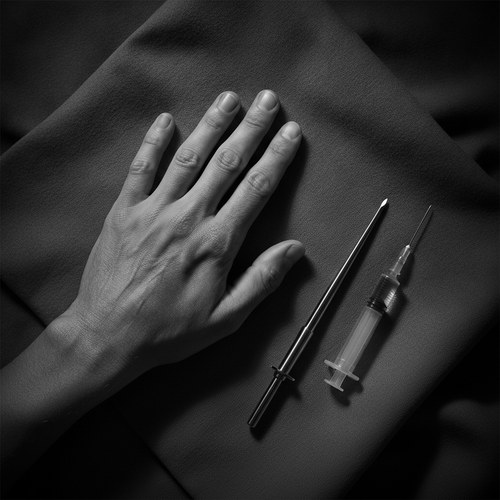
Not too long ago, a reporter from the Daily Mail called asking about hand filler. Hand filler, not face filler. Of all things.
That didn’t surprise me. I’ve been getting the question in consult rooms for over a year now, usually as an afterthought right at the end of a facelift consultation. “Also, can you do anything about my hands?” Almost always said a little sheepishly, like it’s a strange thing to ask a plastic surgeon.
They aren’t. Hands are the most honest part of the body there is. A facelift can buy your face a decade back in the mirror. Your hands don’t get that same deal. They still tell the truth.
Why Hands Age Faster Than Most People Expect
Under the thin skin on the back of the hand sits a layer of fat that cushions the tendons and veins. That fat pad thins with age, the same process that hollows out the face, except faster, because your hands take more sun, more friction, and more daily wear than your cheeks ever do.
Once that padding thins, the tendons and veins that were always there start to show. Add years of unprotected sun exposure and you get sunspots and uneven pigment layered on top. None of this is disease. It’s just wear, in the one spot nobody remembers to put sunscreen on.
The Daily Mail piece I was quoted in framed the current spike in demand around video calls and phones, and I think that’s exactly right. A decade ago, almost nobody spent hours a day staring at their own hands on a screen. Now it’s a Zoom call, a phone held up in front of your face, a ring light for the selfie: your hands are on camera constantly, the same way “Zoom face” made people suddenly notice their neck. Hands got their own version of that.
Three Ways I Actually Treat a Hand
There are three separate problems in an aging hand, and you can’t treat them all the same way. Each one needs its own approach.
| Problem | What I use | Why |
|---|---|---|
| Lost volume, visible tendons and veins | Hyaluronic acid filler, calcium-based biostimulators, or Lipoderma fat grafting | HA is temporary and reversible; biostimulators build the patient’s own collagen; Lipoderma or a patient’s own fat grafting lasts the longest |
| Thin, crepey skin texture | Laser resurfacing, IPL, microneedling with PDGF | Rebuilds texture and quality, not just volume |
| Sunspots and uneven pigment | IPL and laser, paired with daily sunscreen | Treats existing damage; sunscreen is the only thing that prevents the next round |
Most patients need some mix of the three, and I say so upfront instead of just selling whichever one happens to be in my hand that day. A hand with good fat padding but bad sun damage doesn’t need filler. A hand with thinning padding and clean skin doesn’t need a laser. Matching the treatment to the actual problem is most of the job.
Why I Won’t Touch a Hand Without a Cannula and an Ultrasound Probe
Here’s the part that matters most, and the part I told the Daily Mail directly: hands are safe to treat in experienced hands, but anatomy is everything and unforgiving.
The skin is thin. The tendons sit right under it. The veins run closer to the surface than almost anywhere else I inject. There’s no fat padding, no muscle bulk to hide a mistake the way there sometimes is on a face. Poor technique shows immediately, and it shows on a body part your patient looks at fifty times a day.
That’s why I inject hand filler with a cannula, a blunt-tipped instrument, instead of a sharp needle. A cannula is far less likely to puncture a vessel as it moves through the tissue. I also treat ultrasound guidance as a genuinely vital safety tool here, not an optional upgrade. It lets me see the vessels I’m working around in real time instead of relying on landmarks alone.
The common side effects are ordinary and expected: swelling, bruising, and a few days of stiffness that makes gripping things uncomfortable. Lumps or small nodules can form if the filler isn’t massaged correctly right after injection, which is a technique issue, not a product issue. The rare but serious risk is injecting into or compressing a blood vessel and cutting off circulation. That’s the one cannula technique and ultrasound guidance exist to prevent, and it’s why I don’t consider this an entry-level injectable.
Who I Turn Away
Not everyone who asks for hand filler is a candidate, and I say so before I ever pick up a syringe.
I won’t inject over an active skin infection, and I’m cautious with patients who have uncontrolled autoimmune or connective-tissue disease, a history of severe filler reactions, or blood thinners that can’t safely be paused for the appointment.
There’s a subtler category too. Some patients are bothered by prominent joints or visible bones on the back of the hand, not lost volume between them. Filler doesn’t fix that. It sits in the soft tissue; it doesn’t camouflage a joint. I turn those cases away rather than inject anyway, because a patient who leaves disappointed is a worse outcome for both of us than a patient I was honest with in the consult room. Taking the case isn’t the win. The right outcome is.
Why This Sits in a Surgical Practice, Not a Med Spa Menu
I did my plastic surgery fellowship at Mayo Clinic, and I’m a Clinical Associate Professor of Plastic Surgery at Texas Tech University Health Sciences Center Paul L. Foster School of Medicine, where hand and upper extremity anatomy is part of the curriculum. Castle Connolly has named me a Top Doctor for thirteen straight years running.
None of that is a hand-filler credential specifically. It’s the reason I think about vascular anatomy the way I do before I ever pick up a cannula, on a hand or a face. The same caution that keeps a facelift safe belongs in a fifteen-minute hand appointment.
There’s no gown, no operating room, and realistically no downtime built into the schedule. I check the skin under good light, feel for how much padding is left over the tendons, and ask about decades of sun: driving with a hand on the wheel, gardening without gloves, none of it dramatic, all of it cumulative. If filler or a biostimulator is the answer, the injection itself runs fifteen to twenty minutes across both hands under topical numbing. Ice, then back to normal life the same day. I’d rather spend the extra ten minutes on the exam than the extra syringe on the wrong problem.
Ready to Talk?
If your hands have been bothering you longer than your face has, say so. It’s a five-minute exam and an honest answer about which of the three problems you actually have.
Call (915) 590-7900, text 1-866-814-0038, or book online at agulloplasticsurgery.com/appointments. #StayBeautiful.
@RealDrWorldWide on Instagram, TikTok, and Snapchat, @Agullo on X, or @AgulloPlasticSurgery on Facebook.
Cross-links
- Patient-facing version on agulloplasticsurgery.com: “The Hand Filler Question: What I Tell Patients Before I Touch a Cannula” (link once live)
- Practice version on swplasticsurgery.com: “Hand Rejuvenation, Explained: How We Approach the Newest Anti-Aging Trend” (link once live)
- Source: Daily Mail, “‘Hand filler’ is the latest anti-aging trend sweeping America… but experts are urging caution,” Jane Herz, July 23, 2026.