The Title She Defended Three Months After Surgery: Stephanie Han, Motiva Preservé, and the Recovery Her Coach Never Noticed

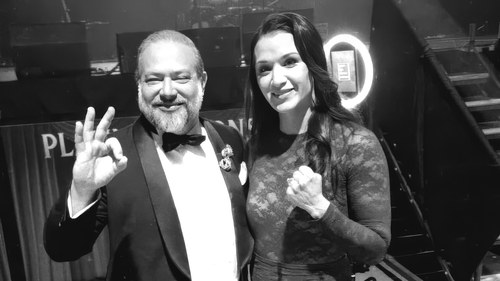
WBA lightweight champion and El Paso police officer Stephanie Han, a Motiva Preserve breast augmentation patient of Dr. Frank Agullo, MD, FACS, at Southwest Plastic Surgery in El Paso, Texas.

Saturday night, Stephanie Han defended her WBA lightweight world title against Holly Holm at the El Paso County Coliseum, live on ESPN, and won by decision. She is 13-0. About four months earlier, she was on my operating table for a breast augmentation, and nobody in her camp knew.

We sat down together to talk through how that was possible. Our conversation is below, in her words and mine.

Your Body Is Your Livelihood. Why Did You Decide to Do This?

Stephanie: “It’s something I’ve wanted to do for a very long time, and I always held back because of the stigma, that you shouldn’t do it because it’s going to affect your performance as a professional fighter. But I did my own research and realized I can still perform at an elite level. Most importantly, I’m doing it for myself. I don’t ask for a lot of things in life. This is personal.”

You’re a Mom of Two Who Breastfed Both. How Did That Factor In?

Stephanie: “I’m a mom of two beautiful kids, and I breastfed both of them. No one tells you your breasts won’t be the same afterward. I could train, I could do a million push-ups, and it would not change this. This was probably my biggest insecurity. I knew if I got it done, it would boost my confidence and make me feel comfortable in my own skin again.”

What Makes Motiva Preservé Recover So Differently?

Dr. Agullo: It comes down to where the implant sits and how we get there. We make a small incision in the fold, about two and a half centimeters, and we open the pocket above the muscle, behind the breast gland. There is no cutting and no electrocautery. We use a balloon to create the space, so we are just pushing the tissues outward and letting the breast’s own ligaments hold the implant. We preserve the nerves and the arteries, and because the muscle is never released, the recovery is fast. We do not even need a mesh. Most patients are back to work the next day and back in the gym in about two weeks.

Her Implants Were Not a Matched Pair, Were They?

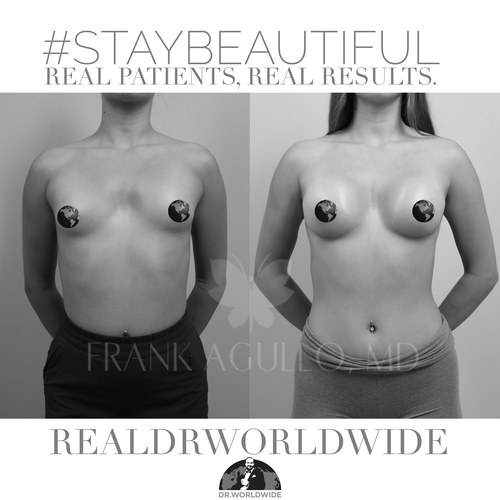
Dr. Agullo: No, and that is part of the artistry. Stephanie had a meaningful difference between the two sides, which is very typical, since we all have an asymmetric side. On the 3D simulation we planned a 265cc Demi Ergonomix on the right, with a little less projection, and a 315cc Full Ergonomix on the left. The Ergonomix implants move with the body, so they fill in beautifully and read as symmetric, even when she cuts weight for a fight.

What Was the Recovery Actually Like?

Stephanie: “Dr. WorldWide told me I’d be fully recovered in two weeks, and honestly I didn’t believe it until it happened. I had maybe a little discomfort for about three days, and after that it felt amazing. It’s been about four months and it truly feels like I didn’t get them done.”

Back in Camp Four Months Later. How Did Your Body Hold Up?

Dr. Agullo: I was surprised she never told her coach, but it made for a perfect test, because he was blinded to it. He watched her spar and train for the whole camp and thought she was in the best shape he had ever seen. That tells me the augmentation did not get in the way of her performance, her strength, or her range of motion, which is exactly the point of Preservé.

Stephanie: “Today I sparred 12 rounds and there was no pain. I can run seven miles, no problem. It feels like nothing, like they’re not even there. It’s maybe a pound of extra weight, and it feels like part of my body.”

Does That Mean the Surgery Helped Her Performance?

Dr. Agullo: No. The implants did not make her a better fighter. They boosted her confidence enormously, she does not stop talking about them, but they did not change her fighting. The whole point is that they did not affect it. They did not make her worse. That is what makes this such a good illustration of what the procedure can do for athletes, and really for all women.

How Do You Feel About the Result?

Stephanie: “They’re so symmetrical, so nice and perky. It’s taken my confidence from probably a six to a ten. I feel beautiful, I feel strong, I feel confident. And at the end of the day, I’m still Stephanie Han. I’m still a world champion boxer, still a police officer, still a mother of two, still a woman of God. This doesn’t change who I am. It’s just something I wanted for myself.”

Is This the Recovery Every Patient Should Expect?

Dr. Agullo: It is realistic for most women having Preservé on its own. Back to work within one to three days, back in the gym at about two weeks, the way I have seen with many patients. If a patient also needs a lift, or is having liposuction or a mommy makeover with a tummy tuck, that changes everything, and the recovery is dictated by those other procedures. For the full breakdown of the technique, the implant, and the recovery ladder, I wrote that up in Back to the Gym in Two Weeks: Motiva Preservé and What Preservation Surgery Actually Means. The technique itself is on the Motiva Preservé page at agulloplasticsurgery.com, and the broader breast augmentation overview is on swplasticsurgery.com.

What Would You Tell a Woman Who Has Been Holding Back?

Stephanie: “This is one of the things I do not regret at all, and I honestly wish I’d done it sooner. Don’t listen to the stigma. You can still be strong, you can still be beautiful, and you can still perform at 100 percent. To every mom and every athlete, especially the women champion boxers and the moms who breastfed, if you have two weeks, you can do it.”

Ready to Talk?

If Stephanie’s story sounds like the version you want, the next move is a consultation. I will tell you whether Motiva Preservé fits your anatomy and your goals, and I will give you a recovery timeline I can actually defend. The goal is the body you recognize in the mirror, and a recovery you can plan your life around. #StayBeautiful.

Call (915) 590-7900, text 1-866-814-0038, or book online at agulloplasticsurgery.com. Follow along at @RealDrWorldWide on Instagram, TikTok, and Snapchat, @Agullo on X, or @AgulloPlasticSurgery on Facebook.
Back to the Gym in Two Weeks: Motiva Preservé and What Preservation Surgery Actually Means

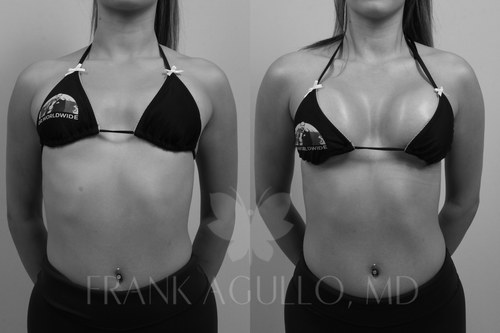
Editorial frontal before and after view of a Motiva Preserve breast augmentation with 315cc Motiva Ergonomix Full implants on a slim athletic young woman patient wearing a Dr. Worldwide bikini, breast augmentation by Dr. Frank Agullo, MD, FACS, double board-certified plastic surgeon at Southwest Plastic Surgery in El Paso, Texas.

The patient in the photos on this page walked back into her office the day after surgery. Two weeks later she was lifting weights again. Four weeks later she was running. The compression bra came off at three. None of those numbers used to be possible.

For most of my career, the honest answer to “when can I lift my kids” after a breast augmentation was four to six weeks. The honest answer to “when can I lift heavy at the gym” was six to eight. I gave those answers a thousand times. They reflected the real recovery from a traditional submuscular augmentation, where the pectoralis muscle is partially released to make room for the implant. The muscle heals. It just takes the time it takes.

I stopped giving those answers about a year ago. The reason is a technique called Motiva Preservé, and it has changed enough about how I plan a breast augmentation that I owe my patients a longer explanation.

What Preservation Actually Means in the OR

The word “preservation” in Preservé is a commitment. Smaller incision (2.5 to 3 centimeters, inside the natural shadow below the breast). The implant sits in front of the muscle and behind the breast tissue, held by the breast’s own ligaments, so there is no muscle release at all. A no-touch funnel so the implant never contacts skin on its way into the pocket. Less tissue dissection overall. The breast and chest wall handed back to the patient as close to their pre-operative state as the operation allows.

What patients feel is less swelling, less tightness, less of the bruised-rib soreness that traditionally defines the first week. The recovery curve compresses. The day-one experience now looks like the week-three experience used to look.

The case in the photos on this page was completed in under an hour in the operating room, under light sedation rather than general anesthesia. She walked out of the surgical suite the same morning and drove home (with someone else at the wheel) before lunch. That is not a marketing claim either. It is the operative report.

That is not a manufacturer claim. That is what every Preservé patient in my practice has told me, with a logbook that backs them up.

The Implant: Motiva Ergonomix Full

The implant in this case is a 315cc Motiva Ergonomix Full. Sixth-generation silicone gel, ProgressiveGel Ultima inside, SmoothSilk surface outside. The shape is what makes the Ergonomix line different from anything else in my OR.

Upright, the implant drapes into a teardrop that looks like real anatomy. Supine, on the back, it flattens and rounds the way breast tissue does. Nothing about its shape is fixed. The implant moves with the body the way tissue would. Patients describe the result as natural in a way I do not hear with older implant designs. That has shown up in my consult conversations and in the reaction shots my own patients send me a year later.

The Full profile is one of three Ergonomix projection options Motiva offers in the United States (Mini, Demi, and Full). For a slim athletic patient who wants visible projection but a natural silhouette, Full is the right end of the range. The 315cc volume was the result of careful sizing in the office. She did not want a striking change. She wanted proportion. For the full breakdown of the technique itself, the Motiva Preservé breast augmentation page on agulloplasticsurgery.com walks through every step.

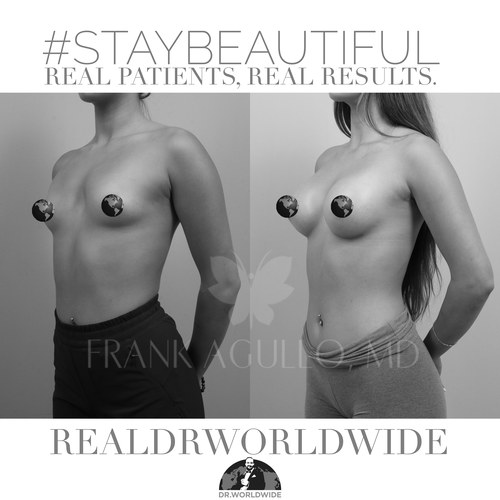
Oblique 45-degree before and after view of the 315cc Motiva Preservé breast augmentation case, showing the projection from a three-quarter angle.

Why I Stopped Promising Six-Week Recoveries

The single hardest number to defend in breast augmentation is recovery time, because the standard answer has been wrong for a long time. We told patients six weeks because that was the honest answer for the surgery we were doing. We are not doing that surgery anymore.

The Preservé recovery ladder, for a patient with this body type and this implant choice, looks like this. Day one: back to desk work, off the heaviest pain medication, sleeping upright. Day seven: showering, light walking, sleeping however she wants. Week two: back to lower-body gym work and short runs, with a sports bra. Week three: compression bra off. Week four: full upper-body programming, with the surgeon’s clearance.

None of those numbers come from a brochure. They come from the patients themselves, who tell me what they actually did, day by day, in the months after. I keep notes. I update the table I show in consults. The numbers have not slipped.

A Short Comparison

A simple way to see the difference:

Question Traditional Submuscular Motiva Preservé
Incision length 4 to 5 cm 2.5 to 3 cm
Muscle release Significant None (implant in front of the muscle)
Implant insertion Hand placement No-touch funnel
Back to desk work 5 to 7 days 1 to 2 days
Back to upper-body lifting 6 to 8 weeks 2 to 3 weeks
Compression bra 4 to 6 weeks 2 to 3 weeks
Shape behavior Round or shaped, fixed Ergonomic, position-responsive

The table flattens some real surgical detail. The full nuance lives in the clinical version of this post on agulloplasticsurgery.com (linked at the bottom of this post), where I walk through the operating room in more depth.

Side profile before and after view of the 315cc Motiva Preservé breast augmentation case, showing the natural drape and projection from a lateral angle.

Who Is the Wrong Candidate

I will tell you who Preservé is not for. A patient with significant ptosis (drooping) needs a breast lift in addition to an augmentation, and the lift drives a different recovery curve. A patient with very thin tissue or a history of capsular contracture needs a more nuanced breast augmentation revision conversation. A patient who wants a dramatic enlargement well beyond what her frame supports is going to be unhappy with any technique, and I will tell her so before we book a date.

The right candidate is a patient with a reasonable skin envelope, a defined inframammary fold, and goals that lean toward proportion. The patient in the photos on this page is one of the easier candidates to plan for. Not every patient is.

Clinical frontal before and after view of the same 315cc Motiva Preservé breast augmentation case, showing symmetry and natural shape.

Why I Trained on This System

I have placed thousands of breast implants going back to my plastic surgery fellowship at Mayo Clinic. Castle Connolly Top Doctor thirteen consecutive years. Clinical Associate Professor at Texas Tech University Health Sciences Center, where I teach breast augmentation to the residents I am responsible for. I do not adopt new techniques because a rep walks them in. I adopt them when the data and my own results justify the change.

Motiva earned FDA approval for its silicone gel implants in 2024 after years of leading the implant market in Latin America and Europe. I trained on the system directly before I placed an implant in a patient. I do not place a Motiva implant the way I place every other implant in my OR, because the technique is different and the implant rewards the difference.

One More Thing About Volume

Patients always ask about size in cubic centimeters first. The number matters less than the planning around it. A 315cc implant on the patient in these photos reads as proportional. The same 315cc on a different frame might read as dramatic. The same 315cc on a third frame might read as not enough. Size, projection, profile, the elasticity of the skin envelope, the position of the inframammary fold. All of those drive the answer to “what should the number be.”

The right surgeon will spend the consult walking you through that math. If the conversation starts and ends with a single number, you are in the wrong consult.

See the case on social: originally posted to Instagram and TikTok.

Ready to Talk?

If you are reading this on your phone and thinking “two weeks back to the gym sounds too good to be true,” the right next move is a consultation. I will tell you whether Motiva Preservé fits your anatomy and goals, whether 315cc is the right number for your frame, and whether augmentation alone is the right operation or whether you also need a lift. If the answer is “not the right time,” I will tell you that too. The goal is the face and body you recognize in the mirror. #StayBeautiful.

Call (915) 590-7900, text 1-866-814-0038, or book online at agulloplasticsurgery.com. For the longer clinical breakdown, see the agulloplasticsurgery.com post on this same case or the swplasticsurgery.com practice version. Follow along on social at @RealDrWorldWide on Instagram, TikTok, and Snapchat, @Agullo on X, or @AgulloPlasticSurgery on Facebook.