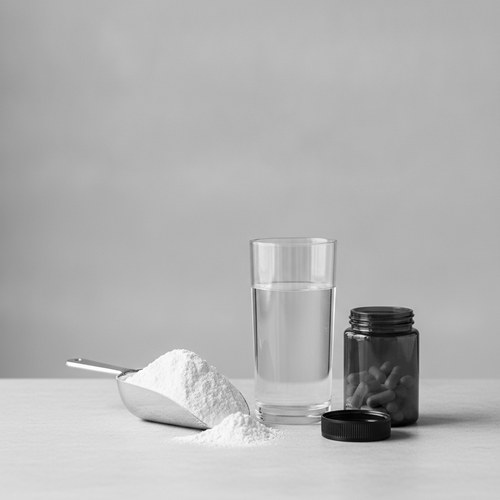
Flow Space called this month to do a piece on collagen supplements. When we got on the phone, the interviewer finally asked the real question on everyone’s mind: powder, pill, gummy, or serum; what actually gets absorbed and works for you?
The explanation I gave her was shortened to fit the article. Here is the full one. The formats are not equal, and the gap between the worst and the best is larger than the price suggests.
Powder Wins, and It Is Not Close
There are no other formats in that aisle with enough human data behind them. Only powder. The researchers did not measure mouse models; they did not measure cells under a microscope. They measured human volunteers at the end of human trials.
They study dosages of anywhere from 2.5 to 10 grams of hydrolyzed collagen peptides a day, and those have resulted in measurable, though often subtle, improvement in skin hydration and elasticity over 8 to 12 weeks.
Read it twice. Modest. And 8 to 12 weeks.
Powder wins because the doses in those studies come out of the tub by the spoonful. You can take exactly what the studies used, which happens to be the hardest thing to manage among all the products in this category.
Capsules Are Usually Underdosed
Capsules are not fraudulent. They are just small.
You would need a large number to get close to even the lower end of what is used in the studies. People pick up a two-cap bottle, think they are being proactive, but still end up with a small fraction of the dose used in the trials, with virtually none of the bottles labeled to warn them about that reality.
Just look at the label to know how much you actually have per serving. Go for the real dose and stick with it, rather than fine-tuning something you will abandon in a month anyway. It costs more per gram with less in the bottle.
Gummies Are the Weakest Option, and Sugar Is Why
Gummies push my buttons in two specific ways, and the two go together poorly.
First, you do not get a meaningful dose. How much collagen can you pack into a gummy and still make it taste good and look like a gummy.
Second, and this one is my main point as a surgeon: most gummies contain added sugar. Sugar in the blood drives glycation, which is essentially when excess sugar in your body binds to proteins and stiffens them. One of the body’s proteins, collagen, happens to be sensitive to this, which leads to stiffness and makes repair take longer. After glycation, collagen fibers become less stretchy, brittle, and break easily, losing the elasticity we all want to retain.
It essentially provides you with a collagen-infused product while including an ingredient that destroys the collagen your body possesses. Strange trade-off to make in the name of skin care, wouldn’t you agree?
| Powder |
Yes, easily |
Best human data in the category |
Where I would put the money |
| Capsule |
Rarely, without high pill counts |
Same peptides, wrong dose in practice |
Acceptable if you take enough |
| Gummy |
No |
Low content plus added sugar |
Weakest option in the aisle |
| Serum |
Not applicable, does not absorb |
Surface hydration only |
A moisturizer, priced like medicine |
Serums Cannot Reach the Place That Matters
A collagen serum is a hydration product wearing a lab coat.
The collagen molecule is too large to cross the outer barrier and reach the dermis. Collagen synthesis happens inside the dermis, and for the collagen in a serum to get there, it has to travel all the way from outside the skin. However, if the barrier let large molecules like that pass, it would defeat its one job of providing protection to everything below it.
Collagen serum just makes skin appear moisturized because it is holding water in the outermost layer of the epidermis. Skin appears dewy because it is storing and keeping that moisture. For a short amount of time, collagen serum helps skin perform that duty better than it would on its own. When you stop, the effect fades right back out.
If you want to tell your skin to produce new collagen, buy retinoids, decent vitamin C, and peptides. Do not ever buy something just because “collagen” is slapped onto the packaging.
The Menopause Number Nobody Prepares You For
The statistic I gave Flow Space hit me right in the head, since it quantified something many of my patients go through but cannot explain.
The average postmenopausal woman loses anywhere from 25 to 30 percent of her skin’s collagen in as little as five years after menopause, not over a lifetime. Within five years.
Therein lies why women report feeling as if they hit a sudden wall with their skin. It changed rapidly, not gradually, and falling estrogen is a big part of why.
No, you are not adding powder and getting 25 percent of your dermal collagen back. That is the reality. Supplements can support the tissue you have left. They cannot rebuild the structure once it is gone.
The Thing That Beats Every Supplement in the Aisle
The cheapest way to protect the protein that keeps our skin tight and supple is not a pill or powder. It is sunscreen.
UV damage is the number one controllable reason collagen loss happens. It causes enzymes to destroy collagen in the skin and hinders new collagen development. One can eat heaps of collagen every day and undo the benefit simply by spending time outdoors in the sunlight later on.
You top it with your retinoid, vitamin C, a bit more protein so your body gets what it needs to make new collagen, real sleep, no tobacco, and less sugar, which relates to glycation all over again, except now you are eating it with dinner.
All free, all better than anything you can buy by the tub.
Where the Real Collagen Work Happens
When a patient wants a bigger push, we work our way through the epidermis and down into the dermis.
Sculptra, as an example, has been shown to produce genuine collagen over a span of months, not days. Radiofrequency microneedling, and microneedling generally, provides enough controlled injury to encourage remodeling. Resurfacing lasers work at the surface and just below it.
When it is descent and not quality, nothing ingestible touches it. Descent means the thing has moved downward and it has to move back up. That is precisely what a deep plane facelift accomplishes, and no amount of scooping replaces real repositioning.
Mayo Clinic trained, dual board certified, and a 13-time consecutive Castle Connolly Top Doctor, yet not one time in my entire career have I seen any of these supplements make any sort of difference to a person’s jawline. Believe me, I have looked.
So Should You Take It?
Sure, if your bank account and your timeline allow, and if you take it in a delivery system that actually works.
I told Flow Space that collagen is a nudge, not a lift. It is not a facelift in a scoop. But it is good for something, and when a category is choked with things that are good for nothing, that is a real step.
The powder is the one, definitely get some. Wear sunscreen always. And give it three months before you call it. #StayBeautiful.
The El Paso patient version can be found on agulloplasticsurgery.com. Our practice version, describing how we fold skin support into in-office treatment, can be found on swplasticsurgery.com.
My comments originally appeared in Flow Space, “Powders, Serums, Gummies. What’s the Best Way to Get Your Collagen?” by Maggie Ryan, July 16, 2026.
Ready to Talk?
Want an honest breakdown to find out if your skin needs a supplement, a treatment, or surgery? Then you may want to invest in seeing somebody, and not another dollar out for a tub.
Call (915) 590-7900, text 1-866-814-0038, or book online at agulloplasticsurgery.com.
@RealDrWorldWide on Instagram, TikTok, and Snapchat, @Agullo on X, or @AgulloPlasticSurgery on Facebook.