
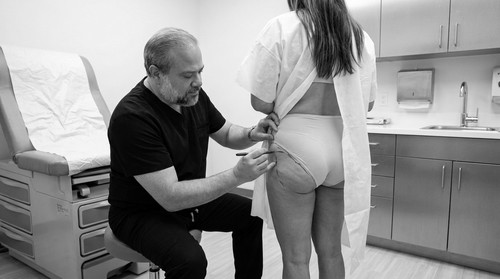
A patient called me from the East Coast for a virtual consultation. Years ago I had done her BBL myself, a supercharged one, implants plus fat. Since then she had babies, started her family, and moved somewhere more conservative. She wanted her body back, or at least a quieter version of it. More discreet. More athletic.
She is not an outlier. She is a wave.
I wrote earlier this year about how beauty standards keep moving, and the buttock is where that pendulum is swinging hardest right now. So let me explain what a BBL reversal actually is, because it is more interesting, and more surgical, than the headlines suggest.
Why They Come Back
The most important reason is time. A BBL is a procedure where liposuction is done in the trunk, including the upper back, lower back, lateral chest, abdomen, and sometimes the thighs and arms, and that fat is transferred to the buttock. Once liposuction is done in those areas, they do not increase in volume as much when the patient gains weight. The buttock becomes the one area that increases the most.
So a patient gains weight years later, and the proportions run away from her. The buttock is no longer proportionate, or has developed cellulite or even droopiness. Some patients develop a double butt crease deformity, which patients themselves call elephant butt or frog butt. Their words, not mine, and they are not wrong about the shape.
Another portion of patients have not gained anything. They just want a more natural, less aggressive body contour. And a certain percentage were never happy in the first place: exaggerated hips, too much projection, a lower back scooped too aggressively, a buttock that doesn’t transition well into the thighs.
The Reversal Toolkit
Reversal surgery can involve a combination of a lot of procedures, and the plan is assembled per patient.
| Tool | What it does |
|---|---|
| Liposuction | Reduces buttock volume and recontours |
| Renuvion J-Plasma | Radiofrequency with helium plasma for skin contraction |
| Morpheus8, stacked on top | Microneedling with radiofrequency, more contraction |
| Buttock lift, lateral thigh lift | Removes loose skin and lifts when volume loss is significant |
| Miami thong lift | Corrects the double butt crease deformity |
| Implant removal | For the supercharged BBLs of the 2010s |
The honest caveat: when we perform liposuction, the skin often becomes looser, and the buttock can droop more. Renuvion and Morpheus8 help create skin contraction, but the amount of contraction is hard to predict, as each patient reacts differently to these technologies. If we’re removing a significant amount of fat, then oftentimes a buttock lift, and even a lateral thigh lift, is necessary. Skin quality work continues afterward with microneedling when needed.
I prefer to do the surgery all at once, which gives the best results. The exception is the patient trying to avoid scars, who declines the lifts in hopes that the energy devices create enough contracture. Those patients know that at three or six months, if they develop buttock ptosis or loose skin, the lift conversation returns.
Can You Get Your Old Body Back?
We can get patients to their pre-BBL body, although most patients don’t really want to go that far back. They’re looking for a result in between: tighter contours, tighter skin, sometimes a more athletic look. That target gets set at consultation, along with an honest answer about whether it is achievable given which procedures they are willing to undergo.
How the East Coast Case Went
Her plan: buttock implant removal, liposuction of the lateral thighs, saddlebags, and buttock, a buttock lift with a lateral thigh lift, and a Miami thong lift to correct the double crease and create a sweeping curve where the lower buttock meets the thigh.
Four and a half hours under general anesthesia. Hotel the same day. My nurse saw her the next morning with IV fluids, helped with her first shower, got her into her garments. Lymphatic massages every other day. Drains out on day seven, and she flew home. No complications, and at four months she is mostly healed and very pleased with the new contour. Most of my reversal patients fly in exactly like this; the majority had their original surgery out of town or in another country, usually more than five years ago. This kind of travel case is routine in my body contouring practice.
Recovery in general runs about a week to get back to normal activity and driving, and about four weeks to return to the gym, running, and jumping. The risks specific to reversal are asymmetries, development of cellulite, and buttock ptosis if a lift is not performed at the same time.
No, the BBL Era Is Not Over
The BBL era is far from over. Patients’ desires have shifted, but it really depends on their culture and each person’s definition of beauty. I still perform minimal BBLs, or skinny BBLs. I also still perform some exaggerated ones.
The tendency is toward a reduced size: maybe only the hip dips and a little projection, more of an upside-down heart shape than a shelf, some reduction in hip width. And still, plenty of patients want a very small waist with larger hips.
My tool for keeping everyone honest: photographs. The buttock is a hard anatomical place to describe with words, so I have patients bring pictures of what they want to the consultation, and again on the day of surgery, so that we’re both on the same page.
I served as founding vice president of the World Association of Gluteal Surgeons. I have watched this pendulum from the front row, in both directions. The surgeons who did the shelf era well are the ones patients now trust to quiet it down.
Ready to Talk?
If your BBL no longer fits your life, there is a surgical path back, and it can usually be planned from a virtual consultation. Call (915) 590-7900, text 1-866-814-0038, or book online. #StayBeautiful
@RealDrWorldWide on Instagram, TikTok, and Snapchat, @Agullo on X, or @AgulloPlasticSurgery on Facebook.
Companion reads: the clinical reversal guide on agulloplasticsurgery.com, and the destination-patient overview at swplasticsurgery.com.