The Mommy Makeover Is a Marketing Name: How I Build the Right List, Not the Longest One

Black and white editorial portrait study. The mommy makeover read by Dr. Frank Agullo, MD, FACS.

Let me say the quiet part first. “Mommy makeover” is a marketing name, not a single operation. It is a label that bundles several procedures under one friendly phrase, and the phrase sells better than the parts.

That is fine, as long as we are honest about what is happening underneath it. When someone books that consult with me, my first job is not to schedule the longest list. It is to figure out which procedures actually serve their goals and which ones they can skip.

Sometimes the most useful thing I do all day is talk someone out of part of it.

What “Mommy Makeover” Actually Bundles

It is a menu we combine, not a fixed package. It can include a breast augmentation or whatever your breasts need, the liposuction 360, the BBL (fat injections to the buttocks), and the tummy tuck. We pick from that list based on you. You do not have to do all of it, and most patients should not.

Being Scared of Part of It Is Normal

Almost everyone walks in certain about one thing and nervous about another. Sure about the tummy tuck, anxious about implants. Or the exact reverse. That is not a reason to rush, and it is not a reason to skip.

It is a reason to slow down and go through each piece on its own. We talk through the parts you are unsure about, one at a time, and you are completely allowed to leave my office undecided. The decision keeps until you are ready.

Implant, Lift, or Both?

This depends entirely on what dropped. If you mostly lost volume, an implant can be enough. If the nipple and tissue have descended, an implant alone can actually make it look worse, and a lift enters the conversation.

Often the answer sits in between. A donut lift, a small circle of skin removed around the areola, raises the nipple about an inch and re-centers it, and I can place a modest implant through that same incision to restore the upper fullness. You get a perkier, natural result without the longer scars of a full lift, and the scar hides at the edge of the areola.

Liposuction or Tummy Tuck? The Key Conversation

This is the one I never let a patient gloss over. Liposuction removes the fat we can pinch. But if your abdominal muscles separated during pregnancy, you will still see a bulge when you relax, and the only thing that fixes that is a tummy tuck.

A tummy tuck makes everything flat and tight and repairs the muscle, like a built-in corset. It is significantly more improvement than lipo alone, but it comes with a scar. I would rather you choose with that clearly in front of you than feel cheated later.

Should You Lose Weight First?

Stable matters more than low. If your weight is still swinging a lot, settling it first usually gives a better, longer-lasting contour.

But a tummy tuck removes loose skin and repairs separated muscle, and no amount of dieting fixes either of those. So the answer depends on what is actually bothering you, and we sort that out at the exam, not by a rule.

What Belongs on Your List vs. What Doesn’t

If Your Concern Is The Honest Recommendation
Lost breast volume only Implant may be enough
Dropped nipple and tissue Lift, often with a modest implant
Pinchable belly fat Liposuction
Bulge when muscles relax Tummy tuck repairs the separation
Loose skin after pregnancy Tummy tuck, not dieting

Can It All Be Done at Once?

Often yes, and it is usually the smarter choice. One anesthesia, one recovery, one block of time off work. When I plan combined surgery I am weighing your overall health and the total operative time, not just stacking a wish list. Adding something small, like the breast portion, frequently does not add much to your recovery.

There is a ceiling, though, and I respect it. Operative time has a relationship to safety, and at some point a longer list stops being convenient and starts being a risk I am not willing to take. When a wish list runs past that line, I stage it. Two calmer surgeries beat one marathon, every time, and I will tell you honestly when that is the smarter plan for your body.

The Recovery You Are Actually Signing Up For

People focus on the surgery and underestimate the recovery, so let me set expectations. The tummy tuck is the dominant part of the recovery in most mommy makeovers. It is the one that asks the most of you, with a real adjustment for the first week or two as the repaired muscle settles.

The breast portion and the liposuction ride alongside it without adding much. Lymphatic massage, the compression garment, and patience carry you the rest of the way. Most patients are back to normal daily life faster than they feared, with full exercise coming later. The point of planning it together is that you do this recovery once, not three separate times.

When Is the Right Time to Do This?

There is no universal answer, but there are good signals. You are finished having children, or confident that you are. Your weight has settled. You have help lined up at home for the first week, because you will genuinely need it. And the reasons are yours, not a date someone else circled on a calendar.

I will not rush a patient into a permanent decision to make an event. If the timing is wrong, I will say so, and we will plan for when it is right. The body you are restoring took years to change, and getting the timing right is worth more than getting it fast.

The Credential Behind the Plan

Double board-certified by the American Board of Plastic Surgery and the American Board of Surgery, Mayo Clinic plastic surgery fellowship, Clinical Associate Professor of Plastic Surgery at Texas Tech University Health Sciences Center Paul L. Foster School of Medicine, and Castle Connolly Top Doctor for thirteen consecutive years. The best mommy makeover is not the longest list. It is the right list for your body and your goals, planned safely.

Ready to Talk?

Let us build the plan that fits you, not a template. For the patient-facing walkthrough, see the companion post on agulloplasticsurgery.com. For the practice’s mommy makeover overview, see the version on swplasticsurgery.com.

Call (915) 590-7900, text 1-866-814-0038, or book online at agulloplasticsurgery.com. #StayBeautiful.

@RealDrWorldWide on Instagram, TikTok, and Snapchat, @Agullo on X, or @AgulloPlasticSurgery on Facebook.

The Augmentation That Never Touches the Muscle: Why I Switched to Preserve

Black and white portrait study of a woman's profile, soft studio light. Preserve prepectoral breast augmentation commentary by Dr. Frank Agullo, MD, FACS.

A woman sat in my consult room last week, pulled up a photo of herself at twenty-five, and said the line I hear several times a week. She wanted the fullness she used to have, and she wanted to know why she should drive past three closer surgeons to see me.

Here is the honest answer. For most augmentations I do now, I never touch the muscle. Not minimally. Not partially. Not at all.

That is a bigger deal than it sounds, and it is the reason recovery looks nothing like what your mother or your older sister went through.

What the Preserve Actually Is

The Preserve augmentation is prepectoral. The implant sits in front of the pectoralis muscle and behind your breast gland, above the muscle but below the gland. I do not cut the muscle, release it, or go under it.

That distinction is everything. A traditional submuscular augmentation goes behind the pectoralis and partially releases it off the chest wall. That release is the source of the long, sore, six-to-eight-week recovery patients remember. Preserve never goes there, so that whole chapter disappears.

I make the pocket by balloon dissection. No cutting, no electrocautery. The tissues are pushed outward, and the pocket is defined by your breast’s own ligaments. Those ligaments hold the implant in position, which is why I do not need mesh to support it.

That also means the nerves and arteries stay where they belong. You keep a higher likelihood of preserving sensation and breast function, because I am not dividing the structures that supply them.

Preserve Versus Traditional, Side by Side

Question Traditional Submuscular Preserve Prepectoral
Where the implant sits Behind the muscle In front of the muscle, behind the gland
Is the muscle cut Yes, partially released No, never touched
How the pocket is made Cutting and cautery Balloon dissection
What holds the implant Muscle and capsule Your own ligaments
Typical recovery Six to eight weeks Back to work in one to three days

How I Pick Your Size

Cup size is a starting point, not a measurement. I work from your dimensions and a Chrysalix 3D simulation, not from a letter on a bra tag.

Almost everyone has some asymmetry, and that is normal. Breasts are sisters, not twins. So I will often choose slightly different volumes on each side to get you closer to even.

There is a quieter advantage to placing above the muscle. I can put the implant precisely where your breast needs the most volume instead of filling the whole breast uniformly. A smaller implant can give a larger apparent size and a little lift. Lighter breast, same result you wanted.

The Implants I Use, and the Ten-Year Myth

I use Motiva Ergonomix. The old rule about swapping implants every ten years does not apply to these. The rupture rate is under half a percent, and they carry a lifetime guarantee.

The surface matters too. These use a nano-surface called SmoothSilk, which produces the lowest inflammatory response of any implant on the market and an extremely low capsular contracture risk. They are soft, the gummy bear type, and they take on a natural teardrop shape when you stand. Ergonomix implants move with the body, so you do not get that fixed, stuck-on look.

What Recovery Honestly Looks Like

This is the part that surprises people, so I will be specific.

I do it under light conscious sedation. You breathe on your own, and you will not remember much. I place Exparel, a long-acting local, between the ribs so the breast stays numb for about the first three days. The incision is two and a half to three centimeters in the fold under the breast, hidden where you will not see it.

The implant placement takes about thirty minutes. Patients are usually awake, pain-free, and able to raise their arms overhead before they leave, often within an hour. Many go back to work the next day, and the gym is reasonable at about two weeks if augmentation is the only thing we did. Add a lift or liposuction and the timeline shifts, and I will tell you that up front.

Why I Was One of the First to Do This

Being an early adopter of Preserve was a deliberate choice. Motiva trained me directly as one of roughly twenty highly selected surgeons in the United States, and I traveled to Costa Rica twice for that training. There are still fewer than forty surgeons in the country doing this.

I am a double board-certified plastic surgeon, certified by the American Board of Plastic Surgery and the American Board of Surgery. I completed my plastic surgery fellowship at the Mayo Clinic and I teach as a Clinical Associate Professor of Plastic Surgery at Texas Tech University Health Sciences Center Paul L. Foster School of Medicine. I committed to preserving your own anatomy because it recovers faster and ages better than cutting through muscle ever did.

The Animation Problem You Avoid

Here is a detail patients rarely hear about until it bothers them. With a traditional submuscular implant, every time you contract your chest, the muscle squeezes the implant and the breast moves or distorts. Surgeons call it animation deformity, and it is a direct consequence of putting the implant under a muscle that is built to move.

Preserve sidesteps it entirely, because the implant never goes under the muscle. You can do a push-up, a plank, or a heavy press without watching your breast jump. For an athlete, a CrossFit patient, or anyone who lifts, that is not a small thing, and it is one of the quieter reasons I prefer this plane.

One Honest Caveat

Preserve is not for absolutely everyone. Very thin patients with almost no breast tissue sometimes need a different plan, and I will say so in the room rather than force the technique. If a standard augmentation or a fat-based approach fits you better, that is the conversation we have.

Read the Patient-Facing Versions

For the patient-facing walkthrough, see the companion post on agulloplasticsurgery.com. For the practice overview, see the version on swplasticsurgery.com.

Ready to Talk?

The honest answer to what size and which implant is right for you needs an exam and a 3D simulation. Come see me.

Call the office at (915) 590-7900, text 1-866-814-0038, or book online at agulloplasticsurgery.com. #StayBeautiful.

@RealDrWorldWide on Instagram, TikTok, and Snapchat, @Agullo on X, or @AgulloPlasticSurgery on Facebook.

Preservation, Not Minimalism: I Wrote a Manifesto for Connectively

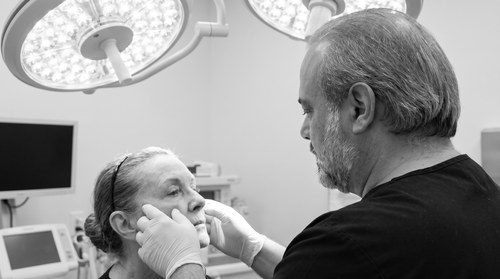
Dr. Frank Agullo, MD, FACS, double board-certified plastic surgeon in El Paso, Texas, in black scrubs in the operating room examining a facelift candidate as part of the preservation-era technique described in his bylined Connectively article.

Preservation, Not Minimalism: I Wrote a Manifesto for Connectively

I keep hearing the same thing in consults. “Doctor, plastic surgery is going smaller now, right? Less volume. Subtler results.”

Half true. Mostly misleading.

Connectively just published my bylined piece on this, and I wanted to push back on the frame in my own voice here too. Volume has not gone anywhere. Patients in my OR this month still wanted fuller breasts. Fuller hips. I still placed implants. I still grafted hundreds of cc of fat per side.

What changed in the last decade is what we refuse to damage when we add that volume.

The Old Bargain

For thirty years, adding volume came with a quiet compromise we did not really put into words for patients.

Breast augmentation, the way I was first taught to do it in training, meant a wide pocket dissection. That meant cutting through the suspensory ligaments of the breast. Those are the fibers that hold the breast up against gravity. We took them down to make room for the implant and we did not think twice about it. The implant looked great at six months. At year five, the breast started to bottom out, and by year ten the patient was back asking what happened.

Gluteal fat grafting in its early era was a free pass. Pre-2015, the field grafted into and through planes that we now know are dangerous. Plenty of surgeons added beautiful volume. A subset of patients did not survive it. The complication that killed people was fat embolism, and the cause was depth, not volume.

Facelifts of that era depended on tension. We pulled skin tight over tissue that had already failed structurally. At one year the patient looked rested. At ten years the patient looked pulled. The lateral sweep. The wind-tunnel mouth. That look did not come from “too much” facelift. It came from a facelift that was working only at the surface.

We did not really articulate any of that to patients at the time. Two reasons. The long-term follow-up data on these trade-offs was incomplete, and in some cases still is. And we did not have reliable alternatives. So we delivered volume, and the side effects came due fifteen years later in someone else’s consult room.

I had the luxury, during my Mayo Clinic plastic surgery fellowship, of seeing both eras in the same hospital. The old habits and the new evidence in the same hallway. That bothered me then. It still drives how I plan a case now. So does the Ponytail Academy training I did later, intermediate course in Pittsburgh, advanced course in Santa Monica, which gave me a deep plane facelift approach that holds at year ten the way an earlier-era SMAS tightening simply does not. Thirteen consecutive Castle Connolly Top Doctor years (2014 through 2026) is a long enough patient sample to feel honest about that claim.

What Preservation Actually Looks Like in My OR

The word “preservation” gets used loosely. So let me show you what it actually means at a case-planning level, by procedure.

Breast Augmentation

I am using ergonomic, lighter implants now (Motiva is the line I use most, see my Motiva Preserve post for what the recovery actually looks like). They project differently, with less weight per cc on the native tissue. That alone lets me use a slightly smaller implant for the same on-camera result.

My pocket dissection is narrower. The suspensory ligaments of the breast, particularly the inframammary ligament along the fold, are preserved instead of divided. The dual-plane release is precise rather than broad. The implant sits where I put it and stays there, because the soft tissue scaffold underneath it is still intact.

My patient leaves the OR with a result that looks finished on day one. The deeper test is what the breast looks like at year five and year ten. That is what preservation buys.

Gluteal Fat Grafting

If you are a regular reader, you know I do not graft above three or four hundred cc per side without a reason. The reason for me is not volume restraint. It is plane discipline.

Every BBL I do is ultrasound-guided. The probe sits on the buttock while I am cannulating. I can see the fascia. I can see the cannula. I can see the plane I am working in, in real time. That is not optional anymore. That is the standard.

Three hundred, four hundred, five hundred cc per side is achievable safely now in carefully selected patients with the right anatomy. Volumes that fifteen years ago carried a risk profile I would not accept. The volume number is not the safety story. The plane is the safety story.

This is the era I trained into. I sit on safety task forces for the Aesthetic Society and the conversation is no longer whether to use ultrasound. It is which probe and how to teach it.

Facial Volume

Here is where most patients have the wrong mental model entirely.

The patient sits down and tells me, “I do not want to look puffy. I do not want filler face.” Good. Neither do I. So I am going to put more volume in your face than you think, just not where you are picturing it.

Aging is not a wrinkle problem. Aging is a volume-loss problem. Deep facial fat compartments empty out over decades. Bone resorbs. The midface loses structural support. The skin you can see is the last thing to fail, and tightening it without restoring what collapsed underneath is the wind-tunnel facelift I described above.

A preservationist face today gets more volume, placed deeper, in the compartments that actually emptied. Buccal extension. Deep medial cheek. Pyriform aperture. Done correctly, the patient does not look “added to.” They look like themselves, ten years younger, because the architecture is back. I cover the technique side of this in my Deep Plane and Ponytail Lift post on this same site.

The Face Volume Surprise

I want to sit with this one for a paragraph because it is the most counterintuitive part of the whole conversation.

Filler trends pushed in the opposite direction. We watched a decade of overfilled, surface-level work go viral. Patients walked into my office showing me Instagram screenshots of what they did not want. Reasonable.

The correction was not less volume. It was deeper volume.

Volume placed superficially, in the wrong compartment, without regard for architecture, gives the puffed, frozen, unnatural read everyone fears. Same patient, same milliliter count, placed in the deep medial cheek and along the bony pyriform: that patient looks rested, not filled. The volume restored structure. It did not distort it.

This is also why I keep telling patients that fillers, used the wrong way, are a tax. You pay every nine to eighteen months, and you slowly add surface volume in places that should not carry it. A correctly planned surgical fat graft, deep, compartment by compartment, lasts years and does the architectural job instead of the cosmetic one.

What To Ask At Your Consult

If you take one practical thing from this piece, take this. The question to bring to a consultation is no longer “How much volume can I get?”

The better one is “What do I want preserved?”

For a breast augmentation: ask the surgeon how wide the pocket dissection is, and how they handle the inframammary ligament.

For a gluteal fat graft: ask whether ultrasound guidance is used intraoperatively, and which plane they graft into.

For a facelift or facial volume restoration: ask which compartments they target, and at what depth.

A surgeon who answers in those terms is operating in the modern framework. A surgeon who answers only with the volume number, with no thought to what is preserved underneath, is using a thirty-year-old playbook on a 2026 patient.

I wrote the full version of all of this for Connectively, with examples and the broader case the field needs to make to patients. You can read it here.

Volume was never the issue. It never was. What we have learned, sometimes the painful way, is that volume and preservation are not in opposition. The craft is knowing precisely where to put what you add, and what you refuse to damage to get there.

That is the shift worth paying attention to.

Ready to Talk?

If you want to have this conversation in person, my office line is (915) 590-7900 and our text consult line is 1-866-814-0038. Book online at agulloplasticsurgery.com. Follow along at @RealDrWorldWide on Instagram, TikTok, and Snapchat, @Agullo on X, and @AgulloPlasticSurgery on Facebook.

#StayBeautiful