The Only Non-Surgical Number That Went Up in 2025

Black and white photograph of four women of different backgrounds seated close together in a dark studio, faces lit by a single hard light, bare skin and strong bone structure. Illustrative image, not patients. Frank Agullo, MD, FACS.

The International Society of Aesthetic Plastic Surgery just published its survey of procedures performed in 2025. Ten non-surgical treatments are tracked. Nine fell. Hyaluronic acid fillers fell 25.2 percent. Non-surgical fat reduction fell 42.2 percent. Even botulinum toxin slipped 7 percent.

Non-surgical skin tightening rose 23.3 percent, to 1,528,552 treatments. Since 2021 it is up 52.3 percent.

I Called the Filler Part

I think the truth is that fillers have decreased considerably compared to other procedures, botulinum toxin still being number one. In my practice, I’ve seen more than a twenty to thirty percent decrease in the use of fillers, and a shift toward biostimulators and donor fat grafts instead.

Really, what I think is that there has been a huge tendency to overfill faces with fillers, and maybe that’s why it’s difficult to count. But truly, what I feel is that there has been such a decrease in the use of fillers that manufacturers and even med spas have become worried, as this is really the only thing they provide, since they do not have a way to provide surgical procedures, which are becoming far more common than hyaluronic acid fillers.

Where the Demand Went

The latest and most promising innovation in plastic surgery has been radiofrequency. Before radiofrequency, the only skin tightening we would see was from some fibrosis created after liposuction or VASER treatments, but it wasn’t truly skin tightening.

I run four radiofrequency devices. BodyTite treats the external skin and the internal fat as a bipolar radiofrequency device. Renuvion J-Plasma treats the subcutaneous tissue, the tissue below the skin, with radiofrequency and helium plasma. And Morpheus8 is limited to treating the superior layers of the skin, dermis, and subcutaneous tissue. QuantumRF treats the deep subcutaneous tissue and skin, creating contracture using higher delivery powers in a safe fashion.

If I had to pick just one, I would pick QuantumRF over all the other devices, mainly because it delivers more power, and does so much faster, in a safe and controlled fashion.

The Catch

Massive weight loss patients may not be candidates. If we see a lot of stretch marks on the skin, or large folds with loss of collagen and dermal tears, the likelihood that the skin will contract is lower, and this would require excisional plastic surgery procedures.

The same report has body lifts and arm lifts rising. Energy tightens skin that still has collagen in it. Skin that has lost it gets removed. The full read, with the device-by-layer table and pricing, is on the Southwest Plastic Surgery site.

Why Me

Double board-certified, Mayo Clinic trained, Clinical Associate Professor of Plastic Surgery at Texas Tech, Castle Connolly Top Doctor 2014 through 2026. Four tightening devices in one practice, and I have tried the newest one on my own face.

Ready to Talk?

Call (915) 590-7900, text 1-866-814-0038, or book online. #StayBeautiful

Find me at @RealDrWorldWide on Instagram, TikTok, and Snapchat, @Agullo on X, or @AgulloPlasticSurgery on Facebook.

Night and Day: What Morpheus8 Cool Felt Like on My Own Face

Black and white photograph of a woman in a dark robe reclining in a treatment chair in a dim studio, seen from behind, a single hard light tracing her cheekbone and jaw. Illustrative image, not a patient. Frank Agullo, MD, FACS.

Morpheus8 is one of the most popular treatments we perform in our med spa. The only drawback was that it is a procedure that can be painful for some individuals, or when we’re treating multiple body areas.

Morpheus8 Cool changes that dramatically. The treatments are the same, the depth of treatment is the same, the power is the same. It just makes the procedure so much more comfortable.

I Had It Done First

I myself had to try it before deciding to offer it in our med spa and in our surgery center. When I tried it, it was night and day. The pain level I perceived was a one or two out of ten, without any topical anesthesia or medications on board. This made the treatment a lot faster. I noticed less swelling of the tissues because of the cooling technology. I did feel a little, almost needle-like sensation every so often, but very tolerable. I also noticed that the handpiece vibrates as it’s performing the treatment, so that camouflages the pain even further.

One of the people who made Morpheus8 so popular is Kim Kardashian. You can actually see my first treatment on Instagram as well, and although I’m not as popular, I think you’ll enjoy it.

What You Feel

You will feel the cool head of the applicator on your face. You will feel some vibration, and every now and then you may feel a small needle prick, similar to when you get Botox.

In terms of recovery, you may have some redness depending on how aggressive the treatment is and the depth of the treatment, and you may feel some itchiness or mild burning on the skin. Depending on the depth and aggressiveness of the treatment, the recovery could be anywhere between 24 and 48 hours, at which time you’ll start noticing the results. You will see the skin is smoother and tighter, the pores are smaller, and the skin looks refreshed.

Nothing Was Traded Away

It’s important to realize that Cool has the same power and effectiveness as the latest Morpheus8. There are several versions of Morpheus8, and we’ve always had the latest one, which includes Burst, which can treat multiple layers with each activation. So the difference between Morpheus8 and Morpheus8 Cool really is that it is much more comfortable. Everything else is the same.

Morpheus8 will not be replaced, because we can still use it in the operating room when the patient is under general anesthesia or IV sedation and won’t experience the pain related to the procedure. But in the med spa, I really don’t think any patient is going to choose Morpheus8 over Morpheus8 Cool, because it’s just so much more comfortable and just as powerful.

We still recommend two to three sessions with Morpheus8 Cool. It’s also one of the few treatments that has successfully treated festoons, which can be very stubborn.

Pricing is the same as Morpheus8 and is on the fees page. The full write-up, with the comparison table and the festoons section, is on the Southwest Plastic Surgery site.

Why Me

Double board-certified, Mayo Clinic trained, Clinical Associate Professor of Plastic Surgery at Texas Tech, Castle Connolly Top Doctor 2014 through 2026. I run the device in the operating room and in the med spa, and I was the first face in my practice to get the Cool version.

Ready to Talk?

Call (915) 590-7900, text 1-866-814-0038, or book online. #StayBeautiful

Find me at @RealDrWorldWide on Instagram, TikTok, and Snapchat, @Agullo on X, or @AgulloPlasticSurgery on Facebook.

Who Paid for the Study: The Collagen Question Nobody Asks

Black and white closeup of an adult woman studying her own face and resting her fingertips along her jawline. Illustrative image, not a patient photograph. Commentary on the collagen supplement evidence by Frank Agullo, MD, FACS.

The collagen meta-analysis got quoted everywhere this year. Almost always for its top line, almost never for the finding underneath it.

What the Paper Found

“Oral collagen has real science behind it, in a meta-analysis of 23 randomized controlled trials with almost 1,500 participants. The supplement significantly improved skin hydration, elasticity, and wrinkles. The most common dose was 4 grams per day, with a median of about 3.5 grams per day.”

What the Paper Found Underneath That

“The most interesting thing about this meta-analysis is that it showed only the pharmaceutical-sponsored studies had significant improvement, while the independent studies did not see any change.”

The effect survives in the trials the industry paid for and disappears in the ones it did not. The authors’ own conclusion is that there is currently no clinical evidence supporting collagen supplements for preventing or treating skin aging. Both sentences live in the same document, and only one of them made it into the coverage.

That pattern is the reason to read aesthetic evidence by funding source before reading it by result.

Two Grams in a Bag of Chips

“Two grams of collagen in a bag of chips sits at the bottom of any range that has been studied. And keep in mind that the studies used a daily dose for three months, every single day. A bag of chips is not really recommended as a daily dose, so somebody eating these a few times a week is only getting a fraction of the dose studied to provide results. I think the same goes for the collagen coffee creamers and waters.”

Why It Is in Everything

“I think the reason the collagen ended up in these products is because it has marketing power for beautification, but also it’s flavorless, and it dissolves easily into foods and fluids. It’s an easy additive.”

Flavorless and soluble is a manufacturing property, not a clinical one.

Where I Land

“In conclusion, collagen is one of the few supplements in aesthetics that actually has some science behind it, and improves hydration, elasticity, and wrinkles. Patients should take 3 to 4 grams per day for at least three months, which puts them in the range that has actually been studied.”

Cheap and safe, and worth the studied dose if you want to take it. It is not a substitute for radiofrequency microneedling or medical-grade skincare, where the evidence is not split by who wrote the check.

The clinical version of this, with the dosing detail, is in the clinical version on agulloplasticsurgery.com. My earlier read on collagen formats covers powders, serums and gummies.


Frank Agullo, MD, FACS. Call (915) 590-7900 or text 1-866-814-0038, or book online.

#StayBeautiful

Sunscreen, Not Syringes: What Actually Slows Hand Aging

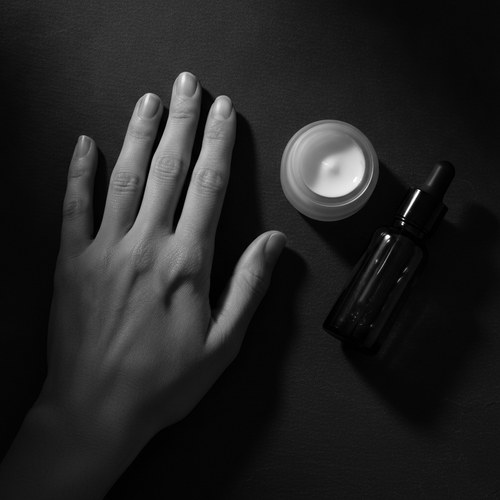
Black and white editorial close-up of a hand with a dropper of serum, illustrating hand skincare prevention commentary by Frank Agullo, MD, FACS.

Last month, a producer over at GB News got in touch and posed a simple question: What is one change you would recommend to keep your hands from aging?

Sunscreen. And the talking did not stop, for the obvious reason that you do not fix 100 percent of life in a $15 tube of moisturizer. I wanted them to remember how completely ridiculous it was.

Here’s what I actually tell patients, in the order I tell them.

Why Your Hands Age Faster Than Your Face

I spend most of a facelift consultation talking about fat pads, retaining ligaments and skin quality on the face. Nearly no patient will ask me the same question about their hands even though it is exactly the same biology occurring on their hands, only more quickly.

Back of your hand skin is much thinner than the skin on your face anyway; the fat pad on it is smaller and thinner, thinning out faster over time. Over a lifetime your hands get a good amount more sun exposure than your face will get because NOBODY remembers sunscreen while they are at a car steering wheel, pulling a shopping cart, working on a computer laptop, etc.

Brown spots and thin, crinkled texture on the backs of hands often show up years before similar changes on patients’ faces. This phenomenon is a normal aging process rather than a disease and occurs because years of unprotected sun damage take their toll on the delicate, less pliant skin of the hands.

The Habit That Actually Works

Sun protection is the single most important habit, and I stand by that answer. Most of the brown spots and crepey texture I see on the backs of hands trace back to sun exposure, not age by itself.

The fix is boring and that’s exactly why it works. Broad-spectrum SPF 30 or higher, every morning, on the backs of both hands. Reapply after you wash your hands, because soap and water strip it off faster than most people expect. That’s it. No serum, no device, no appointment required.

The Four-Step Routine I Give Patients

Sunscreen buys you prevention. It doesn’t rebuild what’s already thinning or fade a spot that’s already there. So I layer three more habits on top of it.

Step What to do Why
1. Protect Broad-spectrum SPF 30+ every morning, reapplied after washing hands Prevents most new brown spots and crepey texture; the single highest-leverage habit
2. Repair the barrier A thick cream with ceramides, glycerin, and hyaluronic acid after every hand wash Rebuilds the moisture barrier that soap and sun both damage
3. Build collagen A retinoid two or three nights a week Stimulates collagen production, smooths texture, softens the crepey look over time
4. Fade what’s there Vitamin C and niacinamide topicals Gradually fades existing age spots and helps prevent new ones from forming

Be upfront with the timing as I do not want to give a false impression with a claim. Both retinoid and vitamin C need to be applied 2-3x weekly and titrated upwards as tolerated, and no patient of mine has really seen significant changes from these before 8-12 weeks. That is not marketing hyperbole; that is an educated estimate on observed effects using either/both of those ingredients on the face; hand skin works on pretty much the same biological timescale as skin on your face.

What the Sunscreen Evidence Actually Shows

I get skepticism about sunscreen more than almost anything else in my practice, usually some version of “does it really matter that much?” It does, and hands are actually the cleanest proof I have.

Cumulative UV exposure breaks down collagen and triggers the pigment changes that show up as brown spots. Hands take that exposure in a way faces mostly don’t anymore, because most of my patients already wear a facial sunscreen or a moisturizer with SPF built in and have for years. Almost nobody extends that same habit past the wrist. The result is a natural experiment running on every patient who drives, gardens, or works outdoors: protected face, unprotected hands, and a visible gap in aging between the two by the time they’re in their forties or fifties.

Sunscreen applied every single day is the main contributor to collagen decline. No other part of a regimen, be it ceramides, retinol or vitamin C, will be as effective without it; the latter two work as helpers to the skin’s underlying support system. It is of no use to treat the problem if the problem source remains unchecked.

When Home Care Isn’t Enough

A consistent routine can preempt many of those future problems, as well as improving skin that has begun showing such changes. Of course, it has limits.

Deeper pigment, more established crepey texture, and visible tendons and veins from real volume loss are not things a cream alone will reliably clear. That’s when I bring in-office tools into the conversation: laser resurfacing and IPL for spots and skin quality that creams can’t touch, chemical peels for texture, and microneedling for texture that’s further along, the same in-office menu the Med Spa and Laser team runs. If the issue is actual lost volume rather than skin quality, that’s a different conversation entirely, and I’ve written about it separately, because filler and biostimulators solve a different problem than sunscreen and retinoids do.

Why I Think About Hands Like a Face

I did my plastic surgery fellowship at Mayo Clinic and I’m a Clinical Associate Professor of Plastic Surgery at Texas Tech University Health Sciences Center Paul L. Foster School of Medicine. Castle Connolly has named me a Top Doctor for thirteen straight years running.

Yet, the above points do not make me a dermatologist by trade. My process for the hands is just the same as my approach to the face: 1) assess what is truly the underlying cause (UV damage/texture changes, compromised moisture barrier, loss of hyaluronic acid/collagen, fat loss). 2) Once that is defined, reach for the correct skincare or tool to address that specific concern. Basically, do what you do with your face for your hands.

One More Thing About Filler

A variety of fillers and biostimulators can be considered for hands; these are both regularly utilized in my practice. However, I will caution that neither is a substitute for an effective skincare routine.

A patient who’s been sun-damaging their hands for thirty years and shows up asking for filler still needs the sunscreen, the barrier repair, and the retinoid, whether or not they add volume on top. Filler restores what’s missing underneath the skin. It doesn’t fix the skin quality sitting on top of it. Skip the routine and you’re paying to maintain a result the sun is actively working against.

Why Choose Dr. Agullo for Hand Skincare in El Paso

Patients come to me from across Texas and beyond, and roughly sixty percent of my current patients travel in from outside El Paso. I think about hand aging the way I think about facial aging: as a structural problem with a preventable component and a treatable component, not as a single product decision.

Ready to Talk?

A hand-skincare consult is short. I check the skin, the barrier, the pigment, and tell you honestly whether a routine will do the job or whether you need something more.

Call (915) 590-7900, text 1-866-814-0038, or book online at agulloplasticsurgery.com/appointments. #StayBeautiful.

@RealDrWorldWide on Instagram, TikTok, and Snapchat, @Agullo on X, or @AgulloPlasticSurgery on Facebook.


Red Light Therapy: Why the Wound-Healing Science Is the Reason to Take It Seriously

Black and white editorial portrait of a face lit by a soft directional light. Red light therapy commentary by Dr. Frank Agullo, MD, FACS.

Patients ask me whether red light therapy is real or just a nice glow. The reason the wound healing research gives us confidence in red light for skin rejuvenation is that the mechanism for wound healing is the same as for skin rejuvenation.

The Mechanism Is Pretty Well Established

The mechanism for LED red light therapy is pretty well established. That’s the mechanism of action on the wound healing side. The light at red and near-infrared wavelengths is absorbed by the mitochondria of the cells. This raises ATP, or energy production, and drives the proliferation of specific cells active in wound healing, like fibroblasts and keratinocytes. It increases collagen synthesis and local blood flow. This has been described in peer-reviewed publications.

And the same mechanism of action is activated in aesthetic applications. So when I use it on skin, I am not hoping for a vague glow. I am running the same cellular cascade that closes a wound.

What the Studies Show

There are randomized controlled trials showing reduction in the wrinkles around the eyes up to thirty percent. There’s also a controlled trial that showed increased intradermal collagen density, which in turn reduces the appearance of fine lines and wrinkles in the skin. And there have been other multicenter randomized studies that have shown measurable crow’s feet improvement.

Where I Put It in the Hierarchy

I am not going to pretend red light replaces a facelift or resurfacing. As an adjunct, though, it earns its place. After surgery it supports the healing the body is already doing. For skin, it supports collagen, and it stacks well with microneedling.

The Catch Nobody in the Gadget Aisle Mentions

Now, it’s important to know that results do vary by wavelength, dose, and device, and many home consumer units are weaker than the devices used in clinical trials. I personally use Elixir MD, which is an FDA-cleared LED device, which builds credibility for plastic surgeons to cut post-surgical downtime. This device uses a spectrum of wavelengths: red for mitochondrial stimulation and blood flow, infrared for deeper tissue repair, blue to reduce bacterial load, and yellow for cellular repair.

The Credential Behind the Opinion

Double board-certified by the American Board of Plastic Surgery and the American Board of Surgery, American College of Surgeons Fellow, Mayo Clinic plastic surgery fellowship, Clinical Associate Professor of Plastic Surgery at Texas Tech University Health Sciences Center Paul L. Foster School of Medicine, and Castle Connolly Top Doctor for thirteen consecutive years. I never write a confident claim that is not grounded in peer-reviewed evidence or my own practice experience, and red light clears that bar.

Ready to Talk?

If you want red light to do real work, the device and the dose matter as much as the idea.

For the patient-facing guide, see the companion post on agulloplasticsurgery.com. For the LED program at the practice, see the version on swplasticsurgery.com.

Call (915) 590-7900, text 1-866-814-0038, or book online at agulloplasticsurgery.com. #StayBeautiful.

@RealDrWorldWide on Instagram, TikTok, and Snapchat, @Agullo on X, or @AgulloPlasticSurgery on Facebook.