
A Good Result Is Half Operation, Half Aftercare: The Recovery Questions I Answer Most

Black and white editorial still of recovery essentials, a compression garment and water. Recovery and aftercare read by Dr. Frank Agullo, MD, FACS.

Here is something most surgeons do not put on a billboard. A good result is half operation and half aftercare.

I can do a beautiful surgery, and if the aftercare falls apart, the result drifts. The patients who do their massages, wear their garments, and call early when something feels off are the ones who heal beautifully. The ones who skip all three are the ones who write the bad reviews.

So the questions I get after surgery are remarkably consistent, and I want to answer the common ones the way I do in a follow-up visit. These are pulled from real follow-ups and consultations, anonymized.

“Is This Firmness Normal?”

Usually, yes. After surgery, firm or hard areas are fibrosis and edema, which is a normal part of healing. I have patients massage these areas a lot, and I tell them it keeps getting softer over about three months. It is a lot better at three months than at three weeks.

What is not routine is new, painful, red, or rapidly changing firmness. That is a reason to call, not to wait.

“A Stitch Is Poking Out, or My Incision Opened a Little”

That is usually a suture working its way to the surface, which is common and minor. If a small area opens where a suture extruded, we keep it covered, sometimes with a little silver dressing because it is antimicrobial, and it heals. It does not mean something went wrong. Rarely an incision needs a few extra sutures, maybe one patient in fifty.

“How Do the Massages Work?”

For body work, the lymphatic massages are not optional in my book. They are how we keep fibrosis from becoming a problem. We have an in-house tech, and I recommend two or three a week for about four weeks. In the abdomen I leave a small drain so that when you massage, any trapped fluid comes out fast, because trapped fluid is what creates lumpiness.

“Which Garment, and for How Long?”

We provide them, two Marena fajas with clips so we can size you down as the swelling drops. You wear them for four weeks, taking them off twice a day to shower and let your skin breathe. If a standard post-op bra is uncomfortable, a supportive alternative is often fine. Comfort that keeps you in compression beats a “correct” garment you refuse to wear.

“When Can I Shower?”

The next day. My nurse actually visits to help with your first shower, check that you are healing well, give IV fluids if you need them, and go over instructions and questions.

What’s Routine vs. What’s a Call

What You Notice What It Usually Means
Firm, hard areas softening over weeks Normal fibrosis and edema
A suture poking through the skin Common, keep it covered
Soreness with movement after lipo Like the gym after a layoff
New, painful, red, rapidly changing firmness Call us

“What About Nausea and Pain?”

If you tend to get nauseous from anesthesia, there is a pill called Emend you take the night before that usually prevents it. Facial procedures barely hurt at all. Liposuction feels like going back to the gym after a long break, sore with movement but tolerable, and easier than a C-section.

“Who Is Actually Taking Care of Me?”

My anesthesia is run by CRNAs who are army and combat trained and have been with me over ten years. They have done anesthesia on me and my family. My surgical techs are certified first assist and have been with me since 2012. After surgery you get a wristband with a 24-hour line to my nurses or nurse practitioner.

“Anything That Speeds Healing?”

A few things I like. NAD infusions with glutathione before and after surgery help clear the anesthesia. Post-op peptides, GLOW for face work and GLOK for body, help with inflammation and tissue regeneration. Arnica and bromelain help with bruising. And for facial recovery, our ElixirMD LED therapy starting seven days out roughly doubles the speed of healing.

The Three Habits That Separate Good Recoveries

If I had to put it on a sticky note, it would be three things. Do your massages. Wear your garment. Call early.

The patients who do their lymphatic massages on schedule are the ones whose tissue stays soft and even. The ones who skip them are the ones I am breaking up fibrosis on months later. The garment is the same story. It is not a fashion accessory, it is the mold your new contour sets into, and the patient who refuses to wear it is fighting against the result we built together.

The third one is the quiet hero. Call early. Almost everything that worries a patient at three weeks is normal, and the few things that are not are easiest to fix when caught early. I would rather take a hundred calls about normal firmness than miss the one that mattered.

“When Can I Travel or Go Back to Work?”

That depends on the procedure and how you are actually healing, so it is a per-patient answer, not a number off a chart. I would rather clear you based on how you look in front of me than on a generic timeline.

If a trip is coming up, tell me early. We can often plan around it, including any precautions to take with you, like movement on long flights and what to watch for. The worst version of this is finding out about the trip after the surgery is booked, so bring it up at the consult.

The Credential Behind the Care

Double board-certified by the American Board of Plastic Surgery and the American Board of Surgery, Mayo Clinic plastic surgery fellowship, and Clinical Associate Professor of Plastic Surgery at Texas Tech University Health Sciences Center Paul L. Foster School of Medicine. A good result is half operation and half aftercare, and I treat the second half with the same discipline as the first.

Ready to Talk?

Recovery questions deserve real answers from the surgeon, not the internet. For the patient-facing walkthrough, see the companion post on agulloplasticsurgery.com. For the recovery menu, see the version on swplasticsurgery.com.

Call (915) 590-7900, text 1-866-814-0038, or book online at agulloplasticsurgery.com. #StayBeautiful.

@RealDrWorldWide on Instagram, TikTok, and Snapchat, @Agullo on X, or @AgulloPlasticSurgery on Facebook.
After the Operating Room: The Peptide Stack My Patients Recover On

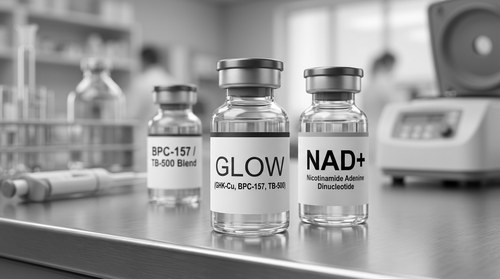
GLOW peptide blend (GHK-Cu, BPC-157, TB-500) and NAD plus vials prepared on a sterile clinical surface, illustrating the post-operative peptide recovery protocol prescribed by Dr. Frank Agullo, MD, FACS, double board-certified plastic surgeon at Southwest Plastic Surgery in El Paso, Texas

I recently did surgery on a woman three weeks ago. When she got seated in the examination room two weeks after surgery, looked in the mirror at her hands and asked the single question that I’ve been asked 100 times over by every patient in that room: “Why do I feel so good already? ” She was doing so with a deep plane facelift. The bruising she had anticipated just didn’t manifest, the post-op fatigue warning she had been issued only seemed to last maybe four days, and, oddly enough, she slept the entire first night of surgery-a feat she was sure she’d be incapable of.

In a lot of ways, I told her the truth: It’s a combination of the right technique (a true deep plane lift lifts ligaments and layers tissue, it’s not skin tightening, which will always cause more swelling and more bruising), good anesthesia and precise closure and a post-op peptide regimen I developed over the past few years, now an option for practically all my surgery patients.

This is the post on what those peptides are, why I use them, and what I think every patient considering plastic surgery should know about them. Not the version a wellness influencer would write. The version a double board-certified plastic surgeon writes.

What a peptide actually is

A peptide is a short chain of amino acids. Examples include insulin, growth hormone, and oxytocin. These signal molecules are synthesized by your body every day to enable communication between tissues. The peptides used for surgical recovery are bioidentical copies manufactured pharmaceutically, dosed precisely.

That’s the part that matters. Peptides aren’t herbal supplements. They aren’t hormones in the testosterone or estrogen sense either. They’re signaling molecules. Inject a small dose of BPC-157 subcutaneously (250 to 600 micrograms daily, in my protocols) and your body responds the way it already knows how. It heals a wound. It lays down new collagen. It recruits cells and growth factors to a sutured edge. It restores mitochondrial energy. The dose is the signal. Your own cells do the work.

Used well, they speed up what the body was going to do anyway. Used poorly, or by patients shopping on the gray market, they are a waste of money or a real safety problem. The version I prescribe comes from a US-manufactured, cGMP-certified pharmacy, with a certificate of analysis, on a dose I selected for the patient and the procedure.

GLOW for face, KLOW for body

I prescribe two related peptide blends, depending on the operation. GLOW is a three-peptide blend: GHK-Cu, BPC-157, and TB-500. KLOW is the same three peptides plus a fourth, KPV. The reason the menu has two versions is that face and body procedures call for different emphasis on the recovery side, and the right blend tracks the operation.

GHK-Cu (glycyl-L-histidyl-L-lysine copper) is a copper tripeptide that exists naturally in human blood. As a person ages, the level of GHK-Cu in the body naturally declines. The same active compound is in many topical copper peptide anti-aging products you’ll find at Sephora, but injected GHK-Cu skips the struggle of the stratum corneum and reaches the dermis directly. This copper peptide activates more than three hundred genes associated with tissue repair. It signals fibroblasts to lay down new collagen and elastin. It also supports basal stem cells in the skin. In plain terms, it’s the piece of the blend that helps a fresh facelift incision heal flat and undisturbed, and that improves the surrounding skin six months down the road.

BPC-157 stands for Body Protection Compound. It is a fifteen amino acid peptide derived from a protein in human gastric juice. The mechanism people care about for recovery is angiogenesis, which is the formation of new blood vessels at injury sites. Healing tissue needs new microvasculature, and the body builds it slowly without help. BPC-157 accelerates that process. It also dampens local inflammation and supports tendon, ligament, and muscle repair. For a body procedure, where I am separating tissue planes and closing layers, this is the workhorse of the blend.

TB-500 is a synthetic analog of Thymosin Beta 4. It regulates a cellular protein called actin, which is the rail system cells use to crawl across tissue. The simple way to put it is that BPC-157 builds the new blood vessels, and TB-500 mobilizes the repair cells to use them. The two are synergistic. The original published research on the pair came out of sports medicine, where elite athletes were using them to push back from soft tissue injuries faster. The same biology applies to a surgical site.

KPV is a tripeptide (lysine-proline-valine) derived from alpha-MSH. Its job is anti-inflammatory. KPV inhibits NF-kB, the master switch for inflammatory gene expression in the body. For a face procedure, where the inflammatory load is comparatively small and the priority is incision quality and skin remodeling, the GHK-Cu story does most of the work, so I run GLOW. For a body procedure, where the inflammatory field is large (BBL, gluteal fat grafting, tummy tuck, mommy makeover, breast surgery), I add KPV to the same three peptides. That is KLOW. Same once-daily injection, same compounding pharmacy, broader anti-inflammatory coverage where the surgical field calls for it.

I dose both blends subcutaneously, in the abdomen or thigh, once daily for the first three to four weeks after surgery. Most patients self-administer at home. Adjustments happen at the post-op visits. The blue tint of the solution is the copper in GHK-Cu. It is normal and not a sign of contamination.

NAD+, the mitochondrial side of recovery

NAD+ is a different molecule for a different problem. It stands for Nicotinamide Adenine Dinucleotide. It is technically not a peptide, but it sits next to peptides on the same prescribing menu, and it pairs well with surgical recovery. The “nicotin” in the name is from vitamin B3 etymology. It has nothing to do with cigarettes.

NAD+ drives our power generators: the mitochondria. And it powers sirtuins, proteins that repair DNA and generally keep the cell tidy. NAD+ levels decrease with age, stress, and illness. Surgery is a stress. The body has to work hard to heal and recover. Adequate NAD+ is the cofactor that work needs.

The default protocol I prescribe is at-home, subcutaneous or intramuscular. Patients go home with a one-month supply, 500 mg total, divided into two doses per week for four weeks. Eight injections, sixty-something milligrams each, spaced through the recovery window. It is well tolerated, easy for patients to self-administer, and it keeps mitochondrial support steady through the period when the body is doing the most cellular work.

For patients who want the IV layer on top, we offer a NAD+ plus glutathione infusion. One before surgery, one after. The pre-op infusion primes mitochondrial reserves before the stress of the operation. The post-op infusion replenishes during the highest-demand recovery week. Glutathione is added as an IV push at the end of the NAD+ drip; it is an antioxidant tripeptide that supports phase 2 liver clearance and helps clear the residual metabolites of anesthesia.

A note on the IV experience. Run too fast, NAD+ causes chest tightness, nausea, and a hot burning sensation. That is rate-dependent and expected. Run slowly, over two to three hours, the patient is comfortable for the entire session. We always run it slowly. The glutathione push that follows takes another five to fifteen minutes.

Who is a candidate

Almost every elective plastic surgery patient is a candidate, with a small number of caveats. Active cancer is a contraindication for most growth-factor-adjacent peptides because we do not want to fertilize a tumor we do not know about. Active infection is a temporary contraindication. Pregnancy and breastfeeding are off the protocol. Patients on therapeutic anticoagulation get adjusted dosing.

Beyond that, the question I ask is whether the patient wants the smoothest possible recovery and is willing to do daily self-injections for a few weeks. If yes, we talk about which blend fits which procedure. A facelift patient gets the skin and incision benefit of GHK-Cu more than anything else, so I prescribe GLOW. A BBL or tummy tuck patient gets more out of the angiogenesis, cell migration, and especially the anti-inflammatory benefit of KPV across a large surgical field, so I prescribe KLOW. Breast surgery and combination cases default to KLOW because the inflammatory load is meaningful. Isolated minor procedures (lip lift, blepharoplasty alone) sometimes do not need a peptide cycle at all, and I will tell a patient that.

The cautious side

Peptides are not on FDA approval pathways the way a new pharmaceutical is. They are compounded by US 503A pharmacies under physician prescription. That is legal. That is also why they are easy to find on the gray market in versions of unknown identity, unknown dose, and unknown sterility.

Two rules I tell every patient. First, do not buy peptides off Instagram, Telegram, or any vendor that ships in unmarked vials. The pharmacy I use issues a certificate of analysis with every batch. The price is higher. The peace of mind is the entire point. Second, do not stack peptides without a physician. The blends are calibrated. Adding random fourth and fifth peptides on top of GLOW because someone on a podcast said to is how you give yourself a problem.

I love fillers for the right patient. I use them every day. But fillers are a tax. Peptides are different. They support the work the body is already doing, and when you stop, the body simply continues at its own pace. There is no rebound. There is no dependency. Used during a defined recovery window, they are a high-leverage tool. Used as forever therapy, they are something else, and we will get into that on a separate post.

Why choose Dr. Agullo for a peptide-supported recovery in El Paso?

Double board-certified, American Board of Plastic Surgery and American Board of Surgery. Fellow of the American College of Surgeons. Mayo Clinic plastic surgery fellowship. Clinical Associate Professor of Plastic Surgery at Texas Tech University Health Sciences Center, where I teach the same techniques I use every day. Affiliate Professor at UTEP. Castle Connolly Top Doctor for thirteen consecutive years. The peptide protocols I prescribe are dosed by me, sourced through a US cGMP-certified compounding pharmacy, and integrated into the same surgical recovery plan I have built operating on out of town and international patients for the last fifteen years.

Ready to talk?

The right time to start the recovery conversation is during the initial consultation, not the day before surgery. We will look at your anatomy, the operation you are considering, your overall health, and we will decide together whether peptides belong in your protocol. If they do not fit, I will tell you. If they do, you will leave the consultation with a clear plan, a price, and a timeline.

Call (915) 590-7900, text 1-866-814-0038, or book online at agulloplasticsurgery.com. #StayBeautiful.

@RealDrWorldWide on Instagram, TikTok, and Snapchat, @Agullo on X, or @AgulloPlasticSurgery on Facebook.