Moderately: A Surgeon on AI Risk, the Diagnosis Nobody Made, and the Reference That Does Not Exist

Black and white photograph of a phone lying face up on a dark desk showing an unreadable chat screen, a pen and a closed notebook beside it, a figure in a sweater seen from behind at the edge of the frame, hard side light, face not visible. Illustrative image. Commentary by Frank Agullo, MD, FACS.

One word for MDLinx. Then the rest.

“Moderately. The failure I worry about is not a dramatic one. It is a confident wrong answer delivered in fluent medical English to someone who has no way to check it. In surgery we have decades of practice at recognizing a bad result. We have very little practice at recognizing a bad output that reads well.”

The Reference That Does Not Exist

“It’s really difficult to recognize hallucinations or wrong information, because AI always feels like an authority, all-knowing. I’ve had experiences where I’m researching a topic and AI comes up with completely false references to support what it’s saying. So this is really the difficult part, and the one where the doctor can come in and rectify and explain what is actually happening, or what’s actually in the literature. So many times when I’m researching a topic, after I receive an answer I’ll ask for references, and then I’ll go look for the source to see if it exists, and read about it to make sure it’s factual. Sometimes, if the information seems strange, I’ll ask again in another question, and a lot of times it will recognize that it made a mistake and rectify it.”

The Diagnosis Nobody Made

“And one of the most dangerous answers AI can give is false reassurance, that you shouldn’t be worried, that it’s really nothing, when in fact it may be, and only a doctor can make that determination.”

The other direction too: a patient told a procedure is simple, expecting what the anatomy will not give.

What It Cannot Do

“I would never trust it with anything that requires a physical exam. AI has now been trained to recognize photos and evaluate lesions, but it cannot touch and feel the way we do when we perform a physical exam, to evaluate hernias or rectus diastasis, masses or lumps in the body or breast, skin laxity, and quality of skin.”

“It’s also not good at predicting results, especially in cosmetic or plastic surgery, where a patient may upload a photo and ask for the postoperative result, which may or may not be a good expectation or even a possible one.”

The Implant Precedent

We approve an implant on trial data, then track it for years, and sometimes learn it behaves differently in the field. Software ships, then changes. The version treating today’s patient may not be the one that was tested. Nobody is tracking it the way we track a breast implant.

Implants Medical AI
Approved on trial data Validated on a test set
Tracked for years after Rarely, and the model changes
Behaves differently in the field Same, and faster
A named surgeon is accountable Nobody, yet

Where I Land

“I don’t think AI would realistically replace office visits. The main factor is the physical exam, which is absent. A lot of times there’s no check of the vitals either, unless a patient has a way to measure these and upload them at the same time. I think it’s a supplement to medical care.”

“I’ve always said that an educated patient is a better patient.”

Prepare with it. Let me examine you. The patient’s how-to is my earlier AI before the doctor visit read; the full MDLinx answer with the three safeguards is on agulloplasticsurgery.com, and the consult-prep version is on the Southwest Plastic Surgery post.

Why Choose Dr. Agullo

Double board-certified, by the American Board of Plastic Surgery and the American Board of Surgery. Mayo Clinic plastic surgery fellowship. Clinical Associate Professor of Plastic Surgery at Texas Tech University Health Sciences Center. Castle Connolly Top Doctor for 13 consecutive years. Harvard certification in AI in Healthcare.

Ready to Talk?

Bring the chatbot’s answer. I will check its references, then examine you. (915) 590-7900, text 1-866-814-0038, or book at agulloplasticsurgery.com/appointments. #StayBeautiful

@RealDrWorldWide on Instagram, TikTok, and Snapchat, @Agullo on X, or @AgulloPlasticSurgery on Facebook.
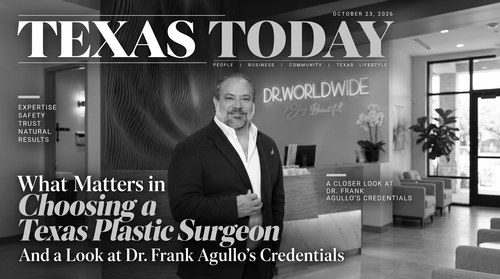

If a Surgeon Has Never Told You No: A Texas Today Cover and the Line I Would Put on a Billboard

Black and white version of the Texas Today cover, October 23, 2026, landscape edition: Dr. Frank Agullo in the Southwest Plastic Surgery lobby in front of the Dr. WorldWide neon sign, cover line What Matters in Choosing a Texas Plastic Surgeon and a Look at Dr. Frank Agullo's Credentials. Photo by Jorge Campos. Commentary by Frank Agullo, MD, FACS.

My face is on this week’s cover of Texas Today. The headline: what to look for in a plastic surgeon in Texas. The second headline: my credentials.

I’ll pass on the credentials, because they’re also the easiest part of the article to verify, and the least interesting. Five minutes and two websites later, you’ll know:

I went over the full verification path in plastic surgery in Texas.

The Word That Means Nothing

The more interesting part of the Texas Today story is this quote:

“Anyone with a medical license can legally call themselves a cosmetic surgeon in Texas. Patients assume the title means training. It doesn’t. The question to ask is not ‘Are you a surgeon?’ It’s ‘Which board certified you, and in what?'”

All of my plastic surgeon colleagues know that, of course. But I’m willing to bet most of my patients didn’t.

A doctor can only refer to him or herself as board certified if he or she has successfully completed the relevant accredited fellowship or residency and passed the written and oral exams administered by the certifying board. For board certification in plastic surgery, that means the American Board of Plastic Surgery.

It’s a distinction with a difference, but a doctor can still legally hang the words “cosmetic surgeon” on his door. Sometimes they’re the same doctor. But you won’t know it from the sign.

Texas Today’s Four Questions

Texas Today recommends four questions to ask when you’re interviewing plastic surgeons. Three of the questions are about your surgeon, his board, his facility, his surgical volume.

The fourth is about you:

What would make me NOT a good candidate?

And this quote, right underneath:

“If the answer to that last one is ‘nothing,’ you are talking to a salesperson.”

I decline to operate on patients every week. Anatomy that won’t allow me to achieve what she’s envisioning. An uncontrolled medical condition. Unrealistic expectations informed by Instagram filters. For certain procedures, smokers who refuse to quit smoking.

“A good consultation is a candidacy assessment, not a sales pitch. If a surgeon has never told you no, be careful.”

It’s a good billboard, because there’s a corollary statement to make: If a plastic surgeon has never had an inappropriate candidate walk into his practice, one of two things is true: either he has never had an inappropriate candidate walk into his practice, or he’s operated on every inappropriate candidate that walked into his practice.

The Line I Would Put on a Billboard

That last quote from Texas Today? That’s the quote I’ll remember from this article. Not “featured on the cover of Texas Today.” Not “thirteen consecutive years on the Castle Connolly list.” Not “editorial board member.” Those are easy to check. The line about saying no is the one that tells you whether a surgeon will tell you the truth.

Most of My Patients Fly In, and Here Is Why

Speaking of quotes I appreciate from Texas Today, did you know most of my surgical patients fly in to see me?

“People find us because of a specific procedure or a specific technique, then they do their homework and realize the trip is worth it.”

By my estimate, 70 percent of my surgical patients live outside El Paso. Here are two of my procedures they make the trip for:

Preservé, nothing cut. I was one of the first roughly 30 plastic surgeons in the country trained in this prepectoral breast augmentation technique, which never cuts or releases the muscle: “I have patients who came to El Paso specifically because they researched Preservé and found out I was the only one offering it in the region. I had never seen that happen with any implant company before.”

Gluteal fat grafting, where every BBL fat embolism had one thing in common. “The technique that kills people is injecting fat into the muscle. We changed where and how we place it years ago, and we teach that. Fast and cheap is not a plan.”

Prices in El Paso (and in Mexico, Too)

It’s true that my prices are lower in El Paso than plastic surgeon prices on the coasts. Lower rent and wages have nothing to do with what happens in the operating room, but they do factor into overhead.

But the more common comparison I hear these days isn’t “Mexico versus the US.” It’s “Mexico versus El Paso.” Last month I dictated a quick response:

“I know many excellent surgeons in Mexico. And I can tell you that for most surgeries, top level surgeons in Mexico charge pretty similar to top US surgeons. The difference lies in that oftentimes anesthesia and operating room costs can be lower, as well as the cost of medications and supplies. So there may be a lower cost in Mexico, but not a very significant difference.”

“When you see very significant differences, where the cost is almost too good to be true, it is because there is a reason to it, and somehow the costs are getting cut in places that may be essential to your care.”

Your surgeon should be able to give you an answer as to why his prices are low. If you can’t get an answer, run.

What the Cover Is For

I wasn’t trying to get on the cover of a magazine when I agreed to do this Texas Today piece. I did it for a patient who sat across from me last month holding a printout from a clinic in another city, asking whether “cosmetic surgeon” meant the same thing as what I do. The patient-facing version, with the four questions laid out, is on agulloplasticsurgery.com. The practice version, with the travel logistics for fly-in patients, is on the Southwest Plastic Surgery post.

Ready to Talk?

Ask me the fourth question. I have an answer.

Call (915) 590-7900, text 1-866-814-0038, or book online. #StayBeautiful

Find me at @RealDrWorldWide on Instagram, TikTok, and Snapchat, @Agullo on X, or @AgulloPlasticSurgery on Facebook.

Why I’ve Never Hidden My Prices

Black and white photograph of a woman in a robe reading a medical practice website on a laptop at night, illustrating clinic website transparency commentary by Frank Agullo, MD, FACS.

For weeks, a researcher investigated 200 aesthetic clinic websites in the UK to see whether they explained: what the procedure entails; how you will be recovering; who is the ideal candidate; and what the inherent risks are. She messaged me on Connectively (which is a platform where journalists and researchers reach out to working professionals for quotes) and asked for me to provide input about her findings based on my medical position.

I read her data before I answered; 96 out of the 200 were sites that did not offer information about risk nor suitability of the treatment. 77 of the 200 had all four of the basics (what it involves, recovery, suitability, and risk information) on a single page. Just over half offer you a chance to book the treatment before looking up any information about it. 6 of the 200 give you a chance to ask a question before entering your telephone and e-mail.

Six out of two hundred.

What I Actually Told Her

“A clinic’s website is not doing its job if a patient has to call just to learn the specific risks of a given procedure, whether they might be a poor candidate for it, and the name and credentials of whoever is actually performing the treatment. If a page cannot answer those questions within a few minutes, that gap is more about the clinic’s priorities than its web design.”

I would tell that to each of the 200 clinics she reviewed.

The Part I Can’t Stop Thinking About

It is the booking number. 51% will take your deposit or book your consultation without you first reading a word about risk or candidacy. No, this is not unintentional. At some marketing meeting, someone decided the book button belongs above the information you need to have.

My stance has been on the opposite side for some time. The pricing is plainly posted on my website: agulloplasticsurgery.com/fees. This is an actual list of starting figures that are all-inclusive (excluding only your prescriptions) available before any conversation or call takes place. This is not because price is the singular factor to consider, it is not, nor should it be, but websites that necessitate a phone call before revealing the cost of a procedure were designed to snag patients before they have had adequate time to contemplate it.

Where This Goes From Here

Not sure if a UK audit changes anything for the clinics included. What it does confirm about my practice though: share the information and prices openly. That leaves the consultation to discuss the patient rather than extracting basic details by phone.

Ready to Talk?

Call (915) 590-7900, text the consult line at 1-866-814-0038, or check my published prices at agulloplasticsurgery.com/fees before you ever pick up the phone. Find me as @RealDrWorldWide on Instagram, TikTok, and Snapchat, @Agullo on X, or @AgulloPlasticSurgery on Facebook. #StayBeautiful

Companion reads: the patient-facing version on agulloplasticsurgery.com and the practice story on swplasticsurgery.com.