When the Implant Rides High and Hard: A Surgeon’s Take on Revision and Capsular Contracture

Black and white study of a woman's torso in soft light, hand resting near the collarbone. Breast implant revision commentary by Dr. Frank Agullo, MD, FACS.

A large part of my week is not first-time augmentation. It is revision.

Women come in years after surgery done somewhere else, and they describe the same handful of things. One breast riding high. A firmness that crept in. A sense that the implant has wandered off where it should be. Or simply, it has been ten years and they want a change.

These are not vanity complaints. They are mechanical problems with mechanical fixes, and they deserve a straight answer rather than a shrug.

What That High, Hard Lump Usually Is

When the description is one side that sits high and feels firm, almost like a lump, it is usually a capsular contracture.

Here is what is happening. Whenever we place an implant, the body forms a capsule of scar tissue around it. That is normal and even helpful, because it keeps the implant in place. But sometimes that capsule, driven by inflammation or an old low-grade infection, tightens and hardens around the implant. It squeezes the implant up and in, and the breast goes firm.

If it hurts, the contracture is more severe. No pain is actually a good sign. And it surprises people that this can show up long after the original surgery, sometimes many years later, but it does.

How I Actually Fix It

The repair is more than swapping the implant. I go in, remove the hardened capsule, take out the old implant, and place a new one.

When I do that and switch the patient to a Motiva implant, the risk of contracture recurring drops below one percent. The nano-surface on these implants provokes a much lower inflammatory response, which is the whole reason the recurrence rate falls so far.

To lower it further, I will often place a mesh, an internal bra layer of support, over the area. With that combination, recurrence approaches zero. And if you want to change size while we are in there, we usually can, through the same incision.

Revision Decisions at a Glance

What You Notice What It Often Means The Usual Move
One side high and firm Capsular contracture Remove capsule, exchange implant, often add mesh
Implants past ten years Older-generation wear Exchange to Motiva, reassess size and position
New, fast asymmetry over weeks Worth imaging Ultrasound or MRI, then a plan
Several prior surgeries Disturbed tissue planes Careful planning, honest expectations

“Should I Just Swap Old Implants?”

If you are at the ten-year mark with older-generation implants, an exchange is reasonable, and it is a good moment to reassess size and position at the same time. I often move patients from an older implant to a Motiva, which lasts much longer and carries far less contracture risk.

“I Have Had Several Surgeries Already. Is It Too Late?”

No. I see patients whose first operation was decades ago with several since. More history does not mean nothing can be done. It means I plan carefully and stay honest with you about what is realistic. Revision is harder than a first augmentation because the tissue planes are already disturbed, which is exactly why it should be planned, not rushed.

Why the Implant Surface Is the Whole Story

When patients ask why a Motiva exchange drops the recurrence rate so far, I bring it back to one thing: the surface. The Motiva implants I use have a nano-surface called SmoothSilk, which produces the lowest inflammatory response of any implant I know of. Capsular contracture is fundamentally an inflammatory problem. The capsule hardens because the body keeps reacting to the implant. When the implant barely provokes a reaction, the capsule that forms stays soft and thin.

That is the mechanism behind a sub-one-percent recurrence rate, and it is why I rarely reach for an older-generation implant during a revision. There is no reason to put back the kind of implant that contributed to the problem.

A Revision Is Often an Upgrade

Patients arrive bracing for damage control, and they are surprised when I tell them a revision is frequently a chance to end up better than the original. The new implants are soft, the gummy bear type, and they move with the body and settle into a natural teardrop when you stand. So while we are correcting the contracture, we can also correct a size you never loved, a position that sat too high, or an asymmetry that was there from day one. The same incision usually does all of it.

On Imaging, and Doing More at Once

If you are feeling a change, an ultrasound or MRI helps me confirm whether the implants are intact and whether what you feel is a contracture, scar, or something that needs more attention. I review your imaging before I commit to a plan.

A firm, high, or newly asymmetric implant, especially a change over a few weeks, is worth coming in for. And if you also want to refine your waistline, we can add liposuction and use J-Plasma to tighten the skin in the same setting, so it is one recovery instead of two.

Why I Take Revision Seriously

I am a double board-certified plastic surgeon with a Mayo Clinic plastic surgery fellowship, and I have been a Castle Connolly Top Doctor for thirteen consecutive years. Revision rewards a surgeon who slows down. I want to examine you and review your imaging before I promise anything, because the tissue tells me more than a photo ever will.

See the Patient-Facing Versions

For the patient-facing walkthrough, see the companion post on agulloplasticsurgery.com. For the practice overview, see the version on swplasticsurgery.com.

Ready to Talk?

If something feels high, hard, or out of place, do not sit on it. Come let me take a look.

Call the office at (915) 590-7900, text 1-866-814-0038, or book online at agulloplasticsurgery.com. #StayBeautiful.

@RealDrWorldWide on Instagram, TikTok, and Snapchat, @Agullo on X, or @AgulloPlasticSurgery on Facebook.
The Augmentation That Never Touches the Muscle: Why I Switched to Preserve

Black and white portrait study of a woman's profile, soft studio light. Preserve prepectoral breast augmentation commentary by Dr. Frank Agullo, MD, FACS.

A woman sat in my consult room last week, pulled up a photo of herself at twenty-five, and said the line I hear several times a week. She wanted the fullness she used to have, and she wanted to know why she should drive past three closer surgeons to see me.

Here is the honest answer. For most augmentations I do now, I never touch the muscle. Not minimally. Not partially. Not at all.

That is a bigger deal than it sounds, and it is the reason recovery looks nothing like what your mother or your older sister went through.

What the Preserve Actually Is

The Preserve augmentation is prepectoral. The implant sits in front of the pectoralis muscle and behind your breast gland, above the muscle but below the gland. I do not cut the muscle, release it, or go under it.

That distinction is everything. A traditional submuscular augmentation goes behind the pectoralis and partially releases it off the chest wall. That release is the source of the long, sore, six-to-eight-week recovery patients remember. Preserve never goes there, so that whole chapter disappears.

I make the pocket by balloon dissection. No cutting, no electrocautery. The tissues are pushed outward, and the pocket is defined by your breast’s own ligaments. Those ligaments hold the implant in position, which is why I do not need mesh to support it.

That also means the nerves and arteries stay where they belong. You keep a higher likelihood of preserving sensation and breast function, because I am not dividing the structures that supply them.

Preserve Versus Traditional, Side by Side

Question Traditional Submuscular Preserve Prepectoral
Where the implant sits Behind the muscle In front of the muscle, behind the gland
Is the muscle cut Yes, partially released No, never touched
How the pocket is made Cutting and cautery Balloon dissection
What holds the implant Muscle and capsule Your own ligaments
Typical recovery Six to eight weeks Back to work in one to three days

How I Pick Your Size

Cup size is a starting point, not a measurement. I work from your dimensions and a Chrysalix 3D simulation, not from a letter on a bra tag.

Almost everyone has some asymmetry, and that is normal. Breasts are sisters, not twins. So I will often choose slightly different volumes on each side to get you closer to even.

There is a quieter advantage to placing above the muscle. I can put the implant precisely where your breast needs the most volume instead of filling the whole breast uniformly. A smaller implant can give a larger apparent size and a little lift. Lighter breast, same result you wanted.

The Implants I Use, and the Ten-Year Myth

I use Motiva Ergonomix. The old rule about swapping implants every ten years does not apply to these. The rupture rate is under half a percent, and they carry a lifetime guarantee.

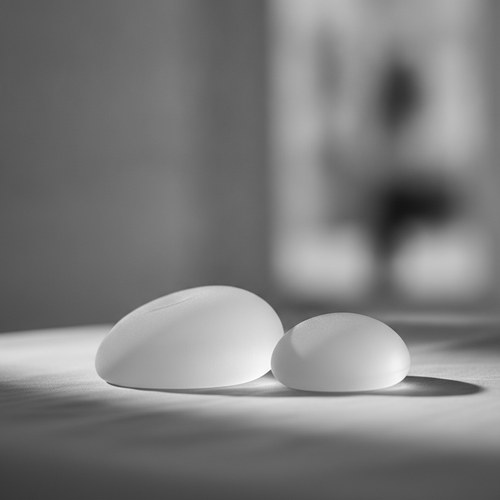
The surface matters too. These use a nano-surface called SmoothSilk, which produces the lowest inflammatory response of any implant on the market and an extremely low capsular contracture risk. They are soft, the gummy bear type, and they take on a natural teardrop shape when you stand. Ergonomix implants move with the body, so you do not get that fixed, stuck-on look.

What Recovery Honestly Looks Like

This is the part that surprises people, so I will be specific.

I do it under light conscious sedation. You breathe on your own, and you will not remember much. I place Exparel, a long-acting local, between the ribs so the breast stays numb for about the first three days. The incision is two and a half to three centimeters in the fold under the breast, hidden where you will not see it.

The implant placement takes about thirty minutes. Patients are usually awake, pain-free, and able to raise their arms overhead before they leave, often within an hour. Many go back to work the next day, and the gym is reasonable at about two weeks if augmentation is the only thing we did. Add a lift or liposuction and the timeline shifts, and I will tell you that up front.

Why I Was One of the First to Do This

Being an early adopter of Preserve was a deliberate choice. Motiva trained me directly as one of roughly twenty highly selected surgeons in the United States, and I traveled to Costa Rica twice for that training. There are still fewer than forty surgeons in the country doing this.

I am a double board-certified plastic surgeon, certified by the American Board of Plastic Surgery and the American Board of Surgery. I completed my plastic surgery fellowship at the Mayo Clinic and I teach as a Clinical Associate Professor of Plastic Surgery at Texas Tech University Health Sciences Center Paul L. Foster School of Medicine. I committed to preserving your own anatomy because it recovers faster and ages better than cutting through muscle ever did.

The Animation Problem You Avoid

Here is a detail patients rarely hear about until it bothers them. With a traditional submuscular implant, every time you contract your chest, the muscle squeezes the implant and the breast moves or distorts. Surgeons call it animation deformity, and it is a direct consequence of putting the implant under a muscle that is built to move.

Preserve sidesteps it entirely, because the implant never goes under the muscle. You can do a push-up, a plank, or a heavy press without watching your breast jump. For an athlete, a CrossFit patient, or anyone who lifts, that is not a small thing, and it is one of the quieter reasons I prefer this plane.

One Honest Caveat

Preserve is not for absolutely everyone. Very thin patients with almost no breast tissue sometimes need a different plan, and I will say so in the room rather than force the technique. If a standard augmentation or a fat-based approach fits you better, that is the conversation we have.

Read the Patient-Facing Versions

For the patient-facing walkthrough, see the companion post on agulloplasticsurgery.com. For the practice overview, see the version on swplasticsurgery.com.

Ready to Talk?

The honest answer to what size and which implant is right for you needs an exam and a 3D simulation. Come see me.

Call the office at (915) 590-7900, text 1-866-814-0038, or book online at agulloplasticsurgery.com. #StayBeautiful.

@RealDrWorldWide on Instagram, TikTok, and Snapchat, @Agullo on X, or @AgulloPlasticSurgery on Facebook.