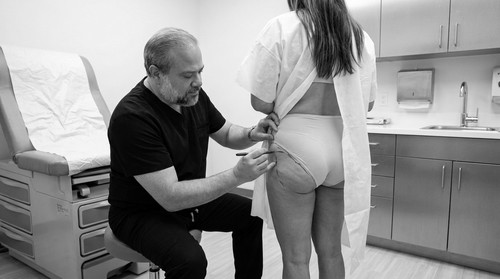
Cindy Crawford built one of the great modeling careers of the century without ever touching the mole on her upper lip. Some moles can be beautiful. She is the perfect example.
Most of the lumps and bumps that walk into my office are not that mole.
They are the cyst on the back that keeps catching on a bra strap. The soft lump on the forearm that has been growing for a decade. The skin tag collection along the collar line. Most patients are self-aware of these. They have been watching the thing for years, and somewhere along the way a doctor told them it was not medically necessary to remove it.
I want to talk about that phrase, because I have seen where it ends up.
The Three Things I Remove Most
Excision of moles is one of the most common minor procedures we do. These are usually on the face, but they can be anywhere in the body. It’s a pretty simple procedure, done under local anesthesia, and patients walk out with a line where the mole used to be.
Inclusion cysts are just as common. These are usually sebaceous cysts, where a hair follicle has been clogged, and the follicle continues to create the oil for the skin. This turns into sebum, which continues to grow. The biggest risk is that it could get infected. And here is the part most people are never told: if you don’t remove the root of the cyst, it usually comes back. Draining one is not removing one.
And then lipomas. These are just fat cells that have gone haywire and continue to grow and create a contour deformity on the skin. They are usually benign, and they are usually more of a shape problem than a health problem, which is exactly why a surgeon who spends his life on contour should be the one taking them out.
How They Compare
| What it is |
Pigmented skin lesion |
Clogged follicle filling with sebum |
Overgrowth of fat cells |
Small hanging skin growth |
| Main concern |
Appearance, rule out malignancy |
Infection, recurrence if root left behind |
Growing contour deformity |
Irritation, catching on clothing |
| Anesthesia |
Local |
Local |
Local, sedation if large |
Local |
| Comes back? |
Rarely when fully excised |
Yes, unless excised to the root |
Rarely when fully removed |
New ones can form elsewhere |
| Pathology |
Yes |
When indicated |
When indicated |
When indicated |
Not Medically Necessary, Until It Is
A lot of doctors may say, oh, this is not an emergency, you don’t really need to get this taken off, it’s not really medically necessary.
Well, if the cyst ends up getting infected, it becomes an emergency.
You usually have to go to the emergency department and get it drained. The way you drain it is you make a cut over it and remove all the purulent discharge, and get on antibiotics. Sometimes you have to be admitted, because the infection may have spread, and you may even become septic.
So something very simple that can be treated early can prevent a major complication. I always recommend excising the inclusion cyst all the way down to the root, so that we don’t have a recurrence, and we avoid any major complications or emergencies. A planned twenty-minute procedure under local, or an unplanned night in the emergency department. That is the actual choice.
No Insurance, and Why That Is the Point
This part of my practice is cash based. No insurance, on purpose.
The biggest advantage is that there’s no need to preauthorize with the insurance, which can take time and effort. Once we have a consultation, and often this can be done via email, virtually, or in person, you get a quote which includes the entire treatment, with the scar management products as well as pathology if it’s necessary.
Instead of dealing with insurance, where you have to use a surgeon that’s within the plan, you’re free to have surgery with me.
The rough price range for an excision is usually around one thousand dollars, but it could be from five hundred dollars and up, depending on the size and number of lesions, tumors, or skin tags we’re removing. One conversation, one quote, one visit. No codes.
The Malignancy Question
If there’s any suspicion that a lesion may be malignant, or we simply want to rule that out for peace of mind, we send it to the pathologist. We send all lesions when there is anything to rule out. The pathologist can be paid through insurance, or it can be included in the package, and we usually get results within three to five days.
Peace of mind turns out to be one of the most underrated things I sell.
The Scar Is the Whole Argument
Anybody with a scalpel can take a lump off. The reason patients seek out a plastic surgeon is what the spot looks like a year later.
As plastic surgeons, we usually do a layered closure of the incisions, which means we approximate the deep layer, the intermediate layer, and the skin level, so that there’s really no tension on the incision itself, and we get the best possible scarring. And this is usually done not only with the care taken during the surgery and the stitching, but also with the follow-up treatments after the surgery, which include taping, silicone sheeting, scar creams like Skinuva, and at certain points for certain patients, we can do steroid injections, laser resurfacing, or microneedling through the med spa at Southwest Plastic Surgery.
The scar itself continues to get better and better, reaching its final result in about a year. Early on, it may be a little bit red and a little raised, and this continues to get better with the scar protocol. Recovery is the easy part. Most patients return to work the next day with light duties, we wait a couple of weeks before any exercise, and if there are sutures, they come out in seven to ten days.
Most lesions, including cysts, lipomas, skin tags, and moles, can be excised under local anesthesia. The only exception is when these are larger than usual, and the patient may not be comfortable, or they may be anxious about the procedure. That’s when we recommend doing IV sedation. It is rare to have to do general anesthesia for these procedures, but it is possible. And sometimes we do it on small children, because they’re not able to stay still.
I trained in plastic surgery at the Mayo Clinic. I teach it as a Clinical Associate Professor at Texas Tech. I have spent my career obsessing over incisions far bigger than these, and a two-centimeter excision gets the same closure philosophy as a facelift. That is the whole pitch.
Ready to Talk?
If there is a mole, cyst, lipoma, or skin tag you have been watching for years, stop watching it. Call my office at (915) 590-7900, text my consult line at 1-866-814-0038, or book online. Recovery is easy: most patients are back at work the next day. #StayBeautiful
@RealDrWorldWide on Instagram, TikTok, and Snapchat, @Agullo on X, or @AgulloPlasticSurgery on Facebook.
Related reading: the clinical walk-through of in-office excisions on agulloplasticsurgery.com, and the practice-side view with scar aftercare options at swplasticsurgery.com.