Reading the Ambassador Face: A Candid Surgeon’s Breakdown of Layered Aesthetic Work

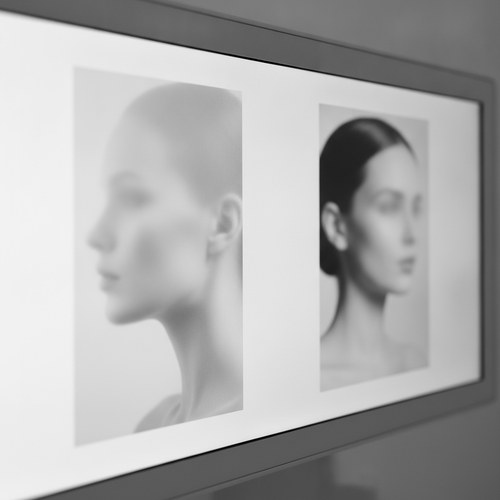
Black and white editorial comparison of two portraits side by side. Aesthetic analysis commentary by Dr. Frank Agullo, MD, FACS.

Reading a face from photos is one of the more interesting things I do, and influencers make it easier. So much of their work gets documented, especially when they are a brand ambassador for a med spa and probably get a lot of their care in exchange for the publicity. Let me read one of these faces candidly, the way I would talk it through with a colleague. This is an educational read, not a diagnosis. I have not treated her, and a photo is not a consultation.

What We Can Be Fairly Sure About

We know for a fact that she’s had neurotoxin to the upper face, which includes the forehead, crow’s feet, and glabella, in hopes of making her eyes more open. She’s had Sculptra to the temples to fill in her temporal recession, hollowness, or temporal wasting. She’s also had Renuva to the temples, also for volume. This is a fat graft. It’s a donor fat graft that is processed, and it encourages ingrowth of fat in that area.

She also had hyaluronic acid filler in the lips, which it seems she did not like and then had dissolved, even though I still see some hints of more volume than she previously had. There is some filler still there that wasn’t completely removed. She had a Botox lip flip. She’s also had PDGF for the under eyes, which is platelet-derived growth factor, which encourages collagen ingrowth. She’s had various lasers and radiofrequency, including Tixel, a thermal resurfacing device, Moxi, a resurfacing laser, and Agnes RF, which is very similar to Morpheus8.

The Weight Loss Is Doing a Lot of the Work

Judging by her earlier photos and her photos now, she’s definitely lost too much weight. I’m not sure if she’s been using a GLP-1, but this has caused her to lose a lot of the good fat in the face, which is the reason she had to fix the temporal wasting. You can notice in the current pictures that she has a lot less lower cheek fat and a lot more angulated jawline. This could all be from weight loss.

Now she has a lot more anterior malar volume, so she may have had some Sculptra and Renuva in the upper cheek area. I’m sure she maintains the skin also with broadband light, like BBL. And I think she’s probably had neurotoxin also to the masseters and lower face, which you can see from her slimmer jawline. She probably has good skin quality maintenance with medical-grade topicals, so tretinoin, vitamin C, but this has never been disclosed.

Why the “She Had X” Take Is Usually Wrong

When you read a face like this, the honest answer is never one thing. It stacks many small treatments over years, plus a real weight change, plus maybe one well-chosen surgical step. The internet wants “she had a facelift” or “she had buccal fat removal.” The truth is messier, and from a photograph you can only ever offer a careful, hedged read.

The One Thing That Hints at Surgery

Now, what calls my attention the most, and I’m not sure she’s had any surgical work, and she is rather young, under forty, is that her brow position is significantly different from her earlier days. It’s pulled up and laterally, which actually opens her eyes. Although a certain degree of this can be achieved with botulinum toxin, the degree she’s showing looks more pronounced. She may have had an endoscopic brow lift, the ponytail type, which can help with brow shaping, and it’s very effective and looks very natural.

Other than that, I don’t see any other signs of actual surgical work. You can see that her nose is unchanged. Although she may have had a rhinoplasty in her early life, you can see that it is off the midline and could actually use improvements. It does look unchanged from her previous photos to now.

The Credential Behind the Opinion

Double board-certified by the American Board of Plastic Surgery and the American Board of Surgery, American College of Surgeons Fellow, Mayo Clinic plastic surgery fellowship, Clinical Associate Professor of Plastic Surgery at Texas Tech University Health Sciences Center Paul L. Foster School of Medicine, Editorial Board Member at Aesthetic Plastic Surgery, and Castle Connolly Top Doctor for thirteen consecutive years. The technical read is fair game. The flat “she had X” diagnosis is not.

Ready to Talk?

If there is a look you are chasing, the real question is which of these layers applies to your face, and in what order.

For the patient-facing treatment-by-treatment guide, see the companion post on agulloplasticsurgery.com. For the treatment menu behind this kind of work, see the version on swplasticsurgery.com.

Call (915) 590-7900, text 1-866-814-0038, or book online at agulloplasticsurgery.com. #StayBeautiful.

@RealDrWorldWide on Instagram, TikTok, and Snapchat, @Agullo on X, or @AgulloPlasticSurgery on Facebook.

The Patient Has Changed: What Looksmaxxing Really Wants From My Consult Room

Black and white editorial photo of a young man in a modern aesthetic consultation setting. Commentary by Dr. Frank Agullo, MD, FACS.

This past April, a twenty-year-old viral streamer named Clavicular collapsed at a Miami mall, sparking discussions across the entire industry for weeks. He represents the public face of the looksmaxxing movement, an online community dedicated to maximizing male attractiveness through any means necessary. His fall from grace suddenly shone a harsh light on the trend my practice has watched approaching.

MedEsthetics contacted me to feature a piece written by Joshua Eferighe about the phenomenon, and my truthful version will now serve as an expansion here.

The statement I keep returning to is this. The patient has changed.

Five Years Ago Versus Now

Five years ago, men visited my clinic with the desire to look less tired. Their only request was simple. Remove the fatigue from their eyes, soften the two frown lines etched between their brows, and prevent them from looking exhausted in photos.

Today they present themselves to my clinic with specific requests about their canthal tilt, their gonial angle, and the eye shape they refer to as the “hunter eye.” They have internalized the lingo, have their ideal reference photos saved on their phones, are typically in their early twenties, and have spent hours on looksmaxxing forums before ever making contact with my staff.

This marks a dramatic shift from the initial consultation framework that guided plastic surgery from its inception.

What the Requests Look Like

One intriguing aspect is that looksmaxxing requests tend to occur in clusters rather than in isolation. When a young man enters my office with such a clearly defined concept in his mind, his list of desired modifications rarely deviates from that of other patients.

Chin augmentation and jaw implants are common, often coupled with genioplasty to bring the chin forward or downward, buccal fat removal to slim the cheeks, a narrowed rhinoplasty, and a lateral canthoplasty to achieve the aforementioned “hunter eye.” Hair restoration is often part of the package too.

The language used is precise and the references are entirely photo-based. These patients are not reticent about their desires. They can articulate every angle, a level of specificity that is genuinely new to my experience.

Where I Think It Comes From

Aesthetic medicine did not originate the idea of looksmaxxing. I do acknowledge, though, that we played a role in laying the groundwork. We established injectables as a norm in the 1990s, endured the subsequent explosion of filler popularity, and ultimately witnessed how filters and social media turned the results of these procedures into an objective checklist.

Online communities embraced these clinical guidelines, stripped out the medical context, and reframed them as optimization objectives. A canthal tilt is an anatomical feature with specific medical implications. It transforms into something entirely different when it is reinterpreted as a metric to be assessed and compared against other men in a comment section.

The Part That Matters: Reading Motivation

This is where my profession fundamentally changed, and it is not the surgical aspect that was transformed.

I now devote more time to understanding a patient’s motivation than to the requested modification itself. There is a significant distinction between a man seeking to subtly blend his nose into the rest of his face and a man who aspires to become the transformed individual he encountered in a viral before-and-after post. The former is a good candidate. The latter is not, at least not at present.

When the desired outcome continues to evolve because it is tethered to an online ideal, the responsible approach is to slow down the planning process. I prioritize the reversible and less invasive steps first, and I am willing to refuse certain requests. Not every desire warrants a scalpel, and the most beneficial outcome is occasionally a recalibration of expectations rather than an irreversible procedure.

This is not about being overly precious. Body image distress is a real and significant issue, and screening for it is an integral part of responsible patient care today, a concept that was far less prominent a decade ago.

The Credential Behind the Opinion

I hold double board certification from the American Board of Plastic Surgery and the American Board of Surgery, am a Fellow of the American College of Surgeons, and completed a plastic surgery fellowship at the Mayo Clinic. I am currently a Clinical Associate Professor of Plastic Surgery at the Texas Tech University Health Sciences Center Paul L. Foster School of Medicine, serve on the Editorial Board for Aesthetic Plastic Surgery, and am now a member of the Editorial Board for PRS Global Open. Castle Connolly has recognized me as a Top Doctor for thirteen consecutive years.

I perform a considerable volume of male aesthetic procedures. I have also increased the rate at which I say no, and I believe that is the critical point of this whole discussion.

Ready to Talk?

If you are a man considering this type of procedure, the crucial question is not which angle you should chase. It is whether the intended change aligns with your facial features and your life, or whether it is simply a pursuit of someone else’s photograph.

For the patient-facing perspective on this, see the companion post on agulloplasticsurgery.com. For the treatment menu behind male aesthetics, see the version on swplasticsurgery.com.

Call (915) 590-7900, text 1-866-814-0038, or book online at agulloplasticsurgery.com. #StayBeautiful.

@RealDrWorldWide on Instagram, TikTok, and Snapchat, @Agullo on X, or @AgulloPlasticSurgery on Facebook.